

Artificial intelligence (AI) has plenty of downsides, but it also brings many benefits. One such benefit is a drastic reduction in translation costs.
For example, wherever you are in the world today, a mobile phone is generally all you need to communicate in speech and writing, in real time and largely without language barriers.
The government also recently announced that it would progressively make its agencies’ websites available in all four official languages. Be it making an application or looking up information, members of the public will be able to use the language they know best, making the process much easier and more efficient.
In the days when every word had to be translated by a person, even money could not necessarily make this possible: there simply were not enough people with the right skills to meet the enormous demand for constantly updated translations.
That resource constraint was finally overcome when the government developed its own large language model for AI translation.
In my own profession, translation technology is driving equally seismic changes.
Many mainstream Western media outlets and news agencies, including The New York Times, The Wall Street Journal and the Financial Times, launched platforms in other languages, particularly Chinese, long ago. But the firewall, and especially the cost of news gathering and editing across languages, have continued to constrain their growth.
Some of China’s state media by contrast, be it newspapers, television networks or news agencies, have achieved a global reach thanks to lavish government investment aimed at telling China’s story. They even cover many less widely spoken languages beyond the UN’s official languages.
In recent years, however, AI has sharply reduced translation costs. Well-funded media organisations have gained even greater capabilities, while small and medium-sized digital outlets, traditional newspapers and television broadcasters around the world — even independent content creators as well — can now experiment with multilingual reporting.
France’s Le Monde is a case in point. For decades, it had wanted an English edition to attract traffic and extend its influence across a wider geographical area, but costs remained an insurmountable obstacle.
In 2022, however, it was among the earliest to harness AI to launch an English edition. With a mix of paid and free content, it soon turned a profit in North America, prompting several other French media outlets to follow suit.
I recently visited the site several times to read its English coverage of riots in Europe. There, I found that editors had polished and checked the articles — it was not simply a matter of clicking an AI button.
Journalists want to extend their reach beyond their usual audiences
Indian media may well have embraced AI translation with the fewest reservations. The country has 22 official languages and countless dialects: a real-life Tower of Babel, perhaps on an even larger scale. AI translation, with its near-zero marginal cost, is ideally placed to bridge those language divides.
Quite a few local television stations have even introduced AI “anchors” to translate and deliver news in real time. I do not know how professionally “they” perform, but when it comes to getting major news to the largest possible audience as quickly as possible, their key performance indicators (KPIs) should be fine.
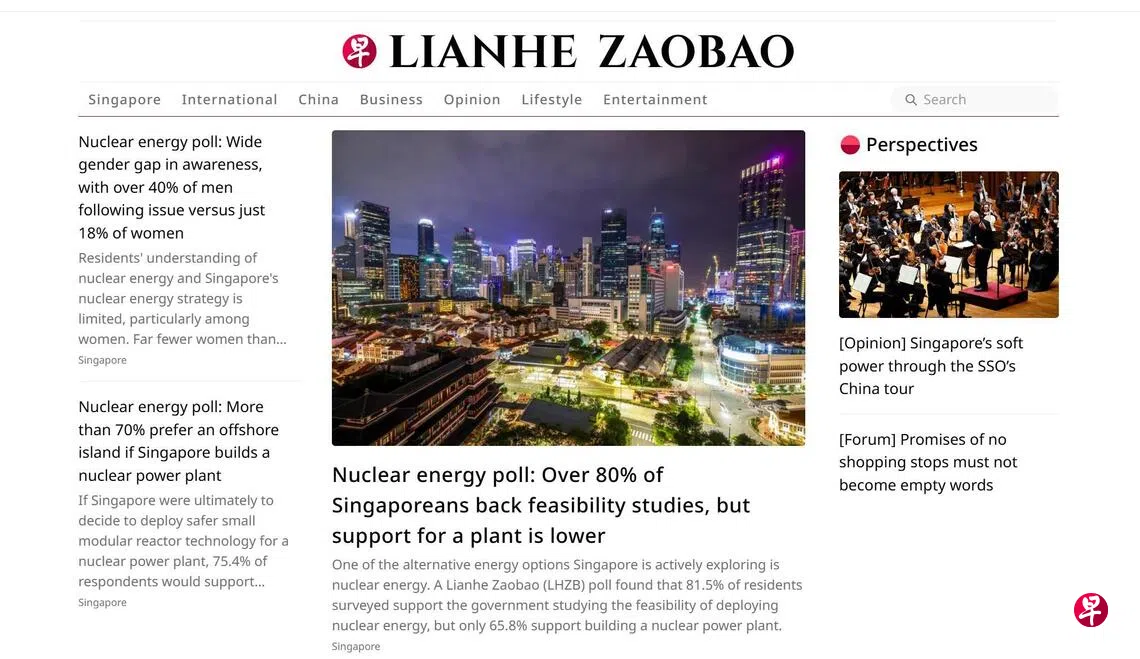
Allow me to make a brief interjection here: two days ago, Lianhe Zaobao (LHZB) officially launched the Lianhe Zaobao English Edition (ZBE), joining the move towards multilingual publishing.
I do not know what lies ahead; perhaps there will one day be a LHZB Malay Edition (ZBM) or LHZB Tamil Edition (ZBT) too. This is not a product plug. Rather, I would like to mark this moment by sharing a few personal thoughts.
First, as a columnist, I am personally excited. The reason is simple: another language channel means more people will read my views and reflections. And if those readers were never part of my intended audience, the satisfaction is even greater.
Two years ago, for instance, a Malay friend texted to say that a commentary in the Malay-language Berita Harian had referred to a piece I wrote in this column about the Gaza war and genocide. A little surprised, I found it online. The only words I recognised were “LHZB” and “Encik Peter Ong”.
After translating it and discovering that the author had praised the piece as “thought-provoking”, I felt particularly gratified. After all, the appreciation came from someone of another ethnicity, giving it an additional sense of reaching beyond my usual circles.
A few months ago, a colleague on the political desk returned from London and told me that he had met a Singaporean Malay academic who teaches at Nanyang Technological University. The academic had mentioned me and my articles.
We had never met; I had only watched him a few times on political discussion programmes on YouTube. It occurred to me that, since neither of these Malay readers knew Chinese, they had most likely read translations on our English-language ThinkChina website. Or perhaps someone had machine-translated the articles and circulated them within their communities.
We have to acknowledge that English is the most valuable currency in the language market, whether in multiracial Singapore or internationally. I therefore believe my reporting colleagues would also welcome the chance for their hard work to gain wider recognition, and the satisfaction of reaching new audiences, through ZBE’s additional reach.
The prerequisite, of course, is that the reporting must be good enough.
My second point: multilingual publishing has both advantages and disadvantages, and media organisations must strengthen themselves.
Once language barriers are no longer difficult to cross, offering multilingual channels becomes only a matter of time. If you do not provide that convenience, a competitor is very likely to get there first.
Readers, too, will move between outlets. During the riots in France, I went straight to Le Monde. Around Israel’s general election, I read the daily updates and weekly highlights from The Times of Israel for first-hand information. On polling day in the US midterm elections, I received The New York Times’ live data visualisations immediately.
Yet I have only 24 hours in a day and cannot carve out any more time for news products. Reading more of A inevitably means spending less time on B, or dropping C altogether. In the future, there will only be more people like me, with little loyalty to media brands, not fewer.
Multilingual publishing offers opportunities to expand audiences. But imagine if every one of our products offered one or even two additional languages. In a limited market, with limited audience attention, could the combined result be a free-for-all of increasingly wasteful competition?
There is, in marketing, a concept called cannibalisation. For decades, colleagues across many of our departments have talked about it often and feared it privately. Will that scenario of our products eating into one another’s markets finally come to pass?
Three essentials for media competition: quality, character and credibility
Ultimately, though, we cannot think only about individual products and their survival. We must look at the interests of the whole group and even those of our island nation, whose people share a common fate.
Many external competitors have already committed themselves fully to the multilingual arms race, their influence surging towards us through every medium and device. Local media have little home advantage left and must compete on their own strengths.
This is no longer simply about whether people want your news or whether you can succeed commercially. It is also about advances and retreats, victories and defeats, in cognitive warfare.
A country with a weak media pillar not only struggles to make its voice heard and is vulnerable to manipulation, but also finds it harder to weather crises. Some Singaporeans deliberately sidestep this when criticising the shortcomings of the mainstream media. Of course, it may also be a genuine blind spot.
Turning back to ourselves, a media brand’s ability to grow, or at least survive, depends on at least three things: quality, character and credibility. With AI, producing enough content is usually not a problem. The key is whether the quality of its output can be improved.
Excessive reliance on AI could instead lower standards. Its translations do not yet merit an A+: they can be stilted, fail to convey the intended meaning, miss subtle cultural differences and even contain errors. Publishing every story as a machine translation without any intervention would damage the brand over time.
I believe the government, too, only felt confident enough to roll out its machine translation after establishing that it was sufficiently localised and suited Singaporeans’ reading habits.
Imagine if the translations used “coach” rather than “bus” and “social housing” rather than “public housing”, or muddled the different Chinese transliterations of “Raffles”. The public would certainly find that jarring.
Then there is character, or what we often call a newspaper’s editorial ethos, which must not be lost. This encompasses conviction, taste and human sensibility: what deserves condemnation, what warrants sympathy and what should be championed or pursued. None of this should be left to AI to decide.
In discussions about AI, colleagues often use the word “cheap”, meaning both inexpensive and tasteless. Their point is that leaving content, visuals, ideas and, in this case, translation entirely to AI and computing power is undoubtedly disrespectful to audiences.
In turn, audiences will look down on the product itself as cheap — much as, perhaps, many people now feel repelled by the deluge of AI-generated microdramas.
Of course, if a product remains popular after lowering its standards, the problem no longer lies with the product or its producers.
As for credibility, it should be the ultimate value of journalism. Accepting whatever AI translates, or pursuing only greater volume, speed and savings without caring about quality — especially by passing information to readers without verification — will inevitably erode trust over time.
I remember an interviewee once answering a reporter’s questions one by one in an email. The reporter said the replies sounded AI-generated. I advised her to use them sparingly, as they lacked authenticity.
I also wondered then: if an interviewee sent the smartest robot to answer questions on camera on their behalf, would we agree to film and broadcast it? We would not, because we would certainly be ridiculed, if not condemned.
Algorithms are your greatest enemy. Media literacy is the defence.
Requiring human intervention at every step would drive costs up enormously and is unrealistic. Slashing investment to the bare minimum and ruining the brand would be a false economy. The more balanced approach is human-AI collaboration.
Major news stories, in-depth features and distinctive commentaries, in particular, should have someone specifically responsible for the final checks and, where necessary, further editing. This approach will not satisfy everyone, but it should be broadly acceptable.
My third point concerns the audience — yes, you. It is chiefly a reminder.
With AI translation, the supply of news will rapidly reach saturation, but its quality will vary widely. Amid this flood of information, people may find that the time they spend reading the news brings little corresponding benefit, leaving them only more fatigued, entrenched in their views and confused.
Let us start with a basic understanding: no media outlet is absolutely objective. Yes, that includes me, a very small part of the industry. Everyone has financial backers, established positions and values, filters through which they see the world, priorities in choosing subjects and a whole set of default narrative frameworks.
Most will not deliberately lie or fabricate, of course, because that violates professional ethics. But cherry-picked reporting — or “half-truths” — combined with well-practised rhetorical techniques can subtly lead people astray. I have written about examples before, though naturally, the ones I chose were all foreign.
Nor does having more information to choose from mean encountering diverse views or seeing the full picture. There is a technology everyone should be wary of: the algorithm. It knows you better than anyone else. Whatever the language or channel, day or night, it keeps serving up what you like, repeatedly affirming what you already believe and gradually forming echo chambers, large and small. Sorry, but your horizons have not actually been broadened.
What can you do? You could put down your phone and consume less information, but that is a rather passive response. Bypassing algorithms and actively managing what you consume is the more constructive approach.
At its heart lies media literacy. Of course, how to develop that is another major subject, one to explore on another occasion.
For a start, maintain a sceptical mind — including towards the arguments in this article. As the old saying goes: “Better to have no books than to believe everything in them.” Today, perhaps “better to have no news than to believe all of it” could also be a first step towards breaking out of our echo chambers.
The writer is an editorial adviser to Lianhe Zaobao.
