


Managing diabetes means paying attention not only to blood sugar, but also to the health of your mouth, feet, eyes and kidneys. Persistently high blood sugar damages blood vessels and nerves, increasing the risk of various complications, some of which may have no obvious symptoms in the early stages.
To mark World Diabetes Day on 14 November, experts interviewed discuss oral, foot and eye health, alongside an endocrinologist’s advice on overall management. They explain how to recognise warning signs, maintain daily care routines and detect problems early through regular screening, stressing that these are all important aspects of long-term diabetes management.
The two-way relationship between diabetes and gum disease
Diabetes affects more than blood sugar; it also increases the risk of oral health problems. Dr Chee Hoe Kit, clinical assistant professor and senior consultant at the Periodontics Unit of the Department of Restorative Dentistry at National Dental Centre Singapore, explains that periodontitis is a bacterial infection affecting the gums and the tissues that support the teeth.

He explains: “As diabetes and periodontal disease share a two-way relationship, thus for people with diabetes, the risk of having gum disease is higher because the body’s ability to fight infections is reduced, making the gums especially vulnerable. At the same time, severe gum disease may make it harder to control blood sugar, creating a cycle where each condition can worsen the other.”
Apart from gingivitis and the more severe periodontitis, people with diabetes may also experience dry mouth, tooth decay and oral infections. High blood sugar or certain medications can reduce saliva production, causing dryness, pain and ulcers. Oral thrush can cause painful white patches.
Bleeding gums when brushing, slight swelling or redness along the gumline may be early signs of gum disease. Poor blood sugar control over a prolonged period weakens the immune response and wound healing, making gum infections harder to control.

Dr Chee recounts the case of a patient with type 2 diabetes whose gums had long bled during brushing, occasionally becoming swollen and discharging pus. The patient dismissed these symptoms as “heatiness” and sought treatment only after the teeth shifted and some began to loosen. The patient was diagnosed with severe periodontitis. At the time, the patient’s glycated haemoglobin (HbA1c) had remained above 8% over the preceding year. After non-surgical periodontal treatment and tailored oral care advice, the bleeding and swelling had subsided by the follow-up appointment two months later. HbA1c had also fallen below 8%, without any increase in diabetes medication during that period. The patient continued treatment, returning every four months for periodontal maintenance.
A systematic review of seven randomised controlled trials found that patients with type 2 diabetes who received non-surgical periodontal treatment saw an average reduction of about 0.5% in HbA1c and 8.95 milligrams per decilitre in fasting blood glucose. Dr Chee says: “These results highlight that addressing gum infections is not just about oral health; it can directly support better blood sugar control.”
Dr Chee recommends brushing at least twice a day for two minutes each time, using fluoride toothpaste and a soft-bristled toothbrush to clean gently along the gumline. Patients should also clean between their teeth with floss or interdental brushes at least once a day. Reducing sugary and acidic foods and drinks, and drinking enough water, also help maintain oral health. Dental check-ups and professional cleaning are generally recommended once or twice a year.
Seek a dental assessment if gum bleeding or swelling persists, white patches appear on the tongue or inside the mouth, or oral ulcers or bruises have not healed after seven to ten days. Before more complex procedures such as tooth extractions, patients should also try to keep HbA1c at the recommended level and monitor their blood sugar regularly.
A small blister can lead to amputation
A small blister or cut may seem harmless, yet it can put someone with diabetes at risk of serious infection or even amputation. According to the Agency for Care Effectiveness (ACE) “Foot assessment in patients with diabetes mellitus” ACE Clinical Guideline (ACG), updated in 2024, people with diabetes in Singapore undergo an average of nearly five lower-limb amputations a day. Dr Ian Phoon, senior consultant and clinical lead of Cardiovascular Disease and Diabetes Mellitus Workgroup at SingHealth Polyclinics, says many cases begin with blisters, calluses or small wounds that go unnoticed.
Dr Phoon says: “Many diabetic foot complications are preventable through regular screening, early treatment and proper foot care. It is also reduced with good control of one’s blood sugar.”
Persistently high blood sugar damages nerves and blood vessels, particularly in the lower limbs. Dr Phoon explains: “This may result in diabetic neuropathy, a condition that reduces sensation in the feet, making it difficult for patients to feel pain, heat or injury. A person may continue walking on a blister, cut or wound without realising it.”
At the same time, impaired blood circulation reduces the body’s ability to heal wounds and fight infection. Untreated wounds can develop into foot ulcers. In severe cases, inadequate blood supply can cause tissue to die, resulting in blackened skin or foul-smelling wounds. Infection may also spread to the bones or bloodstream. In serious cases, toes, part of the foot or even the entire leg may need to be amputated to prevent the infection from spreading and becoming life-threatening.
Annual foot screening and daily self-checks

Dr Phoon says diabetic foot problems can gradually worsen without causing obvious discomfort. Some patients discover that they have lost sensation in their feet only when they undergo screening. Signs such as thickened skin, fungal infections, foot deformities or poor circulation are also easily overlooked. People with diabetes should therefore have their feet screened annually, with healthcare professionals assessing circulation, nerve function and overall foot health. Foot ulcers, severe infections or markedly reduced blood flow may require a specialist referral.
Patients should also check their feet daily, including the soles and between the toes, looking for cuts, redness, swelling, blisters, calluses or broken skin. Any persistent abnormality should be assessed by a healthcare professional. The absence of pain is no reason for complacency.

Dr Phoon says wearing well-fitting, enclosed shoes with socks can reduce the risk of injury. He cautions: “Tight shoes, sandals with restrictive straps and flip-flops may increase the risk of injury and should be avoided where possible.”
Patients should also avoid walking barefoot outdoors, especially on hot or rough surfaces and pebble paths. Care is needed when using heating pads or hot-water bottles, or having foot massages, as reduced sensation can leave injuries or burns unnoticed.
Clear vision does not necessarily mean healthy eyes
Persistently high blood sugar can damage the tiny blood vessels at the back of the eye, causing diabetic retinopathy. Prof Gavin Tan, head and senior consultant at the Surgical Retina Department of the Singapore National Eye Centre (SNEC), explains that damaged blood vessels may develop small bulges, leak or become blocked. Fluid leaking into the macula, which is responsible for reading and recognising faces, can cause diabetic macular edema, the most common cause of vision loss in people with diabetes. In severe cases, abnormal new blood vessels may bleed or form scar tissue that pulls on the retina, leading to retinal detachment or even blindness.

Prof Tan says: “In Singapore, diabetic retinopathy is the leading cause of vision loss among working-age adults.” Early damage often occurs in the peripheral retina rather than the macula. Patients may therefore still see clearly even when blood vessels are significantly damaged or abnormal new vessels have developed.
Prof Tan says: “It is important to emphasise to diabetic patients that seeing well does not mean your eyes are healthy.” Symptoms usually appear only when the macula swells or bleeding occurs inside the eye, by which time some damage may already be irreversible. A local epidemiological study of eye diseases found that 83.3% of patients with diabetic retinopathy had not previously been diagnosed; even among those whose condition was already threatening their sight, about a quarter did not know they had the disease. Patients should therefore not wait until their vision deteriorates before getting their eyes checked.
Regular retinal checks according to disease stage
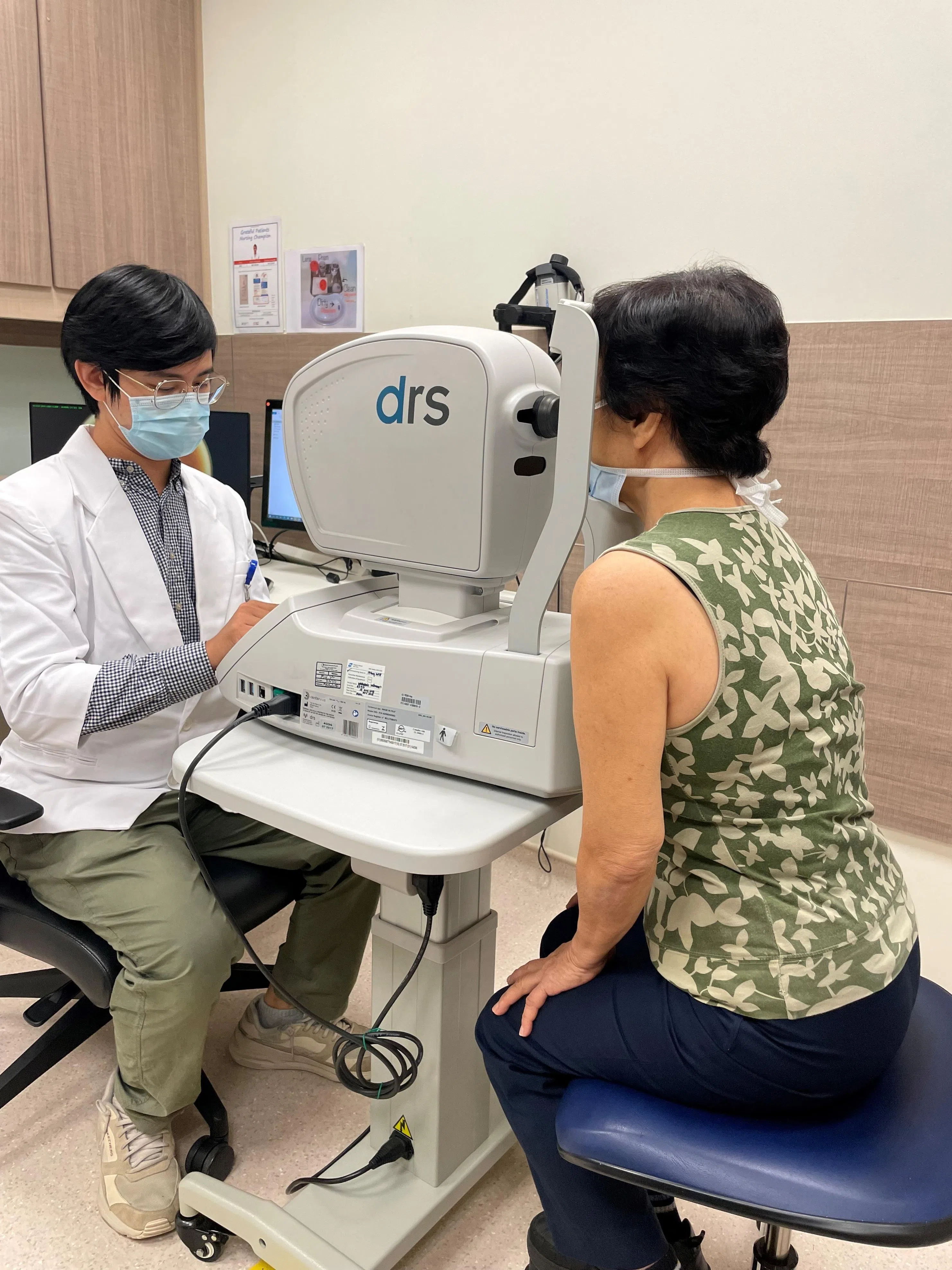
People with type 2 diabetes should have a retinal examination when diagnosed. If no disease requiring a specialist referral is found, screening is generally recommended once a year. Adults with type 1 diabetes should begin examinations three to five years after diagnosis and have them annually thereafter. Children with type 1 diabetes should be screened annually from age 12. Women with diabetes should have retinal examinations before trying to conceive, during early pregnancy and at subsequent stages of pregnancy.
Screening includes a vision test and retinal photography. Some patients need pupil-dilating eye drops to improve image quality. Vision may be blurred for four to six hours afterwards, during which patients should avoid driving or operating machinery. Prof Tan says subsidised diabetic retinal screening is available at local polyclinics, while family doctor clinics participating in the Healthier SG diabetes care programme also offer the service. If screening detects abnormalities, patients may need a referral to an ophthalmologist for closer monitoring, injections into the eye or laser treatment, depending on their condition. Prof Tan notes that treatment cannot fully reverse vision loss caused by permanent blood vessel damage.
Seek medical attention the same day if vision suddenly becomes blurred or is lost, floaters increase abruptly, a red haze or curtain-like shadow appears in the field of vision, straight lines look bent, or there is persistent blurring or a dark spot in central vision. A red, painful eye accompanied by headache, nausea or halos around lights also needs prompt assessment.
Patients should also take their medication as prescribed and work with their doctor to manage blood sugar, blood pressure and cholesterol. Those who already have retinopathy should discuss with their doctor whether closer retinal monitoring is needed before and after intensifying blood sugar treatment. They should not stop medication or avoid treatment on their own.
