

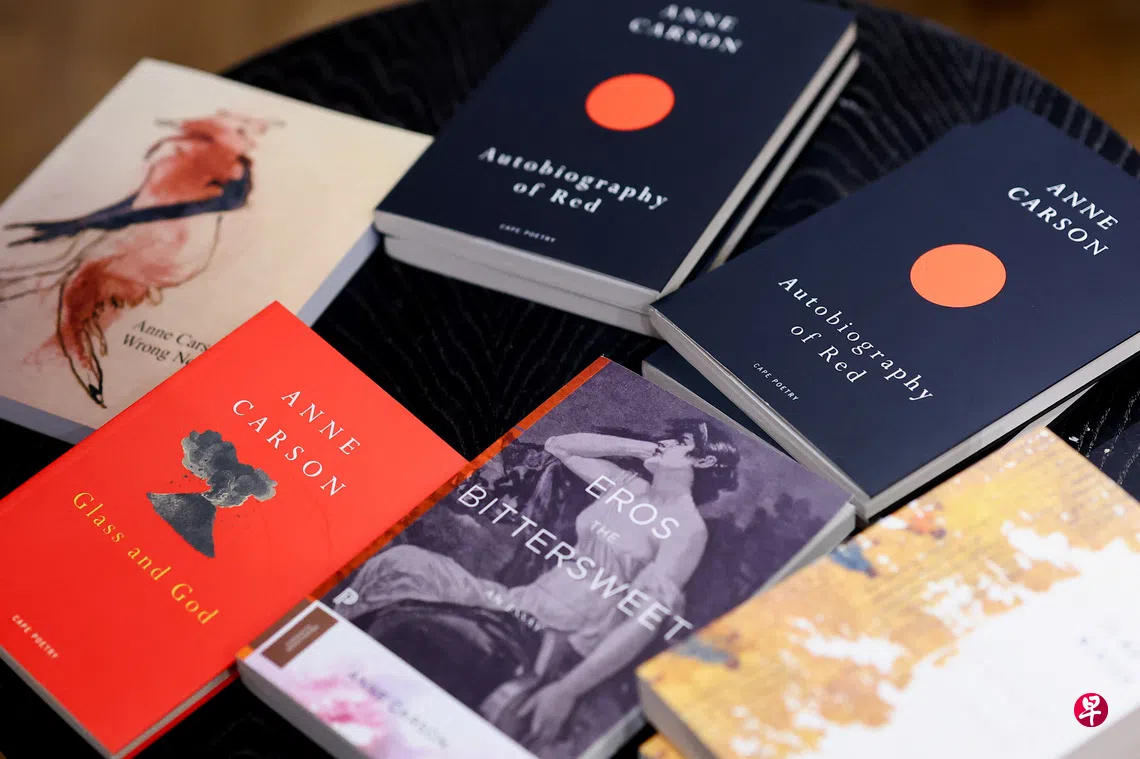
Anne Carson’s winning of the Nobel Prize in Literature brings a little warmth to the few poets left in the world who still believe poetry should be at the forefront of literature, who dare to pursue the avant-garde and accept the solitude it entails.
Imagine: in an age of artificial intelligence (AI) when the world prizes convenience, compression and the rapid exchange of emotional value above all else, here is a poet who insists on forging connections through painstaking craftsmanship with distant ancient Greece and the premodern literary world — indeed, she jokes that she reads only books more than 500 years old.
Through this work, Carson fashions a light that reaches into the depths of human nature, even that of the future. Such unfashionable writing holds the courage to press on alone against all opposition.
To use a popular expression, she is a poet who has never thought of “breaking out” into the mainstream. Her determination to remain invisible is not a matter of physical seclusion, as it is for another Nobel favourite, Australia’s Gerald Murnane. Rather, the orientation and style of her writing move subtly against the currents of contemporary fashion. In other words, she firmly rejects the popular literary tastes cultivated by American creative writing programmes and the bestseller industry.
Born in 1950, the now 76-year-old Carson developed Parkinson’s disease several years ago and uses daily boxing training as a form of self-therapy. Her foremost Chinese translator, the poet Chen Yuhong, recounts that Carson published a new work two months ago whose opening line was simply “waiting for a call that didn’t happen”.
Chen’s response upon reading it was: “That must be a call from Death.” Fortunately, though, the call came from the Nobel Prize office in Sweden. Carson herself may not care about this belated award, but it offers consolation to poetry, which has been so neglected in the new century.
For years, Carson’s public biography consisted of just a few words: “Anne Carson was born in Canada and teaches ancient Greek for a living.” Now, perhaps, it needs only one more sentence: “Anne Carson now lives in Iceland and is a winner of the Nobel Prize in Literature.”
Yes, strictly speaking, this year’s laureate is a poet with dual Icelandic and Canadian citizenship; by poetic lineage, she is also Greek. Having moved from eastern Canada to the even more sparsely populated Iceland, what must trouble her most at present are the journalists arriving from all over the world to waylay her in the bitter wind.
In recent years, I have devoted three sessions of a poetry course I teach at a university graduate institute to close readings of her work. On the first slide of my most recent lecture, beneath her biography, I added: “Perhaps her significance lies in her complete rejection of public visibility and fixed ways of reading.” Refusing to pander to popular taste, and freely breaking established patterns: that is an attitude poets of my generation would do well to learn.
A different path from the outset
Carson took an unconventional path from the beginning, choosing the marginal forms of the short prose poem and seemingly fragmentary essays, which she collated in Short Talks (1992). She was already 42 at that time; by her own account, she had not written a word before she was 20, being interested only in drawing.
Her long immersion in ancient Greek literature and drama, together with her experience of life by middle age, had given her a deep understanding of human hearts and worldly affairs. Poetry written from such a position was bound to be austere and detached rather than emotional and frenzied.
Short Talks and the slightly later Glass, Irony and God (1995) are, in fact, among her relatively “accessible” works. Perhaps their wealth of familiar literary and artistic anecdotes appears to lower the threshold for readers.
Yet you will still find yourself amid branching paths once you step inside them. The critic Hannes Stein likens this discomfort to “a pebble in your shoe that you can never shake out. It hurts as you walk, but when you sit down and take off your shoe, you discover that these pebbles are not merely angular: they are also unbelievably beautiful. They are gemstones, and you can never forget them.”
Short Talks combines hardness with suppleness, but it is done without equivocation. Carson’s poems are intensely compressed, as though they have turned themselves into fuel to burst into flame amid ice and snow, before solidifying again into mineral.
Take “Short Talk on Van Gogh”: “The reason I drink is to understand the yellow sky, the great yellow sky, said Van Gogh. When he looked at the world he saw the nails that attach colors to things and he saw that the nails were in pain.”
In just three sentences, an almost unimaginable transformation takes place: from sensory longing to the force of will, and finally to immense compassion. Who can see the nails, and Van Gogh’s pain?
At every moment, the poems in Short Talks form a glass sphere containing a miniature landscape. Shift your angle slightly and another world opens up. This magic recalls Carson’s predecessor Elizabeth Bishop. Yet Carson is still more concise, compressed and brief; we must work harder to discern her subtleties. As we grapple with the poems, though, a question naturally arises: is poetry a game of words? Can poetry escape wordplay?
Here we should turn to the Nobel Prize in Literature citation: “for her bold and inventive oeuvre that, in playful dialogue with the classical tradition, has created new forms for contemporary literature”. “Playful” suggests not only wit and delight but also mischief and nimbleness. Carson’s games possess all three, sometimes producing something uncanny or divinely inspired.
Take a poem I particularly like, “Short Talk on Mona Lisa”:
Every day he poured his questions into her, as you pour water from one vessel into another, and it poured back. Don’t tell me he was painting his mother, lust, etc. There is a moment when the water is not in one vessel nor in the other — what a thirst it was, and he supposed that when the canvas became completely empty he would stop. But women are strong. She knew vessels, she knew water, she knew mortal thirst.
The “he” here is Leonardo da Vinci, absorbed in painting the Mona Lisa as though confiding in her. Carson then introduces a metaphor that feels distinctly rooted in Eastern philosophy: the relationship between water and vessel is a process of giving form, transforming and restoring, rather than the Western Freudian framework of mother and desire.
As she continues, a startling image suddenly appears: “when the canvas became completely empty he would stop”. Surely, as he keeps painting, the canvas should gradually fill up. Instead, as if in a film running backwards, it grows emptier as he paints. This, too, seems a state belonging not to Western but to Eastern art. Think of Zen: both Zen Buddhism and ink painting seek to apprehend or depict emptiness.
Carson’s poetry is full of these turns, one in every sentence, until it abruptly arrives at its true subject: women. A woman is such a vessel; the Mona Lisa is such a vessel. The man is thirsty, longing to confide, emotionally famished. Ultimately, he wants to pour everything into that vessel and leave only emptiness. But he fails, because women understand all this and keep him in a state of “thirst”, unable to stop.
The reader must fill in the narrative
“The Life of Towns”, a sequence in Plainwater: Essays and Poetry (1995), published after Short Talks, goes further. It anticipates the poetic narratives Carson would later experiment with in her long poems, encompassing a whole world in a tiny corner. Take “Apostle Town”:
After your death.
It was windy every day.
Every day.
Opposed us like a wall.
We went.
Shouting sideways at one another.
Along the road.
It was useless.
The spaces between us.
Got hard.
They are empty spaces.
And yet they are solid.
And black and grievous.
As gaps between the teeth.
Of an old woman.
You knew years ago.
When she was.
Beautiful the nerves pouring around in her like palace fire.
This poem could easily become the opening of a film or the beginning of a novel. Reading her poems sometimes feels like solving a mystery. First, we identify its two key terms: apostle and old woman. Suppose we posit that “you” knew this old woman long ago — that you, an apostle, knew her when she was beautiful. Naturally, we begin to imagine love, profound memories and so forth.
Yet the earlier images of wind and “shouting sideways at one another” all concern separation, the futility of communication. After that futility, the poem suddenly discloses a secret: “the nerves pouring around in her like palace fire”.
There is a suggestion here: if there was some relationship between the apostle and the old woman, perhaps this fire was that of a witch-hunt — perhaps she was a witch burned to death. But it could also be the fire of adultery or desire.
So much can unfold from a very short poem. This is what Carson seeks. The extreme compression requires readers to fill in its so-called narrative. But this is not the narrative of fiction. If poetic narrative merely followed the novel’s methods, there would be no point: one might as well write a novel. That is what Carson reminds us.
Glass, Irony, and God is more mischievous and uninhibited still. Its sequence “The Book of Isaiah” directly teases at the solemnity of theology. Consider these extracts:
Once God and Isaiah were friends.
God and Isaiah used to converse nightly, Isaiah would rush into the garden.
They conversed under the Branch, night streamed down.
From the sole of the foot to the head God would make Isaiah ring.
Isaiah had loved God and now his love was turned to pain.
Isaiah wanted a name for the pain, he called it sin.
Now Isaiah was a man who believed he was a nation.
Isaiah called the nation Judah and the sin Judah’s condition.
Inside Isaiah God saw the worldsheet burning.
…
God arrived.
God smashed Isaiah like glass through every socket of his nation.
Liar! said God.
Isaiah put his hands on his coat, he put his hand on his face.
Isaiah is a small man, said Isaiah, but no liar.
God paused.
And so that was their contract.
Brittle on both sides, no lying.
The opening satirises the writing of Rilke and others on the divine; the second half is where the real deconstruction takes place. A useful comparison is the mutual teasing between God and Crow in Ted Hughes’s celebrated “Crow’s First Lesson”.
This poem catches my attention today because of the paradoxical situation in the Middle East, and because the “saviours” of every nation in every age believe they bear their country’s honour and disgrace, then invoke that responsibility to commit all manner of aggression or revenge. Who says Carson does not engage with politics?
A challenge issued 30 years ago
A more important work in Glass, Irony, and God, however, is “The Glass Essay”, which continues the approach of Short Talks. Its underlying text is Emily Brontë’s great novel Wuthering Heights.
One commentator argues: “This is a poem richer than the vast majority of novels today. Look at how it weaves and merges theme after theme within an utterly lucid narrative, how it makes Brontë a presiding spirit over the poem, how, drawing on her, it tells two powerful stories with Tolstoy’s technique, how it reflects on its themes in exquisite, astonishing ways…”
This poetic revolution confronts her contemporaries with questions: as we take in these arguments, have we ever thought about writing poetry this way? Should we try? If we do not, if we continue to write within our lyrical traditions, can we still hold our own against her in the poetic landscape of the 21st century? Carson, one might say, posed that challenge to us 30 years ago.
Pushed to its furthest extent, this approach produced Carson’s ambitious The Autobiography of Red (1998). It is also her bestselling poetry collection, with cumulative sales of 100,000 copies before the award. She reworks the story in the Theogony and Geryoneis, in which Heracles hunts the monster Geryon to atone for killing his wife and children.
The Geryon of the Aegean becomes an awkward, vulnerable gay teenager living on a Canadian island, with a strange pair of red wings growing from his back. He falls in love with the handsome, powerfully built Heracles. Carson’s forms are unpredictable: the poem includes an interview with Stesichorus, the original author of Geryoneis, which continues to the end of the long poem, as well as an embedded essay about Geryon.
“Her narrative framework presents the possibilities of entering and leaving, knowing and not knowing, the implicit and the explicit; classical and contemporary resources are excavated, alternated and accommodated together.”
All of this is visible on the surface: it shows how complex a poem can be. But I must admit that this complexity probably means little to the vast majority of the world’s readers. It matters only to those who teach or study literature, or write poetry. Excessive displays of erudition and the forced grafting of contemporary gender issues, moreover, make it seem less effortless than Short Talks.
The finest line in the entire collection is: “If prose is a house, poetry is a man on fire running quite fast through it.” In saying this, Carson is really suggesting how we should read her work. Prose here has its Western meaning, as the counterpart to verse. All non-metrical prose, fiction, non-fiction and so on constitute this stable house.
Poetry is something distinct from the house, a destabilising element. In Carson’s vision, the person running through it is actually someone who spreads the flames until the entire house burns. This is precisely where poetry’s experimental role should lie.
Clearly, Carson’s ambition at the time was to rival the novel, to prove that poetry could sustain whatever fiction could, and do it even better.
That ambition finally finds a comfortable fit in the subtler The Beauty of the Husband (2001), perhaps due to its connection with real life. The collection was reportedly written after the failure of Carson’s first marriage, and we can see her reflections on the mutual dependence and antagonism of husband and wife. It also contains her challenge to images of marriage entrenched over thousands of years.
The subtitle of The Beauty of the Husband is “A Fictional Essay in 29 Tangos”. Anyone who has watched a tango knows how the two dancers intertwine like a pair of tormented lovers, as though fighting and making love at once, advancing and retreating repeatedly. It is an especially apt counterpart to relations between the sexes within the traditional structure of marriage.
Read together, both title and subtitle sharpen the irony of this “beauty of the husband”. In a literary climate where feminism has become an established field of study, almost every reader will take the phrase as a mockery of men, rather than a genuine celebration of a husband’s beauty. We therefore approach the book wondering how she will satirise and dismantle this supposed beauty. Is love an illusion?
Yet this is a poem, not a feminist manifesto or a treatise on the institution of marriage. The Beauty of the Husband has a simple narrative framework: a couple meet as teenagers in a Latin class, marry, and then see their marriage break down. There is already a hint of autobiography at the outset, with ancient Greek lessons merely replaced by Latin.
This domestic tragicomedy closely resembles a novel such as Ulysses, capacious both in its worldly concerns and its spiritual crises. The collection collages fragments from Keats, Kenzaburo Oe, Bataille and Beckett, among others, drawing freely on documents, artistic allusions and anecdotes: Keats, repeatedly taken out of context, Duchamp, forcibly inserted…
As Lumen, the publisher that first brought out the book, puts it: “Anne Carson draws us into the intimate story of a broken marriage” — an intimate story about something broken, rather than the process by which an intimate story breaks apart — “inviting us to imagine marriage as often cruel, moving and darkly funny.”
Not every marriage will be made into such a work. Yet because this work exists, we can imagine how our own marriages came to this point, and what they ought to be. Early humans had to depend on one another to survive a harsh environment, and so marriage arose. But in modern society, where women can survive independently, is such a union still necessary? Perhaps this is what Carson wants to suggest.
After the success of The Beauty of the Husband, Carson became still freer and more uninhibited. Two of her subsequent major works, Nox (2010) and Float (2016), use unusual combinations of structure, layout and materials, moving beyond text into the realm of contemporary art objects. Do their formal flourishes intensify or dissipate their emotional content — the mourning for her dead brother in Nox, for instance? I have yet to grasp it, slow-witted as I am.
Finally, Carson’s translations must be mentioned, especially her collection of Sappho’s fragments, If Not, Winter (2002).
A decisive moment in Carson’s life reportedly came when a secondary school Latin teacher agreed to teach her ancient Greek during lunch breaks. In 1981, she earned a doctorate in classics from the University of Toronto. Her dissertation, Odi et Amo Ergo Sum — Latin for “I hate and I love, therefore I am” — examined the theme of eros in Sappho’s work. Her first prose work, Eros the Bittersweet (1986), also extended this theme.
The success of If Not, Winter can be said to have brought full circle the study of Sappho to which Carson had devoted half her life. In it, we read not only Sappho’s love for Greek boys and girls, but also Carson’s love for the world we inhabit.
Even through the Chinese translation, I could see a woman poet entirely different from the one I had encountered before. She — they — are not incarnations of the Muses, but people like you and me, struggling with and immersed in desire without regret.
In the introduction to If Not, Winter, Carson quotes Derrida: “Breaks are always, and fatally, reinscribed in an old cloth that must continually, interminably, be undone.” To my mind, this is also the secret of her own writing. The search for that break drives her ceaseless poetic experimentation.
(This article was first published in Caixin Weekly. Crossheads were added by the editors.)
