

Looking back through group photographs from a decade ago, we sometimes notice an old shop in the background or a familiar figure in a corner that we missed when we were focused on the people posing for the camera. The photograph has not changed; only years later do we see the details we once overlooked. The sky images stored by astronomers are like an ever-growing photo album. Some of our solar system neighbours were photographed long ago, but have only recently been recognised amid the dense starlight.
On 27 October, the International Astronomical Union’s Minor Planet Center announced a newly discovered object designated 2026 ED138. Discovered by the Vera C. Rubin Observatory in Chile, it is currently about 46 times the average distance between the Earth and the Sun. Sunlight takes more than six hours to reach it. Preliminary estimates put its diameter at about 600km to 1,500km, making it a dwarf planet candidate. Why has such a large neighbour only now been recognised? The answer lies not just in how far telescopes can see, but also in how we identify what they have already photographed.
Finding a familiar face among the stars
The discovery began with a set of observational data stored on computers. On the evening of 13 October, astronomer Matthew Holman ran a search programme he had developed with colleagues. It compared points of light recorded by the Rubin Observatory earlier this year, looking for detections at different positions on different nights that might belong to the same moving object. That was how 2026 ED138 emerged. Its brightness and distance suggested an unusually large object, prompting Holman to wonder briefly whether there had been a mistake.
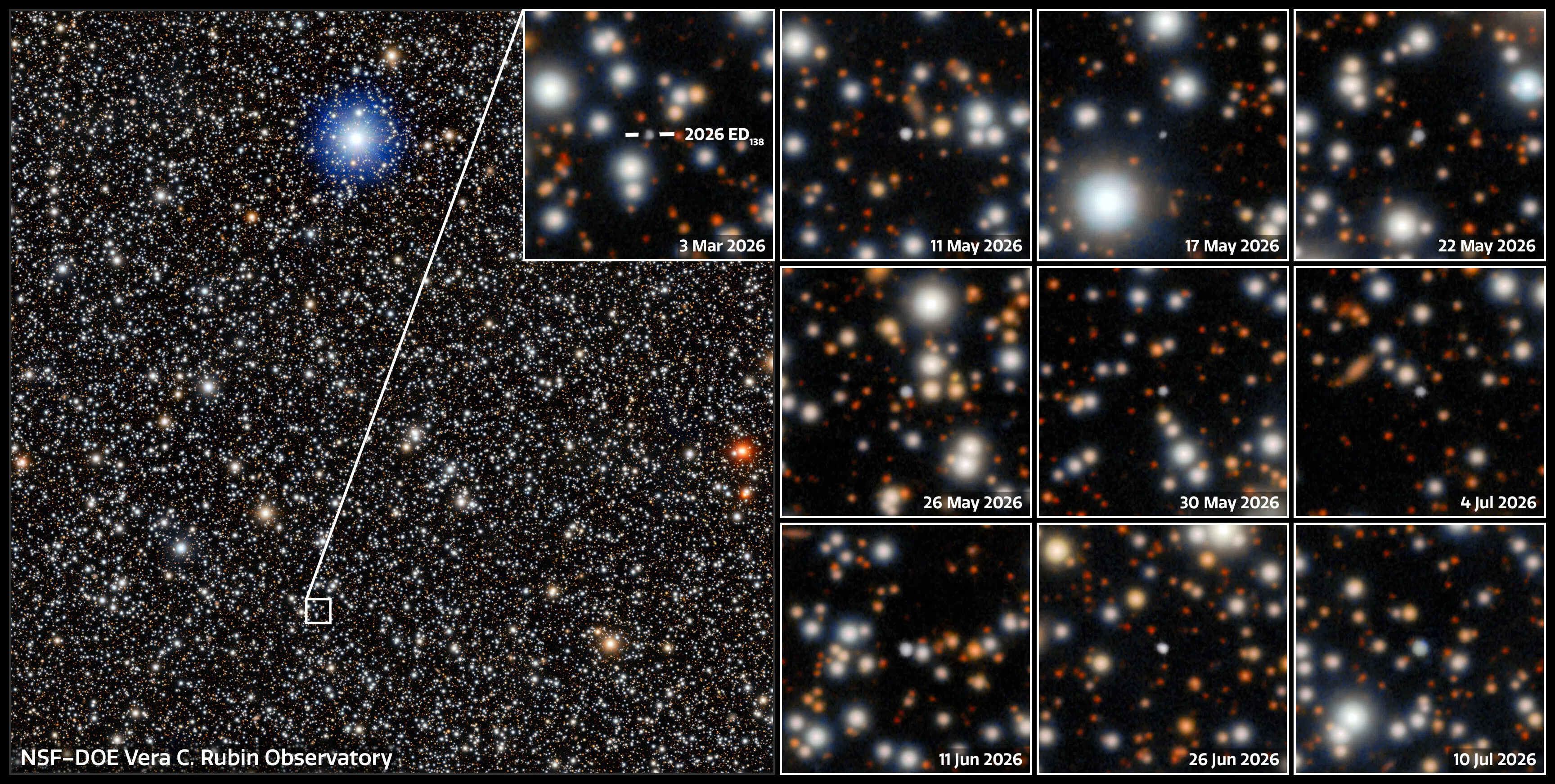
The team subsequently found more observations, even identifying it in archived images from other sky surveys dating back to 2016. It had not just entered the solar system; it had already been captured by human cameras long ago. Linking its observed positions over a decade allowed researchers to determine its orbit more accurately.
What makes the Rubin Observatory special is not just its telescope’s large aperture, but its plan to photograph the southern sky repeatedly over ten years, recording subtle changes. In a single image, a distant object may be no more than an unremarkable point of light. But comparing images from different nights can reveal its slow movement relative to the background stars. The challenge is that computers must work out which points of light belong to the same object from billions of detections. This tests not only the telescope’s sensitivity, but also the algorithms’ ability to recognise patterns.
There are two reasons why this object was missed. First, it lies in the southern part of the sky, where past sky surveys provided uneven coverage. Second, it is close to the plane of the Milky Way, with a background crowded with stars. Searching there for a slowly moving point of light is like trying to spot a familiar face at Raffles Place MRT station during the evening rush hour. The person is not hiding; there are simply too many people around to make them out easily. Only repeated imaging, followed by computer comparisons of its path, offers a chance of identifying it amid the crowded starlight.
The Kuiper Belt beyond Neptune’s orbit is home to many small worlds made of ice and rock. They preserve material from the early solar system, and their orbits may also bear traces of disturbances caused by the migration of giant planets. The orbit of 2026 ED138 is tilted by nearly 25 degrees relative to the orbital plane of the solar system’s major planets, possibly because of past gravitational disturbances from Neptune. Studying these distant objects is not merely about adding names to a map; it is also about tracing how the solar system came to look as it does today.
Seeing a point of light does not reveal its size
Identifying an object does not mean we already know how large it is. For distant targets whose outlines cannot be resolved directly, the first thing a telescope measures is brightness. Even once the distance is known, researchers face another difficulty: brightness depends on both size and the surface’s ability to reflect light. A small, reflective object can appear as bright as a large, dark one, just as a small piece of white cloth and a large piece of dark cloth in the distance might reflect similar amounts of light towards our eyes.
At the same distance and under the same observing conditions, the amount of reflected light is roughly proportional to the square of the diameter, and also varies with reflectivity. Two objects whose diameters differ by a factor of two and a half can have similar brightness if the larger one is about six times less reflective. The estimated diameter of “600km to 1,500km” for 2026 ED138 comes from different assumptions about its reflectivity; it is not a precise measurement.
One way to distinguish further between “large and dark” and “small and bright” is to measure the thermal radiation emitted by the object itself. After absorbing sunlight, an object radiates energy at infrared and other wavelengths. Combining reflected visible light, thermal radiation and relevant models allows more accurate estimates of its size and reflectivity. Another method is stellar occultation: when the object passes directly in front of a background star, observers at different locations record when the starlight disappears and reappears. Combining those timings with the speed at which the shadow sweeps across the ground allows researchers to calculate the object’s projected outline.
Does it qualify as a dwarf planet?
There is no simple diameter threshold for a dwarf planet. Under the International Astronomical Union’s definition, it orbits the Sun, is not a satellite, and has enough gravity to make its overall shape nearly spherical, but has not become dynamically dominant in its orbital neighbourhood. This does not mean that its surroundings must be completely empty. Whether an object’s own gravity can pull it into a rounded shape also depends on its material properties and evolutionary history. More observations of 2026 ED138 are therefore needed to confirm whether it meets the definition of a dwarf planet.
Many have lamented Pluto’s reclassification as a dwarf planet in 2006. With 2026 ED138, beyond what it should be called, we want to know what it is made of and how it has changed over time. Recognising it is only the beginning of understanding it.
The Rubin Observatory will continue photographing the southern sky, searching for more neighbours yet to be recognised, while new clues will lend fresh meaning to old images. It is like looking through a group photograph from years ago: only when we finally recognise the figure in the corner do we realise it has been there all along. The next unfamiliar world may already be hidden in plain sight in our photo album.