

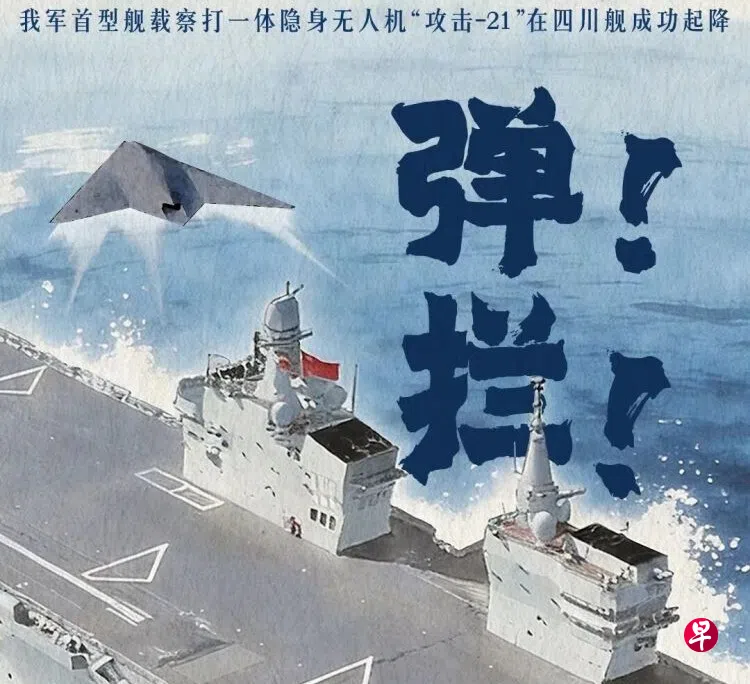
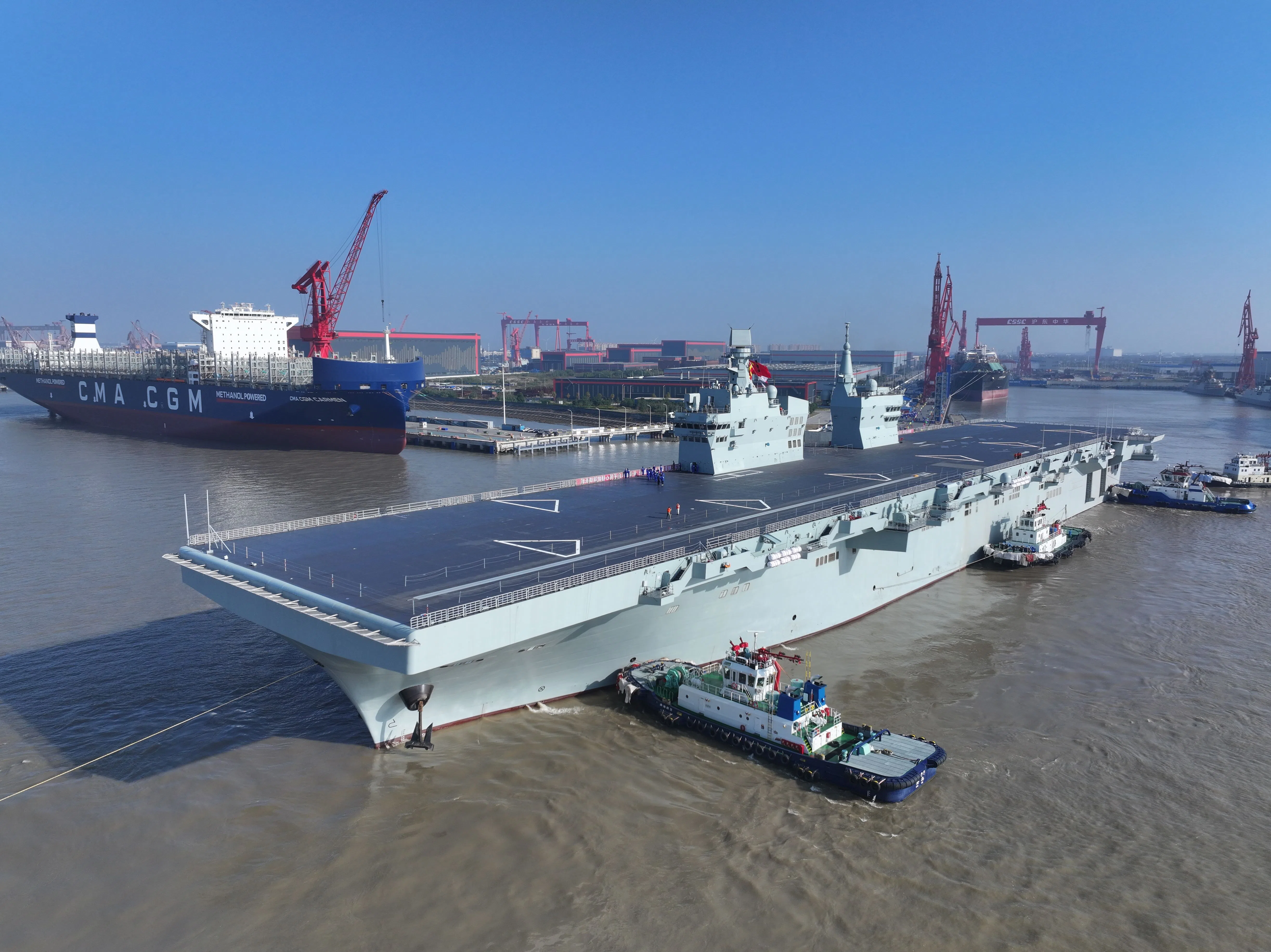
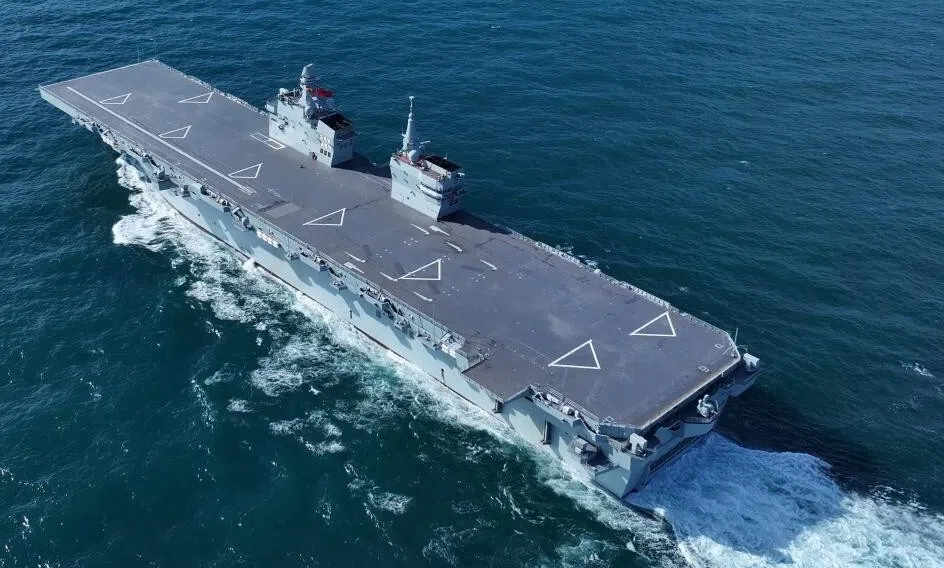
As the Sichuan, the Chinese navy’s first Type 076 amphibious assault ship, marked the first anniversary of its maiden sea trial on 14 November, the first successful take-off and landing by China’s first carrier-borne stealth drone, the GJ-21, aboard the vessel drew attention from Western military media. The Sichuan is also known as a “drone carrier”.
Retired Taiwanese major general Li Cheng-chieh said on a CTi News programme: “Although the Type 076 is described as a drone carrier, its primary combat mission remains amphibious assault. The GJ-21 makes the Type 076 a drone carrier, but its role is not to secure air superiority. It is to conduct ground strikes, targeting counter-attacking forces and armoured units during landings.”
He also said that a Type 076 light carrier equipped with GJ-21 drones would pose “a major threat to parties across East Asia, whether in Japan’s Okinawa islands, Taiwan, or even island-seizure operations against the Philippines”.
The Type 076 is China’s largest amphibious assault ship to date and its first equipped with electromagnetic catapults, enabling it to launch large drones for strike and reconnaissance missions. The first ship, the Sichuan (hull number 51), was launched in Shanghai in December 2024 and began its maiden sea trial in November 2025. It is expected to enter service formally before the end of 2026. With a full-load displacement of more than 40,000 tonnes, it will be able to launch drones and carrier-borne fighters such as the J-15T and J-35, becoming the world’s first drone carrier equipped with electromagnetic catapults.
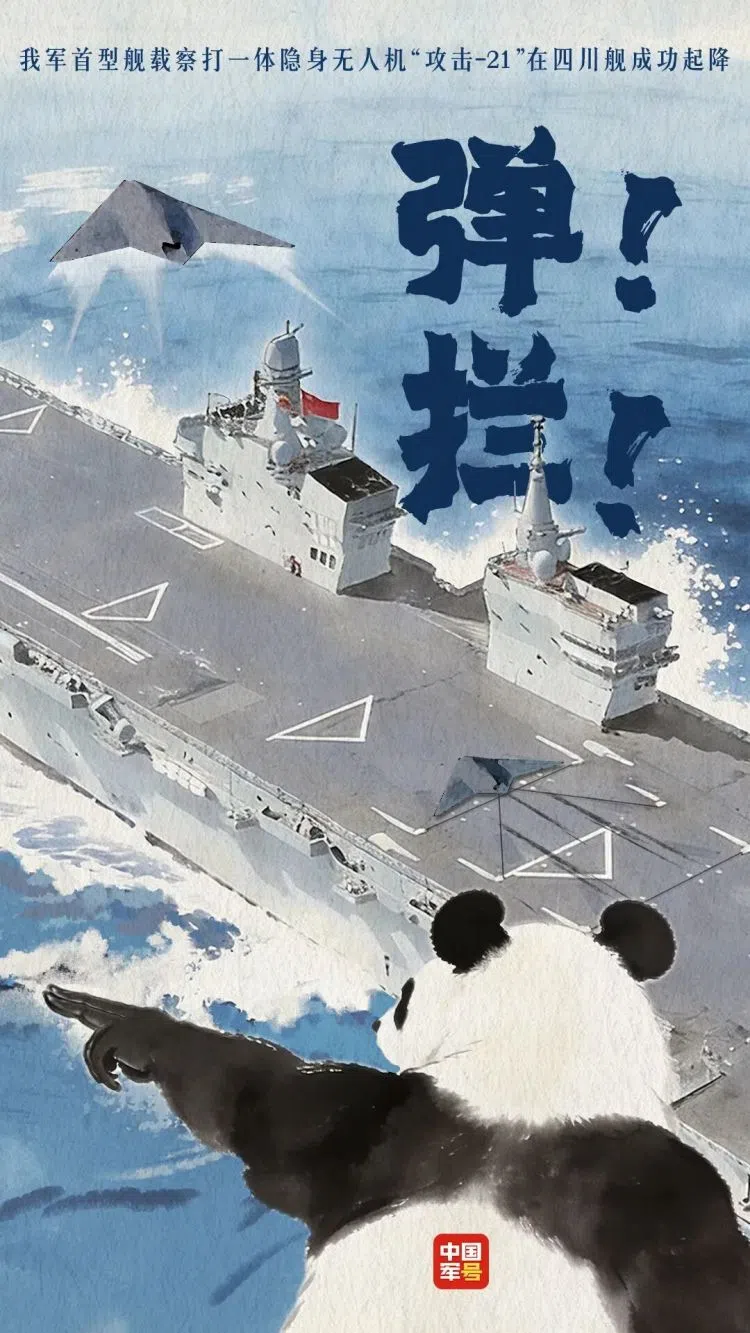
In its brief announcement on 30 October, the Chinese navy described the GJ-21’s first successful take-off and landing aboard the Sichuan as another breakthrough in the development of amphibious assault ships. It said this demonstrated the navy’s ability to operate fixed-wing stealth drones from large naval combat platforms. The statement did not disclose when or where the operation took place, nor did it include photographs or video.
The statement also said that the Sichuan had conducted various sea trials as scheduled since its maiden voyage, successfully completing equipment commissioning and overall operational stability tests. This suggests the light carrier may be nearing formal commissioning.
On 6 November, Senior Colonel Chen Xi, a spokesperson for China’s Ministry of Defence, described the GJ-21’s first take-off and landing aboard the Sichuan as an important milestone in the Chinese military’s development of combat capabilities in new domains and of new types.
Chinese military expert Zhang Xuefeng told CCTV that the GJ-21 had achieved two world firsts. It is the world’s first stealth drone capable of integrated reconnaissance and strike missions to be carried by an amphibious assault ship. Its catapult-assisted flight operations aboard the Sichuan also marked the world’s first catapult launch of a large reconnaissance-strike drone from an amphibious assault ship.
Zhang said the GJ-21’s stealth flying-wing configuration, without a vertical tail, already makes aerodynamic control highly demanding. Shipboard take-offs and landings must also contend with complex disturbances such as deck movement and turbulence behind the ship, making them far more challenging than land-based landings. Its successful flight operations aboard the Sichuan demonstrated both the maturity and reliability of its flight-control technology and the operational readiness of the ship’s fully automated landing guidance system.
Publicly available information shows that the GJ-21 was independently developed by China and is the world’s first large carrier-borne stealth reconnaissance-strike drone to enter operational service. It is extensively adapted from the land-based GJ-11. Both its length and wingspan exceed 10 metres. It has a take-off weight of more than 10 tonnes, a payload of about two tonnes and a maximum range of 3,000 to 4,000 kilometres. It cannot take off unaided from a conventional flight deck and requires a catapult.
After its public debut at the 3 September military parade last year, the GJ-21’s designation was disclosed for the first time on CCTV’s Military Report (《军情时间到》) on 27 September. In April this year, the large drone took part in combat-oriented exercises organised by a Chinese naval aircraft carrier formation in the Bohai Sea, completing drills in reconnaissance and early warning, air defence and missile defence.
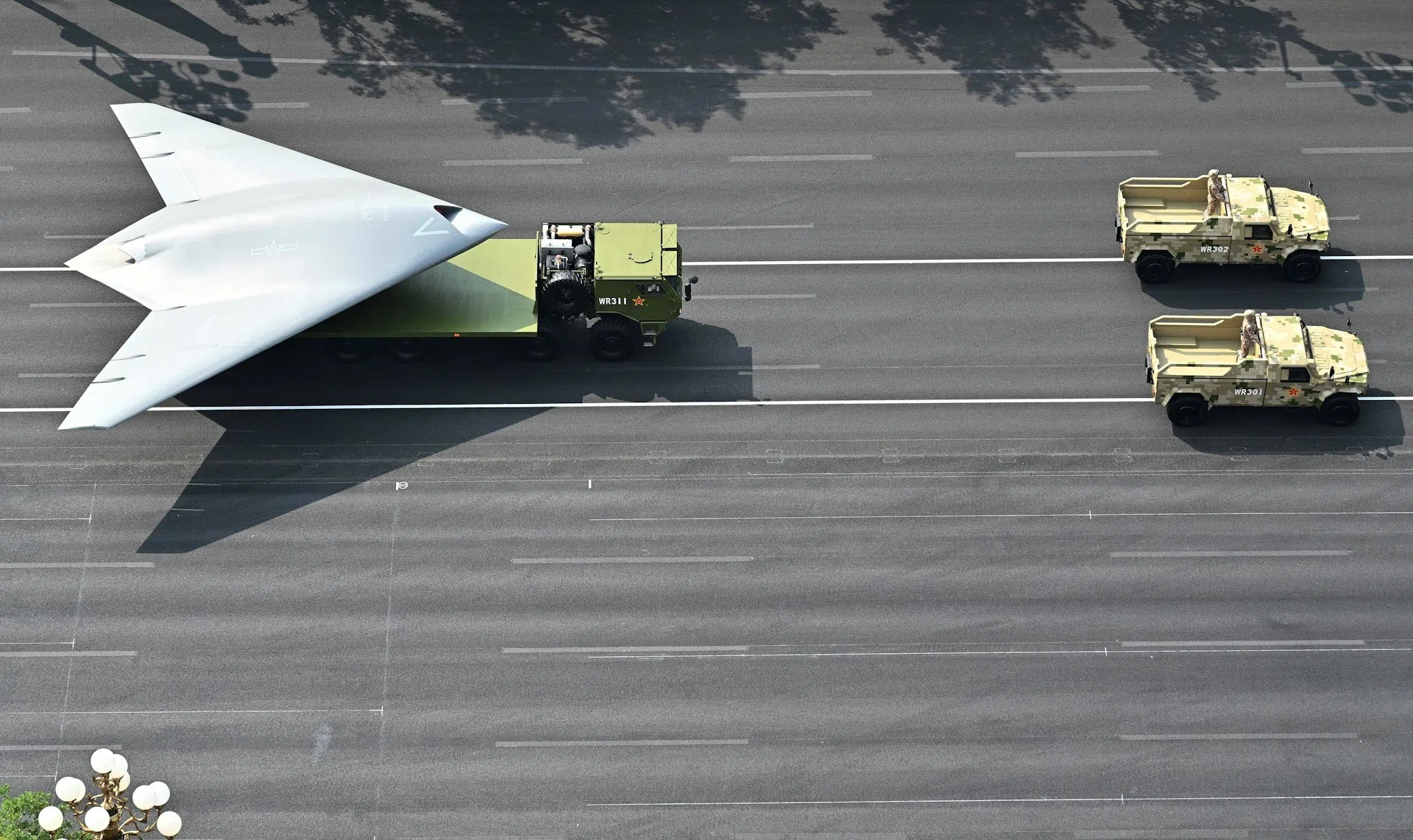
Explaining the GJ-21’s advantages to the Global Times, Zhang said its first strength was its outstanding stealth performance. Its flying-wing configuration and dorsal S-shaped air intake eliminate strong radar reflection sources across the aircraft, giving it excellent all-aspect stealth. Its stealth performance is even better than that of stealth fighters currently in service, making it suitable for attacking heavily defended targets as part of an initial strike force tasked with breaching enemy defences.
Its second strength is its relatively large combat radius. The flying-wing configuration improves subsonic cruising efficiency. Although the drone is much smaller than the J-35 and J-20, its combat radius is comparable. Third, it has low operating costs and is reusable.
The Type 076 can also operate alongside aircraft carriers. Zhang expects that equipping it with the GJ-21 would significantly strengthen a carrier formation’s ability to strike targets at sea and on land. The drones could also form teams with crewed fighters for complex, high-risk missions, such as suppressing air defences. Crewed fighters could open an air corridor while drones move ahead to suppress enemy ground targets and air-defence systems.
Chinese military expert Song Zhongping predicted that the GJ-21 could eventually be deployed aboard the Fujian, an aircraft carrier equipped with electromagnetic catapults, broadening the ways in which carrier formations conduct combat operations.
The US introduced the X-47B carrier-borne drone for conventional aircraft carrier operations as early as 2013, but the project was ultimately scrapped because of multiple technical constraints. By contrast, Song said, the GJ-21 programme had progressed steadily and efficiently, with a wide range of potential future applications.
On the first anniversary of the Sichuan’s maiden sea trial, military observer Wei Dongxu told the CCTV News app that deploying large stealth drones aboard ships would bring three changes to amphibious landing operations.
The first is covert reconnaissance. Before deploying amphibious forces, the Sichuan could send GJ-21 drones to conduct covert reconnaissance of the landing area. Their strong stealth performance makes them difficult for air-search radars to track. The GJ-21 could “observe quietly”, transmitting information and intelligence to the amphibious operations command system.
The second is long-range precision strikes: the GJ-21 can attack both moving targets at sea and targets deep inland on islands. The third is countering maritime interception. If enemy surface vessels interfere with the Sichuan while it is transporting troops at sea, GJ-21 drones could strike first to eliminate the intercepting forces.
PLA could deploy Type 076 light carrier for operations east of Taiwan
Following the GJ-21’s unveiling, Taiwanese media coverage focused on its combined reconnaissance and strike capabilities, long range, thick wings and considerable landing capabilities, saying it could be used to blockade Taiwan’s main island.
US military news outlet The War Zone (《战区》) reported on 30 October that, over more than a year, mounting evidence had indicated that the Chinese navy was preparing for this major milestone in naval aviation.
China aviation specialist and The War Zone (《战区》) contributor Rupprecht noted that satellite imagery showed several GJ-21 drones conducting simulated electromagnetic catapult launches and arrested landings late last year at the Chinese navy’s land-based facility in Huangdicun, Huludao, Liaoning province. A GJ-21 mock-up subsequently appeared on the Sichuan’s flight deck in February this year.
The War Zone said stronger naval aviation capabilities would give the Chinese navy additional flexibility in operations close to home, including countering potential military intervention in the Taiwan Strait or asserting its extensive territorial claims in areas such as the South China Sea. The Type 076 would also allow China to project naval and air power further from its coast, “one of the key factors driving the country’s broader aircraft carrier ambitions”.
Huang Yu-chun, a former deputy representative to the US for Taiwan’s opposition Kuomintang, told a Global News programme that the People’s Liberation Army’s development of drone carriers would not only reduce Beijing’s combat costs but also extend its operational reach. “In effect, it could force the US to retreat further from the first island chain. Taiwan would feel the greatest impact, followed by Japan. This would force the US to reassess its deployments in the Taiwan Strait, or the mechanisms through which it might jointly defend Taiwan in future.”
If war were to break out across the Taiwan Strait, the PLA could send the Type 076 into waters east of Taiwan to form a group with the Fujian, and potentially the Liaoning and Shandong, for joint maritime combat operations, former Taiwanese naval captain and military expert Lu Li-shih told Guancha.cn. In that scenario, the aircraft carriers would deploy carrier-borne fighters while the Type 076 launched GJ-21s and other drones to conduct reconnaissance and strikes against relevant targets.
Lu noted that Hualien and Taitung in eastern Taiwan host important Taiwanese air bases and aviation forces, including F-16V fighters. “The GJ-21’s stealth design will pose a considerable challenge to the existing air-defence system in eastern Taiwan.”
Huang said that, faced with the PLA’s carrier for specialised unmanned operations, eastern Taiwan could no longer be considered a rear area. Taiwanese forces might have to fight on two fronts, while the US might be unable to enter Taiwan’s airspace for three or four months, let alone help defend it.
The routine deployment of GJ-21 drones aboard the Sichuan in the near future appears highly likely. It would send a further deterrent signal to Taiwan and powers outside the region, while giving the PLA better options for amphibious landings on Taiwan. The drones could not only clear the way for other advanced combat aircraft but also effectively reduce financial costs and casualties in operations to seize beachheads. Whether the defenders can similarly reduce the costs of fighting back will be a key factor shaping the future cross-strait military balance, and an important development to watch.
