

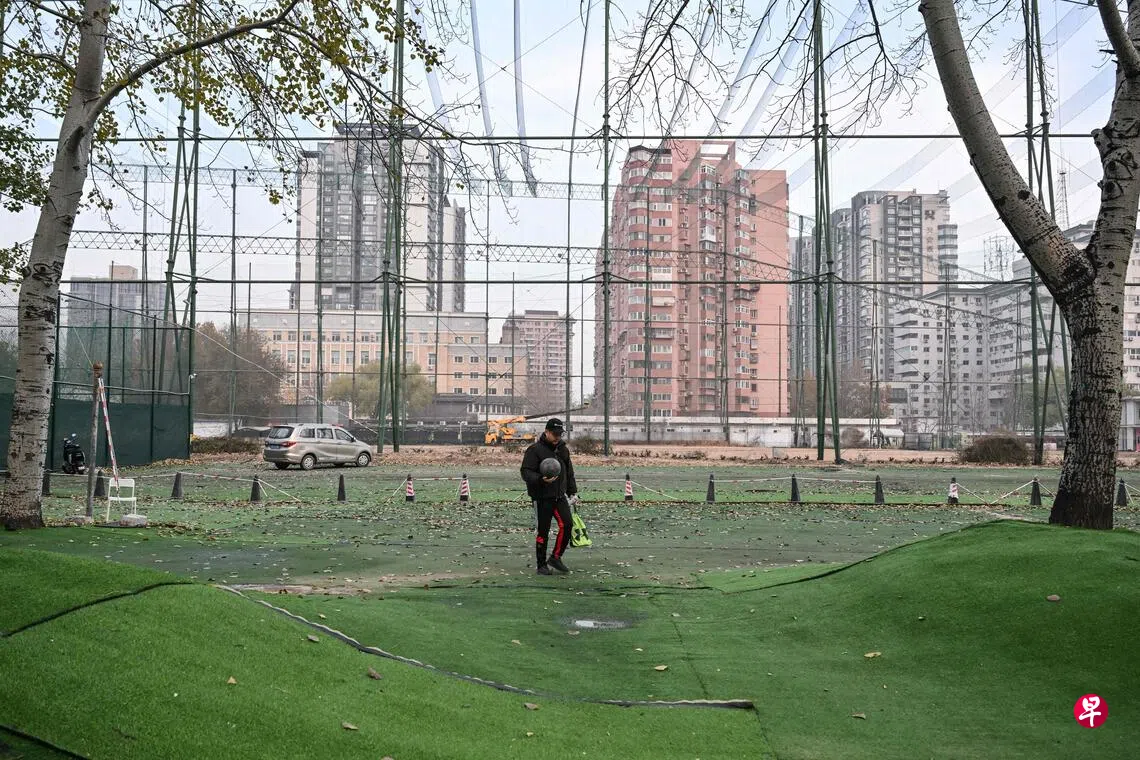
The practice mats have been put away and the signs taken down. Staff who once welcomed golfers now answer calls every few minutes from members asking about refunds.
This was the scene an AFP reporter found at the golf driving range at Dongfeng International Sports Park in Beijing on Thursday (26 November).
In a notice that day, the park said the driving range had ceased operations from Wednesday (25 November), as required by the relevant authorities. An employee who has worked there since 2016 said the range had no shortage of members willing to pay thousands of RMB (1,000 RMB is about S$193) for a few months’ membership. But all he knew about the sudden closure was what the online notice said.
This is not an isolated case. According to AFP’s tally of public notices and social media posts, at least 18 golf courses in China have announced their closure this month, including 10 in Beijing. Many said they were closing at the government’s request.
Online videos also show facilities being dismantled at at least four courses. Some employees contacted by AFP confirmed that the authorities had ordered their courses to close, though some said they did not know the specific reasons.
Expansion and crackdowns despite a construction ban
The succession of closures within a month inevitably brings to mind China’s previous large-scale crackdowns on golf courses.
In 2004, China’s State Council General Office ordered a halt to the construction of new golf courses to protect land and water resources. Yet the ban failed to effectively curb their expansion. According to the China Golf Industry Report (《中国高尔夫行业报告》), the number of courses nationwide rose from 178 in 2004 to 521 in 2013.
The authorities subsequently launched several rounds of enforcement against unauthorised construction. In 2011, multiple government departments began a nationwide review and clean-up of golf courses. In May 2014, China’s Ministry of Land and Resources named and criticised five property developers for building courses in breach of regulations, ordering them to take corrective action.
In 2015, the authorities announced that 66 unauthorised courses had been shut down. Results of the crackdown released in 2017 showed that 111 courses nationwide had been ordered to close, another 18 had withdrawn from operation, 47 projects had been cancelled and 507 courses had been ordered to rectify breaches.

What problems were these crackdowns targeting? The violations listed by the authorities included occupying farmland and forest land, encroaching on drinking water source protection zones, extracting groundwater illegally and compromising flood safety.
The ecological impact of golf courses has also long been contentious. Environmentalists worry that extensive reshaping of the terrain, planting a single type of turf, and using fertilisers and pesticides for maintenance could damage local ecosystems and increase the risk of soil and water pollution.
Maintaining the turf also requires considerable amounts of water. Chen Chaoxing, general manager of Forward Group, previously said that in 2014, the turf on an 18-hole course in China used an average of 255,000 cubic metres of water a year. Although this was lower than before, it remained above the 188,000 cubic metres used by comparable courses in the US.
Concerns over power and money on the fairway
Beyond land and environmental issues, golf courses have also come under anti-corruption scrutiny because of the risk of improper benefits changing hands in dealings between officials and businesspeople.
Golf courses are places for both sport and socialising. When officials play alongside business owners seeking favours from them, membership cards, golfing fees and accompanying hospitality can become ways to cultivate ties and confer improper benefits.
A Xinhua report in late 2014 noted that Tan Li, the disgraced former vice-governor of Hainan, had been playing golf with private business owners before he came under investigation. In 2010, more than 20 officials in Wenzhou, ranging in rank from deputy department director-general to deputy division director, held leadership positions in a golf association. The ill-gotten gains of several disgraced officials also included golf membership cards worth hundreds of thousands of RMB.
Some related violations also involved spending public funds. According to the magazine China Discipline Inspection and Supervision (《中国纪检监察》), during a round of inspections and corrective action involving 25 centrally administered state-owned enterprises in 2015, at least 60 people faced Party or administrative disciplinary penalties, or other organisational action, for playing golf at public expense.
The Communist Party of China’s disciplinary regulations, revised that same year, explicitly made the improper acquisition, possession or use of golf membership cards punishable. They also prohibited officials from accepting fitness, entertainment or other activities that could compromise the impartial performance of their official duties.
These rules do not amount to a blanket ban on Party members playing golf. In 2016, China Discipline Inspection and Supervision News (《中国纪检监察报》) pointed out that there was nothing inherently right or wrong about playing golf as a sport.
Yet even after the disciplinary boundaries were made clear, some ostensibly surrendered their membership cards while continuing to hold and use others in private. In 2021, the Central Commission for Discipline Inspection and the National Commission of Supervision said that Yin Jiaxu, former chairman of China North Industries Group Corporation, had surrendered three golf membership cards and pledged to hold none. In reality, he still held six cards obtained for him by private business owners and others, and continued playing regularly, with some expenses paid by subordinates or business owners.
Why the closures have prompted talk of an anti-corruption drive
Since news of the latest wave of closures emerged, much of the analysis has linked it to the anti-corruption campaign. Such associations also reflect the sustained intensification of that campaign in recent years.
Official Chinese figures show that discipline inspection and supervisory agencies nationwide disciplined 983,000 people in 2025, about 10% more than the 889,000 in 2024. The Central Commission for Discipline Inspection and the National Commission of Supervision opened investigations into 181 centrally managed officials, nearly double the previous year’s 92. In the first three quarters of this year, discipline inspection and supervisory agencies nationwide opened 800,000 cases and disciplined 680,000 people.

Golf-related misconduct also continues to feature in recent disciplinary notices.
In September this year, the Central Commission for Discipline Inspection and the National Commission of Supervision said that Pan Liang, a former official of vice-ministerial rank at the State Council’s State-owned Assets Supervision and Administration Commission, had repeatedly accepted golf outings arranged by private business owners in breach of regulations between 2016 and 2025. He had also accepted entertainment arranged for him, his relatives and friends, with the hosts covering the costs. Pan was expelled from the Party for serious disciplinary and legal violations, including these acts, and his suspected criminal offences were referred to prosecutors.
Yi Yingsen, former chief marketing officer and general manager of the institutional banking department at the Agricultural Bank of China, was announced to have been expelled from the Party in February last year. His disciplinary violations also included improperly acquiring, holding and using golf club membership cards.
These cases show that, although the disciplinary boundaries have been clearly drawn, the use of golf to cultivate connections and confer improper benefits has not disappeared. The absence of public spending does not mean there is no corruption risk. Business owners who pick up officials’ bills may also expect favours in return.
The persistence of such problems makes it easier to associate the latest closures with the anti-corruption drive. But past cases alone are not enough to establish whether the closures are linked to it. Even if anti-corruption considerations are involved, closing a golf course does not necessarily sever a chain of vested interests.
Behind the membership cards and hospitality lies a relationship of power between those playing and those paying. Golf courses may close, but the business of currying favour with the powerful will not necessarily end with them.
