

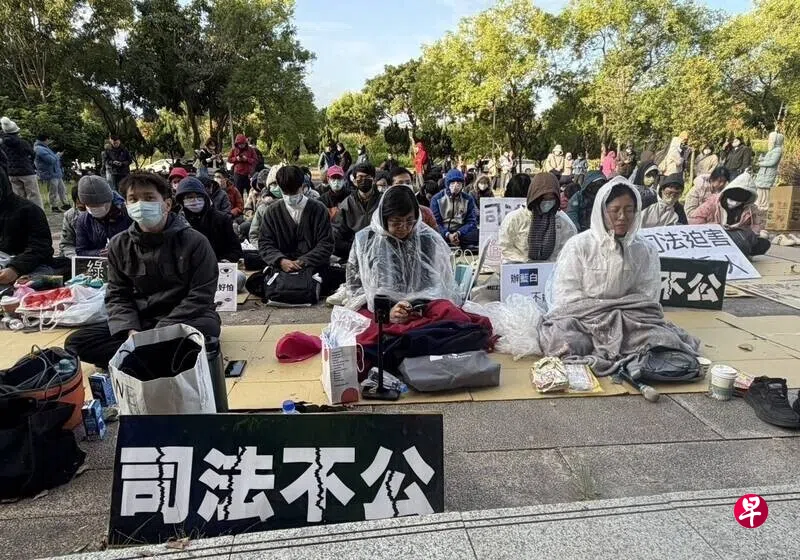
As Taiwan’s “nine-in-one” local elections enter their final, heated stretch, Kuomintang (KMT) candidate for Hsinchu county magistrate Hsu Hsin-ying began a sit-in and hunger strike outside the Hsinchu District Prosecutors Office on Friday (20 November) evening after police took her aide away. Her protest had lasted 11 hours as of Saturday (21 November).
Hsu also questioned on Friday evening why Democratic Progressive Party (DPP) candidate for Hsinchu county magistrate Tseng Sheng-kai had issued a press release accusing her aide of involvement in a sexual smear campaign while the aide was still being questioned.
KMT chairwoman Cheng Li-wun voiced support for Hsu in a Facebook post on Friday evening following the incident.
Cheng wrote that she stood with Hsu, stressing that the justice system must be impartial and must never become a political tool.
She said it was deeply concerning that Hsu’s aide had suddenly been taken in for questioning by prosecutors and police with just eight days until the election. “I support Hsu Hsin-ying’s call to uphold judicial impartiality, and it pains me that she has gone so far as to declare a hunger strike in protest.”
Cheng said the justice system should seek the truth rather than create a chilling effect. Prosecutors and investigators must clearly explain the grounds for their actions and ensure due process, she added, saying the public must not be allowed to lose confidence in the justice system.
She offered Hsu encouragement, stressing that “the Kuomintang stands with you”, and urged her to take care of her health.
According to reports by Taiwan’s United Daily News and Liberty Times, DPP’s Tseng said in a press release on Friday that he had faced a series of online sexual smears in recent days, with abusive messages even directed at his wife’s private account. He had already filed a police report and a criminal complaint, and learnt that day that the suspect identified by police was Hsu Hsin-ying’s council aide, surnamed Lee. He angrily asked: “Could taxpayers’ hard-earned money really be funding an industry of election-related sexual smears?”
In response, Hsu said she only learnt from news reports that the case might involve an explicit video and insinuations circulating online. She stressed that she had never seen the video and did not know the details of its contents. She also said she did not believe that her young female aide, who is in her 20s and handles design work, would be involved in an online smear campaign.
Hsu questioned why Tseng had publicly accused her council aide of involvement while the aide was still being questioned and her campaign team had yet to establish the facts of the case. Making public accusations before investigators had clarified the matter amounted to a trial before any court proceedings, she said.
Hsu suspected possible political manoeuvring behind the case. “Someone behind the scenes is writing the script, and the justice system is acting as a tool to play along,” she said, demanding that prosecutors and police explain the source of the information.
Tseng, however, stressed that Hsu could not brush the matter aside by claiming ignorance. He asked whether Lee was paid with public funds, whether Hsu knew of or authorised her actions, and whether the sexual smear material had been produced and distributed during working hours or using equipment in the council office. He called on the judicial authorities to investigate whether anyone had directed the alleged actions, vowing never to settle or withdraw his complaint.
The Hsinchu District Prosecutors Office issued a press release on Friday evening clarifying that the investigation and searches were based on specific evidence of criminal conduct and court-issued search warrants, and had nothing to do with any particular candidate or political activity.
The office said the case stemmed from an aggravated defamation complaint lodged with police by a Zhubei mayoral candidate surnamed Tseng over the online distribution of false sexual images. Investigators followed leads that implicated a defendant surnamed Lee and executed search warrants at her home and another residence, seizing three laptops, one desktop computer and four mobile phones.
After questioning Lee, prosecutors found grounds to suspect offences under the Public Officials Election and Recall Act involving intent to prevent a candidate’s election, breaches of the Personal Data Protection Act, and aggravated defamation and distribution of sexual images under the Criminal Code. They initially ordered her release on bail of NT$100,000 (S$3,913), pending further summons.
However, no one was able to post bail for her. After two hearings in the early hours of Saturday, the conditions were changed to restrictions on her residence and a ban on leaving Taiwan. She left the prosecutors’ office through another exit shortly after 2.40am.
