

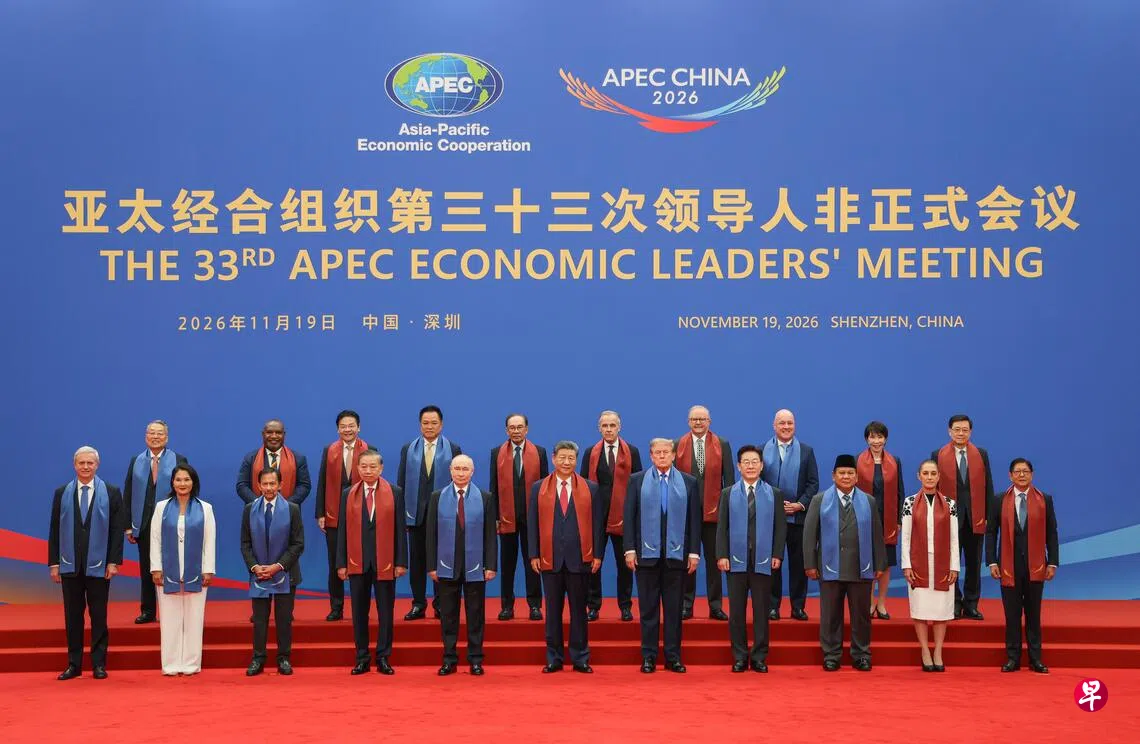
Asia-Pacific Economic Cooperation (APEC) leaders have adopted a joint document titled the Shenzhen Outlook, breaking with the convention of issuing a “declaration”. The document reaffirms their commitment to strengthening regional economic cooperation, improving the trade and investment environment and maintaining supply chain resilience, while supporting deeper cooperation on the digital economy and emerging technologies.
The document, adopted on Thursday (19 November), also calls on member economies to address risks such as data breaches, online scams and the malicious use of digital and emerging technologies, while strengthening cooperation on cross-border data flows and safeguarding data protection and privacy. It makes no mention of the World Trade Organization, the multilateral trading system or rare earths.
Xinhua initially reported that “the meeting unanimously adopted the 2026 APEC Leaders’ Declaration, setting out the ‘Shenzhen Outlook’ for building an Asia-Pacific community”, along with three outcome documents on trade, connectivity and innovation. However, the final Chinese-language document was titled the 2026 APEC Leaders’ Shenzhen Outlook.
According to Reuters, the document’s English title is “2026 APEC Leaders’ Shenzhen Outlook”, likewise replacing the customary “Declaration” with “Outlook”. No official explanation was given for the change.
Nikkei reported that APEC’s English-language website briefly listed the Shenzhen Outlook in its section for leaders’ declarations from previous summits, before removing it. A check by Lianhe Zaobao (LHZB) found that the document had not been uploaded to that section as of 10pm on Thursday.
The APEC meeting was held in Shenzhen, China, from Wednesday (18 November) to Thursday, with leaders or representatives from all 21 member economies attending.
Chinese President Xi Jinping chaired the meeting and, in his address, called for an Asia-Pacific community built on solidarity and cooperation, openness and integration, innovation and inclusive development.
He said, “Members of the Asia-Pacific family are all in the same boat. To weather the storms of the Pacific, we must work together, support one another and strengthen the bonds of shared interests.”
Xi also proposed strengthening the four pillars of trade and economic cooperation, connectivity, innovation and development. He advocated steady progress towards a Free Trade Area of the Asia-Pacific, reducing trade and investment barriers, improving infrastructure networks, and advancing policy and regulatory coordination, cross-border payments and the movement of people.
He also called for stronger digital infrastructure, secure cross-border data flows, greater use of artificial intelligence (AI), and deeper cooperation on energy, food security and green, low-carbon development.
Xi announced that China would provide US$20 million (S$25.78 million) to fund practical cooperation within APEC and establish an Asia-Pacific community research centre in Shenzhen.
US President Donald J. Trump described the US economy as “booming like never before” at the meeting and said the US would soon sign trade agreements with several major countries.
On AI, he said “it’s almost entirely good”, but added that its risks must be managed carefully. He also opposed “globalist regulation” that could control or hinder the development of AI.
Russian President Vladimir Putin stressed at the meeting that building constructive partnerships with Asia-Pacific economies was a strategic priority for Russia. He said, “We are an integral part of this region and make a significant contribution to its economic prosperity.”
