

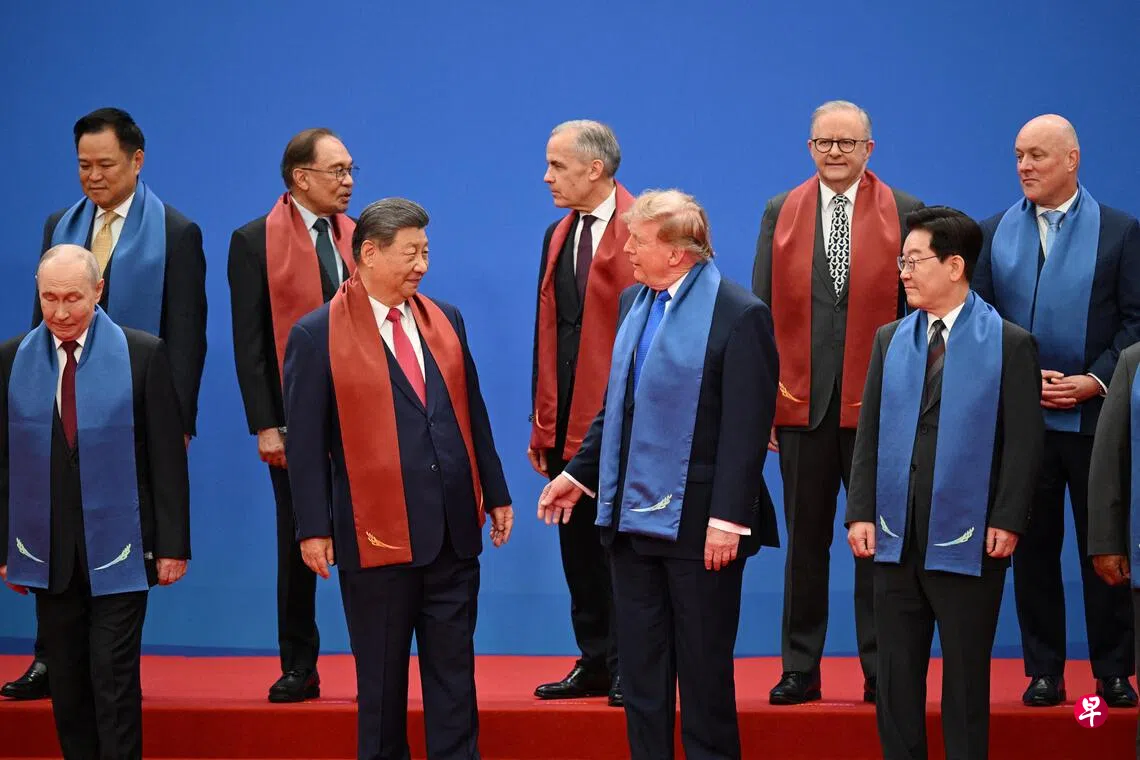
Leaders of Asia-Pacific Economic Cooperation (APEC) economies donned red and blue silk scarves provided by their hosts for a group photograph as the summit opened in Shenzhen, China, on Thursday (19 November). Chinese President Xi Jinping chose red, while US President Donald J. Trump and Russian President Vladimir Putin opted for blue. The scarves also feature 21 silk threads woven into the fabric, symbolising close cooperation among APEC’s 21 member economies.
According to reports by Xinhua and Hong Kong’s South China Morning Post, the scarves, named “Brocade of Unity”, were designed and produced under the direction of Suzhou-based Shangjiukai. They combine four traditional Chinese intangible cultural heritage crafts: Song brocade, xiangyunsha silk, Suzhou embroidery and Cantonese embroidery.
The scarves come in red and blue, with participating leaders choosing their preferred colour. The red version is made primarily from xiangyunsha silk from Shunde in Foshan, Guangdong, while the blue version uses Song brocade weaving techniques from Suzhou.
The design also incorporates symbols of Asia-Pacific cooperation. The APEC emblem on the scarves features 21 interwoven feathers forming a soaring kunpeng, a mythical bird. This echoes Shenzhen’s nickname, “City of the Peng”, while symbolising the interdependence and shared development of the 21 economies.
The design team also wove 21 natural wild silk threads through the scarves, symbolising close cooperation and mutual benefit among the economies. This echoes the theme of this year’s summit, “Building an Asia-Pacific Community to Prosper Together”.
The scarf patterns also combine auspicious cloud motifs from the Han and Tang dynasties, wave motifs from the Song and Yuan dynasties, and floral elements such as kapok and bougainvillea from the Lingnan region. The cloud and wave motifs evoke the history of the ancient Maritime Silk Road and express hopes for peace and prosperity.
The tradition of APEC leaders wearing attire reflecting the host’s culture for their group photograph began at the 1993 summit in Seattle, US. Then US President Bill Clinton provided leather jackets for the leaders to create a relaxed, informal atmosphere. Many subsequent hosts have followed suit.
China also provided distinctive outfits for leaders on the two previous occasions it hosted the APEC summit. The 2001 Shanghai summit featured “new Tang suits”, combining traditional and modern designs, while the 2014 Beijing summit introduced “new Chinese-style attire” made from Song brocade.
In recent years, however, some hosts have increasingly opted for scarves rather than full traditional outfits. The 2024 summit in Lima, Peru, and the 2025 summit in Gyeongju, South Korea, both adopted this approach. This year’s Shenzhen summit continues the more understated arrangement.
