

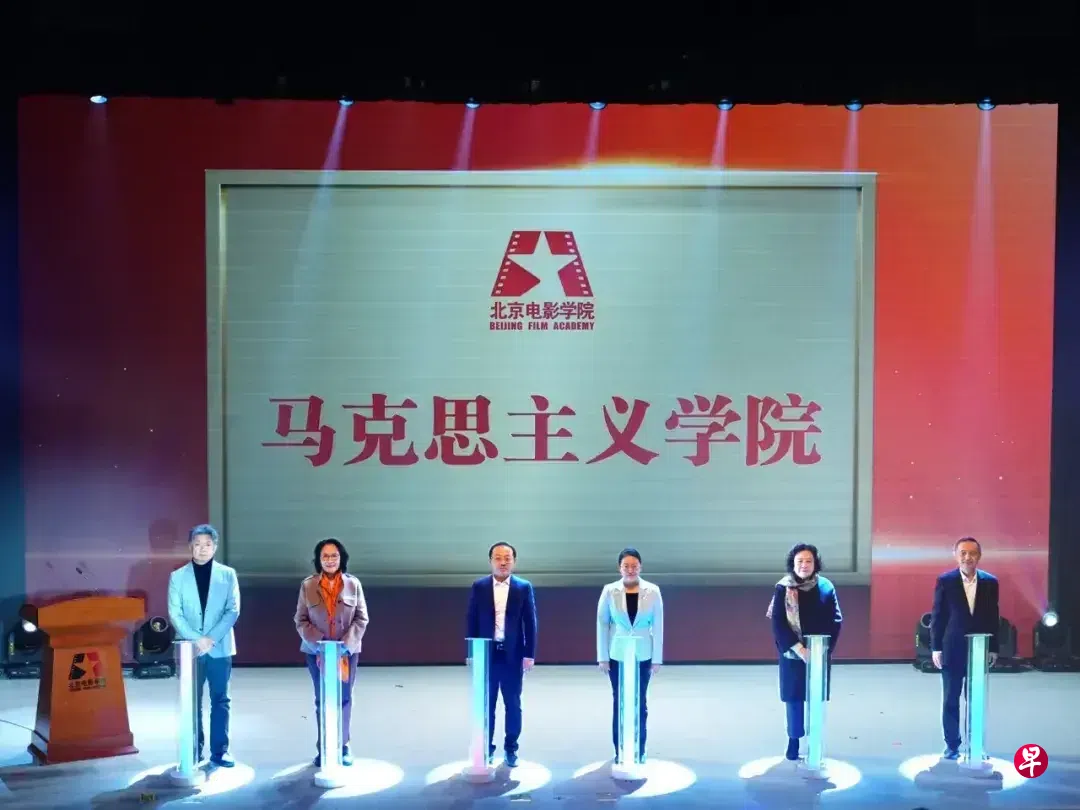
Beijing Film Academy, a prominent Chinese institution, established a School of Marxism this week, stressing the need to “hold the banner of Marxism high in arts education”.
In a post on its official WeChat account, the academy announced that its School of Marxism was formally established on Wednesday (18 November). It said: “From its origins in the Yan’an Film Group, Beijing Film Academy has remained committed to its founding mission of fostering virtue and nurturing talent, educating people for the Party and cultivating talent for the country, and holding the banner of Marxism high in arts education!”
Those attending the inauguration ceremony included Zhang Yulei, deputy secretary of the Education Work Committee of the Communist Party of China’s Beijing Municipal Committee; Xu Xing, a member of the leading Party members’ group and vice-chairman of the Beijing Federation of Social Science Circles, and deputy director of the Beijing Municipal Office for Philosophy and Social Sciences Planning; academy alumni director Xiao Guiyun and actress Song Xiaoying; the academy’s Party secretary Zhang Jian; its deputy Party secretary and president Hu Qiang; and academy leaders Tong Lei, Li Wei, Pan Ruojian and Jiang Xiaohui.
In her speech, Zhang Yulei said the school’s establishment was an important step towards strengthening the Party’s overall leadership, fulfilling the fundamental task of fostering virtue and nurturing talent, and advancing high-quality development. She urged the academy to strengthen the Party’s overall leadership to provide a firm political foundation for the new school; focus on shaping values and educating students to build a leading centre for Marxist theoretical research among arts institutions; and uphold a people-centred approach to creative work to nurture a new generation of artists with both moral integrity and artistic excellence.
At the ceremony, Hu Qiang outlined a work plan for the high-quality development of Beijing Film Academy’s School of Marxism. According to the academy, the plan sets out systematic measures in six areas: maintaining political guidance, highlighting film and television specialisations, strengthening theoretical and practical research, serving society, developing its talent pool, and strengthening the school’s governance. Development will proceed in three stages: “laying solid foundations, improving quality and tackling key challenges, and pursuing excellence”. The aim is to build a distinctive School of Marxism with strong educational standards and develop practices that can serve as a model.
After the inauguration ceremony, Zhu Rongrong, an instructor in ideological and political education at China’s National University of Defense Technology, delivered the School of Marxism’s “first lesson”. Beijing Film Academy said Zhu “drew on the revolutionary deeds of her grandmother, the martyr Zhu Feng, on the clandestine front to discuss the passing down of revolutionary family traditions and the power of conviction. Through authentic historical details and heartfelt storytelling, she delivered a particularly compelling lesson in ideological and political education to the teachers and students present”.
