

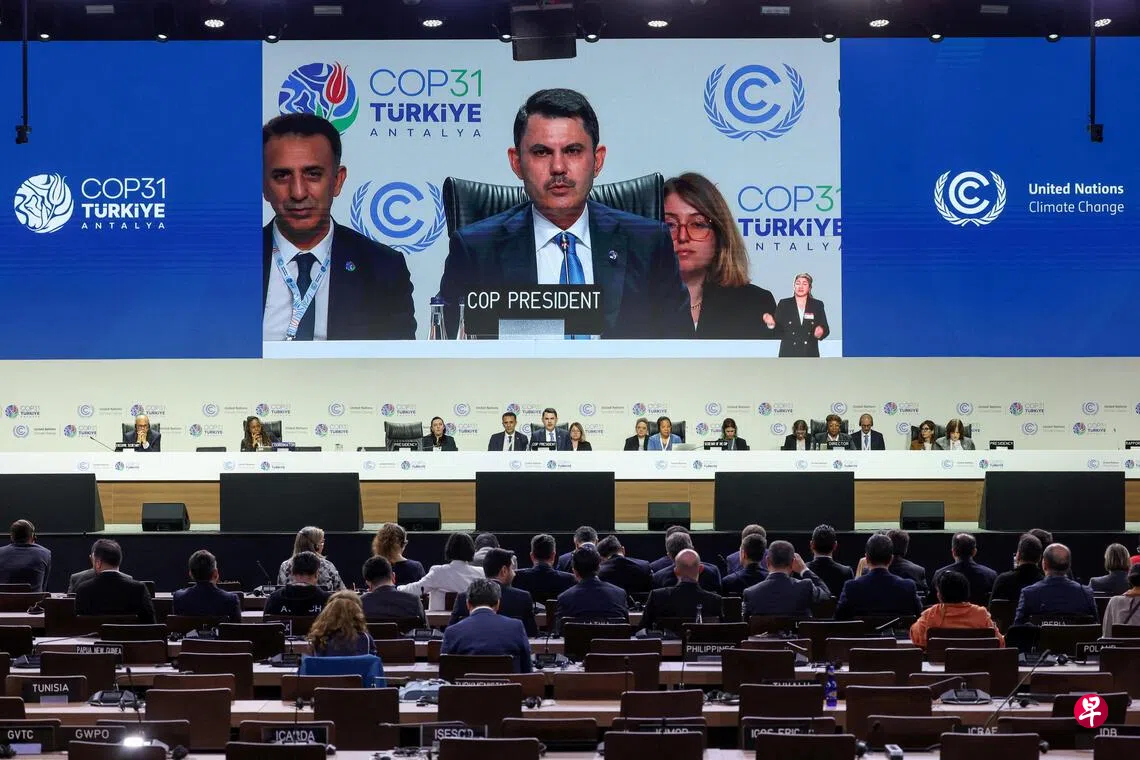
China’s Ministry of Foreign Affairs said it was disappointed that the final draft agreement at the UN climate change conference (COP31) was not adopted because parties failed to reach a consensus, but would not lose faith in the multilateral process.
Responding to a question at a regular press briefing on Monday (23 November), Chinese foreign ministry spokesperson Guo Jiakun said the 31st Conference of the Parties to the UN Framework Convention on Climate Change had concluded on Sunday (22 November) in Antalya, Turkey. The conference adopted a series of decisions on issues including a just transition, mitigation, adaptation and finance, but ultimately failed to reach a consensus on a political decision. “We are disappointed by this, but believe it should not cause us to lose confidence in the multilateral process.”
He said China stressed that tackling climate change was a shared endeavour for humanity and that the global shift towards green, low-carbon development was irreversible. All parties must uphold multilateralism and the principle of common but differentiated responsibilities. On the basis of respect for multilateral rules, science and national circumstances, they must further demonstrate the political will to tackle climate change through solidarity and cooperation, build consensus and advance the implementation of the Paris Agreement.
Guo said that, as a staunch defender of multilateralism, an active participant in international cooperation and a key driver of the green transition, China would continue to take a responsible approach and work with all parties to address challenges, overcome difficulties and advance the global green, low-carbon transition and sustainable development.
Separately, the BBC reported that countries at COP31 in Turkey had failed to reach a major new agreement on tackling climate change amid deep divisions over fossil fuels and finance.
The talks were scheduled to end last Friday (20 November), but continued until Sunday evening as negotiators sought common ground, making it the longest-running climate conference in UN history.
The EU, Pacific island nations and others could not accept the final draft agreement because it made no direct reference to fossil fuels, the main cause of global warming.
Many poorer countries expressed frustration that wealthier nations had made no firm financial commitments to help them adapt to the effects of rising temperatures.
The last major breakdown in UN climate talks was at the Copenhagen climate conference in 2009.
