

The Chinese Communist Party of China (CCP) has set out plans to elect a record 2,360 delegates to its 21st national congress by the end of June next year. The official election notice makes no mention of “further optimising the composition of delegates”. Nor does it raise the required margin by which candidates must outnumber seats, hence retaining the “more than 15%” requirement used for the previous three congresses.
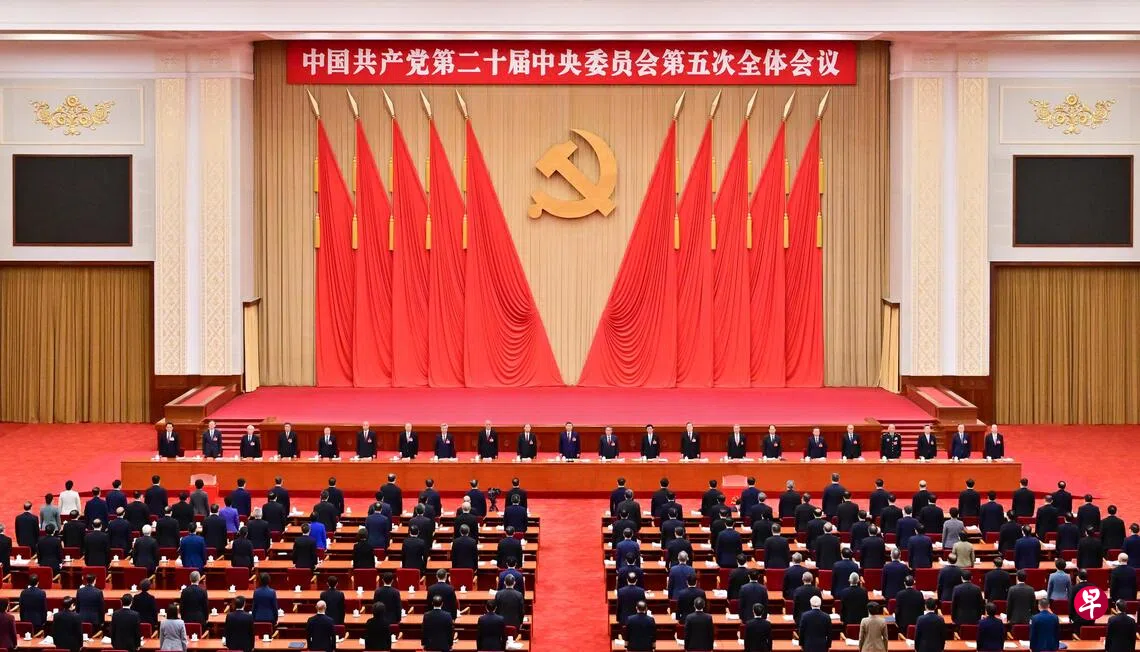
The fifth plenary session of the 20th CCP Central Committee, which concluded on 29 October, decided that the 21st national congress would be held in Beijing in the second half of next year. The launch of delegate elections marks the formal start of the party’s preparations for the congress.
Xinhua reported on Saturday (7 November) that the CCP Central Committee had recently issued a notice on the election of delegates to the party’s 21st national congress. The Central Committee’s Organisation Department also recently held a meeting to make detailed arrangements.
According to the notice, 2,360 delegates will be elected by 38 electoral units across the country. This is 60 more than the 2,300 places allocated for both the 20th congress in 2022 and the 19th congress in 2017, setting a new record.
During the delegate elections for the 20th congress, Chinese state media quoted an official from the Central Committee’s Organisation Department as saying that delegate places were allocated primarily according to the number of party organisations and members, while also taking into account factors such as the number of places at previous congresses.
As of the end of 2025, CCP membership had risen to 101.28 million. Before the 19th and 20th congresses, membership stood at just over 88 million and 95 million respectively.
Leading officials at various levels, particularly those in middle-ranking and senior positions, will form the bulk of the 2,360 delegates. Based on past practice, they are expected to account for two-thirds of the total. Members of the next Central Committee and the new CCP leadership will be drawn from these 2,360 delegates.
The explicit call to “further optimise the composition of delegates” in the elections for the 19th and 20th congresses has been replaced this time with a requirement to “ensure an appropriate composition of delegates”. A longstanding requirement that delegates “include both leading party officials at all levels and party members on the front lines of production and work” has been removed.
However, the notice still calls for “ensuring the proportion of delegates from the front lines of production and work”. It also mentions “workers in new forms of employment” for the first time when listing the groups from which delegates should be drawn.
Official statistics show that China has 84 million workers in new forms of employment, including food delivery riders, couriers and ride-hailing drivers. They account for 21% of the workforce.
Candidates must still outnumber seats by more than 15%
Elections in which candidates outnumber available seats are regarded as an important form of democratic election. However, the required margin for the 21st congress delegate elections has not been increased, remaining at “more than 15%”, as it has since the 18th congress. This indicates that the CCP does not intend to introduce greater electoral choice in selecting delegates to the 21st congress.
For the 16th CCP congress in 2002, candidates were required to outnumber delegate seats by more than 10%. The requirement for the 17th congress in 2007 was at least 15%. Since the 18th congress in 2012, it has been “more than 15%”.
Automatic disqualification for politically unqualified candidates
Political commitment remains the foremost criterion for delegates to the 21st CCP congress. In its notice, the Central Committee called for strict political vetting and closer assessment of candidates’ party commitment, focusing on their political positions, attitudes, awareness, judgement, understanding and ability to implement policy. It stipulated “automatic disqualification for those deemed politically unqualified”.
On “strict checks on candidates’ integrity”, the notice reiterated that candidates with existing misconduct issues must not be nominated or elected. It also added checks on conduct, calling for “particular attention to moral character, conduct and public image”.
Separately, Friday (7 November) was Polling Day for elections to Beijing’s district and township people’s congresses. Chinese President Xi Jinping cast his vote that day at the Huairen Hall polling station in the Zhongnanhai constituency in Beijing’s Xicheng district. The other six members of the CCP Politburo Standing Committee voted in their respective constituencies, while Chinese Vice-President Han Zheng and former CCP general secretary Hu Jintao entrusted staff members to vote on their behalf.
Among them, Wang Huning, chairman of the Chinese People’s Political Consultative Conference (CPPCC) National Committee, voted at the Huairen Hall polling station in the Zhongnanhai constituency rather than the polling station at the CPPCC National Committee’s offices, breaking with a practice of the past 20 years.
