

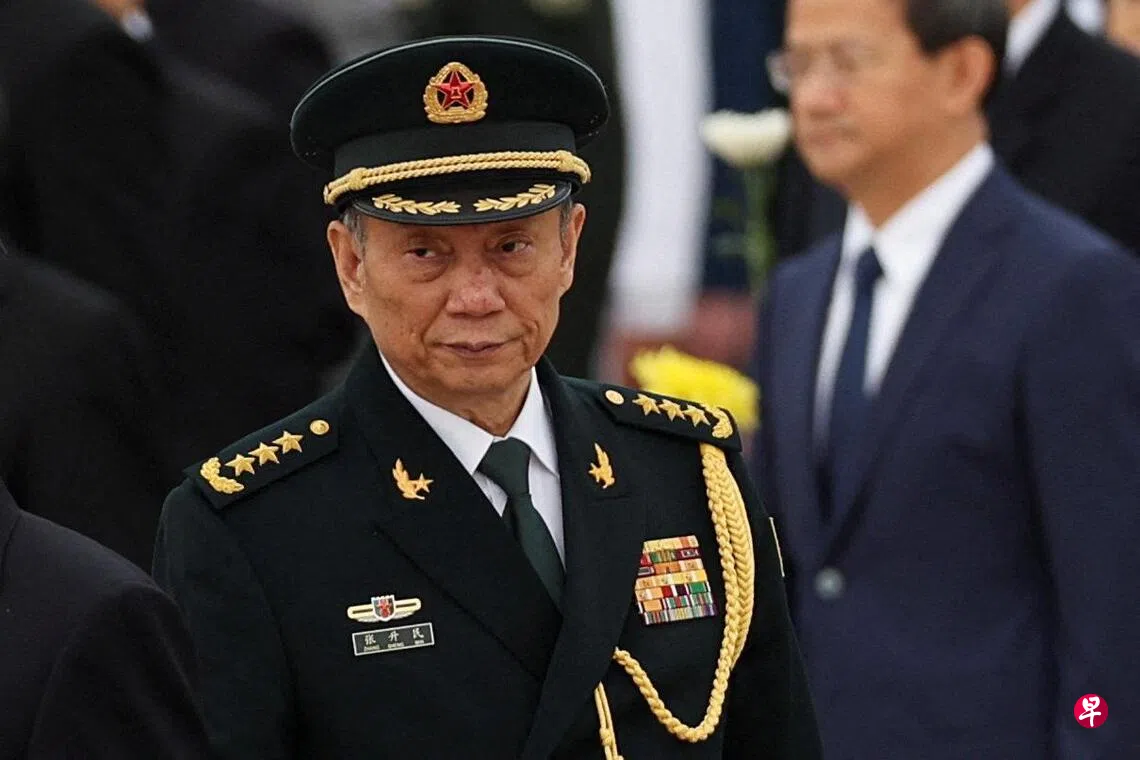
The fifth plenary session of the Chinese Communist Party’s (CCP) 20th Central Committee elected Central Military Commission Vice-Chairman Zhang Shengmin to the Politburo, marking the party’s first mid-term addition to the body in 32 years.
Only 279 of the 376 full and alternate Central Committee members elected at the CCP’s 20th National Congress in 2022 attended the fifth plenum. The attendance rate fell to 74.2%, its lowest since the end of the Mao Zedong era, underscoring the unprecedented intensity of the party’s anti-corruption drive across the party, government and military over the past five years.
The four-day fifth plenum concluded in Beijing on Thursday (29 October). According to a communique issued by state news outlet Xinhua, the plenum confirmed the Politburo’s earlier decisions to expel 33 people, including Ma Xingrui, Zhang Youxia and Liu Zhenli, from the party. They comprised 24 full Central Committee members and nine alternate members. Alternate member Li Yunze was also stripped of his party posts, while 10 alternate members, including Lu Dongliang and Liu Jie, were elevated to full membership.
Zhang Shengmin was promoted to vice-chairman of the Central Military Commission at the party’s fourth plenum in October last year, but did not enter the Politburo then. His election this time gives him both posts, restoring the practice of military commission vice-chairmen also serving on the Politburo.
The CCP last elected a Politburo member mid-term in September 1994, when the fourth plenum of the 14th Central Committee elected then Shanghai Mayor Huang Ju. He subsequently became Shanghai party secretary.
Tzeng Wei-feng, an associate research fellow at the Institute of International Relations at Taiwan’s National Chengchi University, told Lianhe Zaobao (LHZB) that Zhang’s election could mean that “his work has won the approval of [CCP General Secretary] Xi Jinping”.
Tzeng said Zhang’s role on the military commission was akin to that of “Xi Jinping’s secretary”, primarily helping to advance the military’s internal overhaul. Although his higher standing within the party did not necessarily mean greater military command authority, “at the very least, he will be able to accurately convey the requirements of Politburo meetings within the military in future”.
The Politburo now has 22 members, still two fewer than the 24-member body formed after the 20th Party Congress. Chen Xiaojiang, who became party secretary of the Xinjiang Uighur Autonomous Region last year, was not elected to the Politburo at this plenum.
Shengyu Wang, a research assistant at the Center for China Analysis of the US think tank Asia Society Policy Institute, said in an interview: “He may still need to prove himself politically before formally joining the Politburo at next year’s 21st Party Congress.”
Using the original 205 full and 171 alternate Central Committee members elected at the 20th Party Congress — a total of 376 — as the baseline, attendance stood at 364, or 96.8%, at the third plenum in 2024. It fell to 315, or 83.8%, at last year’s fourth plenum, and declined further to 279, or 74.2%, at this year’s fifth plenum. The vast majority of the absent full and alternate members have fallen from power over the past few years.
Hung Yao-nan, deputy director of the Cross-Strait Relations Research Centre at Taiwan’s Tamkang University, said in an interview that attendance of 279 was still well above half the membership, posing no issue to the plenum’s statutory operations.
He said the real impact of the anti-corruption campaign was evident in the posts affected. “Ministries, provinces and military units have large numbers of acting or newly appointed leaders, making decision-making more dependent on top-down instructions. The Central Committee’s deliberative role has weakened further; it mainly ratifies [appointments and removals].”
The fifth plenum also adopted the Decision of the CCP Central Committee on Several Major Issues Concerning Persistently Advancing Full and Rigorous Party Self-Governance. Xi delivered a work report on behalf of the Politburo and explained the draft decision.
According to the communique, the fifth plenum spoke highly of the achievements in exercising full and rigorous party self-governance in the Xi Jinping era. It said the CCP Central Committee with Xi at its core had shown “great political courage and a strong sense of responsibility” in confronting what had once been “the grave reality of weakened, hollowed-out and diluted party leadership; a lack of rigour, substance and effectiveness in party governance; and shocking problems within the party”.
On the results of the anti-corruption drive and efforts to improve conduct within the party, the communique said that by “turning the blade inward and using tough measures to tackle disorder”, the party had fundamentally reversed a “lax, loose and weak” approach to self-governance. It had curbed unhealthy practices that had long gone unchecked, tackled persistent problems that had remained unresolved for years, and “eliminated serious hidden dangers within the party, the state and the military”.
The communique also included “Xi Jinping Thought on Party Building”, describing it as “an important component of Xi Jinping Thought on Socialism with Chinese Characteristics for a New Era” that provides “fundamental guidance and a guide to action” for strengthening the CCP.
The meeting also set out plans for sustained efforts to exercise full and rigorous party self-governance. It called for stronger education in loyalty to the party, upholding and strengthening the centralised, unified leadership of the CCP Central Committee, and regulating how top leaders perform their duties and exercise power. It also called for maintaining intense pressure against corruption, strengthening checks and oversight on the exercise of power, and holding those responsible for poor party governance or serious problems strictly to account.
The plenum also decided that the CCP’s 21st National Congress would be held in Beijing in the second half of next year. It urged the leadership transition to be accompanied by training for newly appointed leadership team members, especially top leaders, on how to approach their performance in office. The meeting also called for making full use of macroeconomic policies and tapping the potential of domestic demand to ensure that this year’s main economic and social development targets and tasks are met.
