

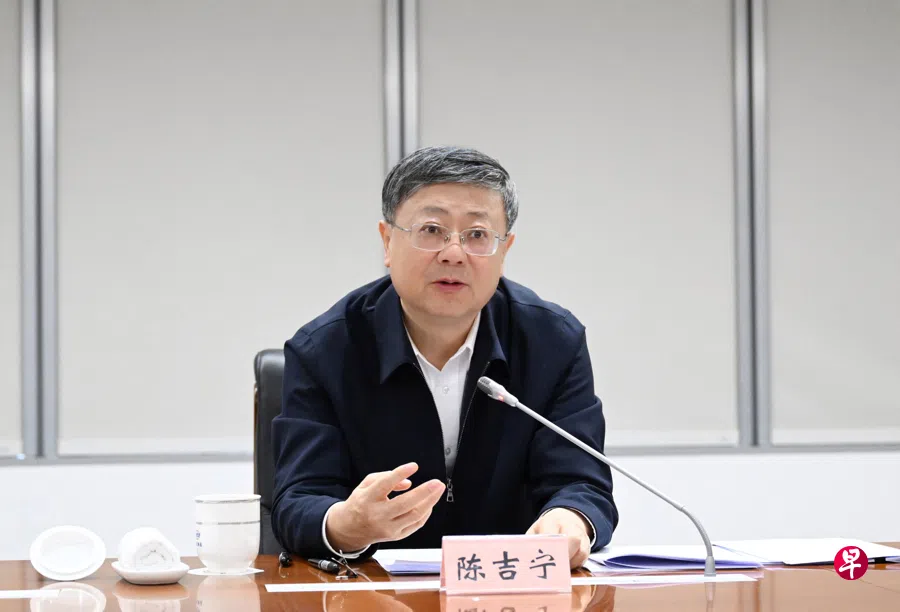
China’s top leadership has been hit by another major upheaval. Authorities announced on Tuesday (24 November) that Chen Jining, a member of the Chinese Communist Party’s Politburo and Shanghai party secretary, was under disciplinary review and investigation for “suspected serious violations of discipline and the law”. He is the fourth serving Politburo member to fall in roughly the past year, and the second Shanghai party secretary in 20 years to be investigated while in office, after Chen Liangyu in 2006.
Three other members of the current CCP Politburo had already fallen: Central Military Commission vice-chairmen Zhang Youxia and He Weidong, and Ma Xingrui, the former party secretary of the Xinjiang Uighur Autonomous Region.
Academics interviewed said investigations into four members of the same Politburo were highly unusual in China’s reform and opening-up era. By political convention, the Shanghai party secretary has a very high chance of joining the Politburo Standing Committee in the next term. Chen’s downfall not only points to possible gaps in the cadre assessment system, but also means the choice of his successor will have implications for personnel arrangements at the CCP’s 21st national congress.
The standing committee of the CCP’s Shanghai municipal committee held an expanded meeting the same day, declaring its firm support for the central leadership’s decision. It stressed the need to remain absolutely loyal to the party, uphold the authority and centralised, unified leadership of the party’s Central Committee, strictly observe political discipline and rules, and take an unequivocal stand against corruption. Caixin reported that Chen’s last public appearance was on 19 November, during a visit to China COSCO Shipping Corporation.
Chen, 62, earned his undergraduate degree at Tsinghua University and holds a doctorate from Imperial College London. He became president of Tsinghua in 2012, minister of environmental protection in 2015 and acting mayor of Beijing in 2017, before being confirmed as mayor the following year. He joined the Politburo and took charge of Shanghai in October 2022.
His career record shows that he worked at Tsinghua for more than two years alongside Chen Xi, the former head of the CCP’s Organisation Department. All his key career advances came during Chen Xi’s tenure at the department’s helm. As Beijing mayor, he also worked alongside then city party secretary Cai Qi for nearly five years.
Kou Chien-wen, a distinguished professor at the Graduate Institute of East Asian Studies at Taiwan’s National Chengchi University, told Lianhe Zaobao that the case’s repercussions would depend on its nature. If it involved only personal financial misconduct or ordinary disciplinary breaches, the impact would be limited. But if it involved political loyalty, the channelling of benefits or cadre appointments, it could affect the “Tsinghua faction” and its personnel network.
Kou Chien-wen outlined three possible scenarios for Chen’s replacement. The first was a lateral transfer of a party chief from a major province. The second was the promotion of Shanghai Mayor Zhu Zhongming, 54, which would bring forward the rise of the CCP’s “seventh generation” of cadres — those born between 1967 and 1975. The third was the transfer of a serving deputy state-level leader, or the appointment of one to hold the Shanghai post concurrently. This would resemble the appointment of Deputy Prime Minister Zhang Dejiang as concurrent Chongqing party secretary after Bo Xilai’s downfall in 2012, and would minimise knock-on personnel changes at the local level.
Hung Yao-nan, deputy director of the Centre for Cross-Strait Relations Studies at Taiwan’s Tamkang University, said there had been three main models of succession following the downfall of party chiefs in China’s directly administered municipalities over the past 20 years. After the Chen Liangyu case in Shanghai in 2006, Mayor Han Zheng took over in an acting capacity before then Zhejiang party secretary Xi Jinping succeeded him. After the Bo Xilai case in Chongqing in 2012, then Deputy Prime Minister Zhang Dejiang took on the role concurrently. Following the Sun Zhengcai case in Chongqing in 2017, then Guizhou party secretary Chen Min’er succeeded him and subsequently joined the Politburo at the 19th party congress.
With only about a year to go before the CCP’s 21st national congress, Hung assessed that the most likely route to appointing Shanghai’s new party chief was the “Chen Min’er model”: transferring a major province’s party chief who enjoys the trust of the CCP leader to take charge of Shanghai, paving the way for entry into the Politburo at the congress. The next most likely option was the “Zhang Dejiang model”, with a serving Politburo member or central leader transferred laterally or appointed to hold the post concurrently to restore stability quickly. Zhu, who was only brought into Shanghai in 2024, was less likely to be promoted directly to city party secretary and enter the Politburo.
Hung said Chen’s downfall meant the selection of the Politburo at the 21st party congress would be more about “filling vacancies” than strategic planning. “The vacancies are being filled with reliable people, not successors.”
