

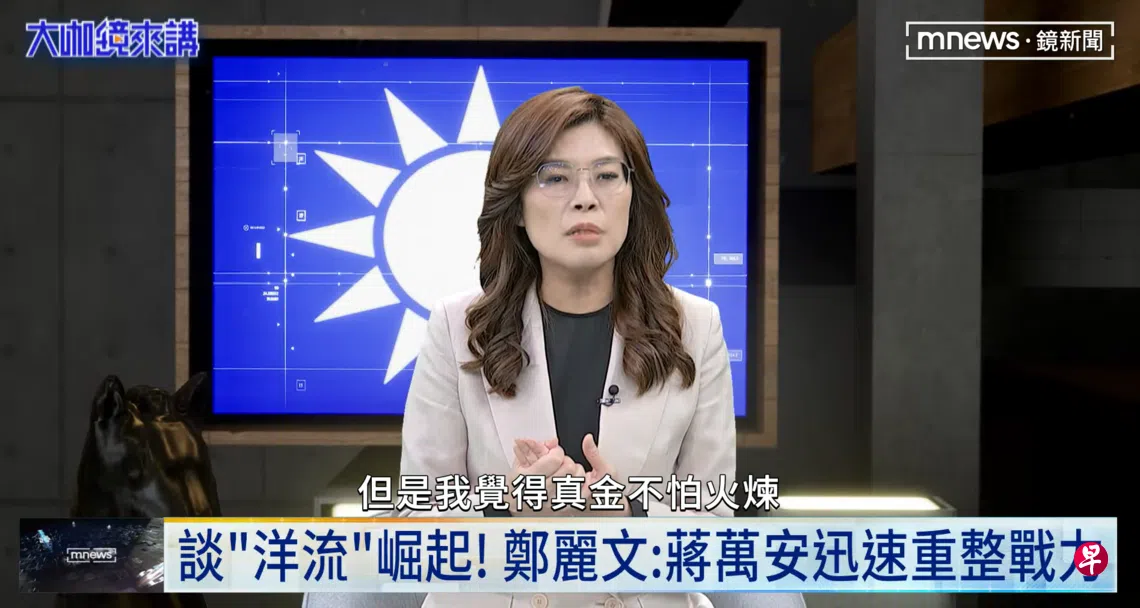
With Taiwan’s local elections entering the final stretch, Kuomintang (KMT) chairwoman Cheng Li-wun said she was cautiously optimistic about the party’s overall prospects and expected it to weather the challenges. She acknowledged that some races in the four special municipalities governed by the KMT were tight, but believed the party could retain all four if its supporters turned out in force.
She also acknowledged that the “Shen wave” generated by Democratic Progressive Party (DPP) Taipei mayoral candidate Puma Shen posed a challenge to incumbent mayor Chiang Wan-an’s re-election bid.
According to Taiwan’s United Daily News (《联合报》) and ETtoday, Cheng expressed cautious optimism about the KMT’s prospects in the nine-in-one local elections on 28 November during an interview on Mirror News’ In Conversation with the Big Names (《大咖镜来讲》) on Tuesday (10 November) evening. She said the party’s overall position was stable and it should ultimately weather the challenges.
Asked about closely contested races in New Taipei City and Hsinchu, Changhua and Yilan counties, Cheng said the party’s position in Hsinchu County had gradually stabilised following controversy over its primary. The contest remained a showdown between the pan-blue and pan-green camps.
As for New Taipei City, Cheng acknowledged that DPP candidate Su Chiao-hui was a formidable opponent, benefiting both from her family’s longstanding grassroots work and from an astute campaign strategy.
Turning to the Taipei mayoral race, Cheng acknowledged that the “Shen wave” had energised the DPP’s core supporters and young voters, giving Chiang’s team a sense of urgency after it had initially hoped to keep the contest low-key.
However, she said Chiang’s camp had regrouped, with Taichung Mayor Lu Shiow-yen serving as campaign chairwoman and KMT legislator Lo Chih-chiang as campaign director, and had “regained some ground” in a recent televised debate.
Cheng said Chiang still had a strong personal brand, and voters would also weigh his performance in office over the past four years. As his campaign team found its footing, she believed his electoral prospects would steadily improve.
In Changhua County, incumbent county magistrate Wang Huei-mei had earlier refrained from appearing at campaign events for KMT candidate Wei Pingzheng, raising concerns about unity within the pan-blue camp. Cheng said Wang had shared a stage with the candidate in October and the party organisation remained in contact with her. “I think Wang Huei-mei is very likely to make further campaign appearances,” she said.
Cheng also said she was relatively reassured by the party’s prospects in counties such as Nantou and Miaoli, allowing it to devote more resources to tightly contested constituencies. The KMT hoped to maintain its results from the previous local elections while seeking breakthroughs in southern counties and cities long governed by the DPP. It was also confident of winning Kinmen, Matsu and Penghu.
Amid questions over whether the KMT’s electoral performance would affect her position as party chairwoman, Cheng stressed that the chairperson played only a supporting role in local elections, with the primary task being to give candidates full campaign support. She said she would “not set a minimum benchmark” for herself.
She also urged party members not to become pessimistic prematurely, much less start looking for scapegoats before the elections were over. She stressed that the KMT must not allow a defeatist mood to take hold and must not concede defeat before the very end.
