

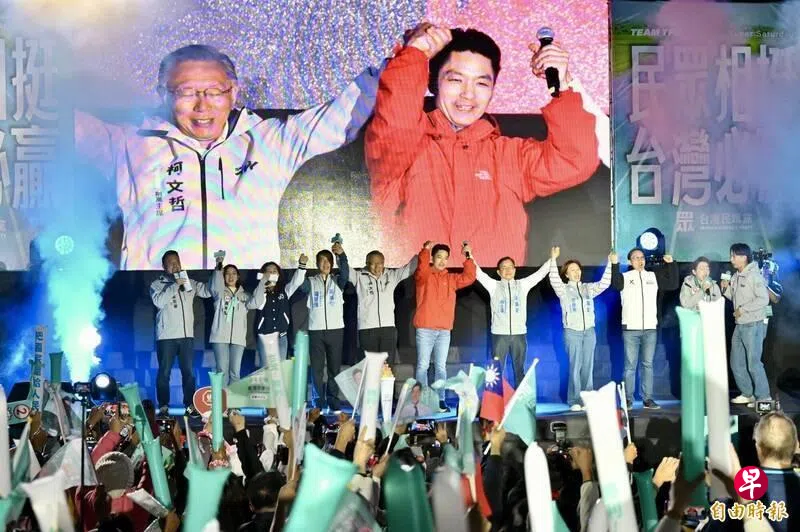
(Taipei) With Taiwan’s nine-in-one local elections entering their final week, incumbent Taipei Mayor Chiang Wan-an of the Kuomintang (KMT) appeared on stage with Taiwan People’s Party (TPP) founding chairman Ko Wen-je in a bid to win over TPP supporters. His challenger, Democratic Progressive Party (DPP) candidate Shen Pao-yang, held a large street carnival to sustain the momentum of his “Yang wave”.
The Taipei mayoral race is exceptionally fierce in this round of nine-in-one elections. Analysts say the joint appearance by Chiang and Ko puts the final piece in place for cooperation between the KMT and TPP in Taipei, giving Chiang reassurance ahead of the decisive contest. Conversely, if even Chiang, the KMT mayor who initially enjoyed the highest public support, loses, it would deal a severe blow to the KMT camp and affect the outlook for the 2028 presidential election.
The TPP, known as the “white force”, held a rally under the slogan “With the people’s support, Taiwan will win” at the plaza in front of Taipei City Hall on Saturday (21 November) evening. Ko and party chairman Huang Kuo-chang entered carrying electronic torches as supporters waved flags and chanted “Go all out, without hesitation”. Organisers said about 30,000 people attended. Observers in Taiwan had been watching to see whether Ko would appear alongside Chiang at the last moment and mobilise the TPP’s supporters, known as “Little Grass”, to back him.
Chiang attended the rally at the party’s invitation. In his speech, he thanked Ko for laying the groundwork during his eight years as Taipei mayor. He also voiced support for Ko, who is embroiled in legal cases, saying the judiciary should not become a tool for “political persecution”, and called for unity among opposition parties.
Ko said the “Yang wave” generated by Shen was merely an illusion, telling Chiang that he would win if he stayed steady and methodical. He also joked that he would give Chiang a copy of the Diamond Sutra (《金刚经》) to help him see through the “Yang wave”. The pair clasped hands and chanted slogans, bringing the rally to a climax.
Niu Tse-hsun, a professor in the Department of Advertising at Taiwan’s Chinese Culture University, told Storm Media that Chiang had adopted a strategy of “respecting Ko and befriending Huang”, referring to TPP chairman Huang Kuo-chang. Chiang had acknowledged Ko’s achievements in office, backed him over his legal cases and mentioned former deputy mayor Vivian Huang’s policy white paper, extending goodwill to the TPP camp. Although Ko did not chant “Get elected”, his appearance alongside Chiang had already signalled his support. With that, the final piece of KMT-TPP cooperation in Taipei had fallen into place, giving Chiang reassurance ahead of the decisive contest and putting his campaign strategy on a firmer footing.
However, while campaigning in Hualien on Sunday (22 November), Ko stressed that the TPP retained its own identity. While the two parties could cooperate in county magistrate and mayoral elections, they were still competing against each other in council elections, so “KMT-TPP cooperation” was not an accurate description.
Shen, meanwhile, was also seeking to win over TPP voters in the final stretch. At a policy presentation on Saturday, he displayed three books signed by Vivian Huang, including the policy white paper from her 2022 election campaign. He stressed that good policies should be continued and pledged that, if elected, he would appoint people on merit, regardless of whether they belonged to the KMT, DPP or TPP camps.
In a subsequent post, however, Huang did not explicitly endorse Shen, saying only that “policies have no party colours”.
On Sunday afternoon, Shen also held an event called “Citizens on the Move: City Action Exhibition”. Six themed stages were set up along Fuxing South Road, Zhongxiao East Road and Beiping East Road in Taipei, with music, dance and interactive activities creating a street carnival atmosphere.
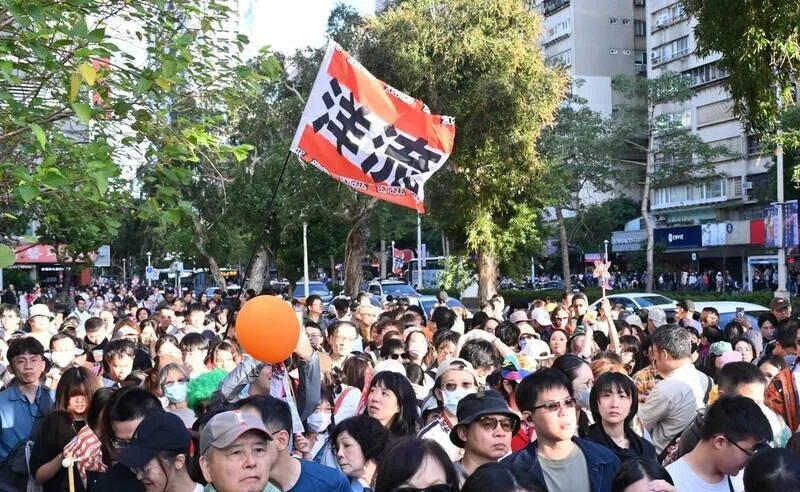
The event drew large numbers of supporters, known as “Little Water Droplets”, with crowds spilling off pavements on some stretches. “Yang wave” streamers proved popular, with supplies at several stages exhausted by early evening. Shen said that evening that more than 100,000 people had attended, exceeding expectations.
Meanwhile, as the election countdown continued, controversy over solar panels at Feitsui Reservoir became a public welfare issue on which the KMT camp sought to regain the initiative. Located in New Taipei City but managed by the Taipei City Government, the reservoir is crucial to the safety of drinking water for about six million residents in Greater Taipei. The dispute has therefore become an issue in both cities’ election campaigns.
The controversy stems from letters sent by the Water Resources Agency under Taiwan’s Ministry of Economic Affairs in each of the three years from 2022 to 2024, surveying the potential for additional solar power installations. At a press conference on 19 November, Chiang and KMT New Taipei mayoral candidate Li Ssu-chuan opposed the installation of solar panels at Feitsui Reservoir. They warned that such a move could jeopardise drinking water safety in Greater Taipei and demanded that the DPP’s candidates in both cities state their positions. Chiang also produced official documents, questioning why the central government had continued its surveys after the local government rejected the proposal.
The issue has clearly resonated with voters. The Water Resources Agency clarified that the letters were merely intended to assess the potential for solar power installations at reservoirs across Taiwan, not to require Feitsui Reservoir to install solar panels. Shen accused the KMT camp of manufacturing a controversy. DPP New Taipei mayoral candidate Su Chiao-hui also said the central government had no installation plans at all, accusing the KMT camp of exploiting the issue.
Niu said Chiang and Li were jointly highlighting the reservoir issue to counter the pressure from the “Yang wave”, redirect criticism towards the DPP central government and force the DPP camp to respond. He said the call to “say no to drinking water from reservoirs with solar panels” was easy to understand, while cooperation between Taipei and New Taipei could broaden the issue’s impact and give their campaigns greater confidence in the days ahead.
