

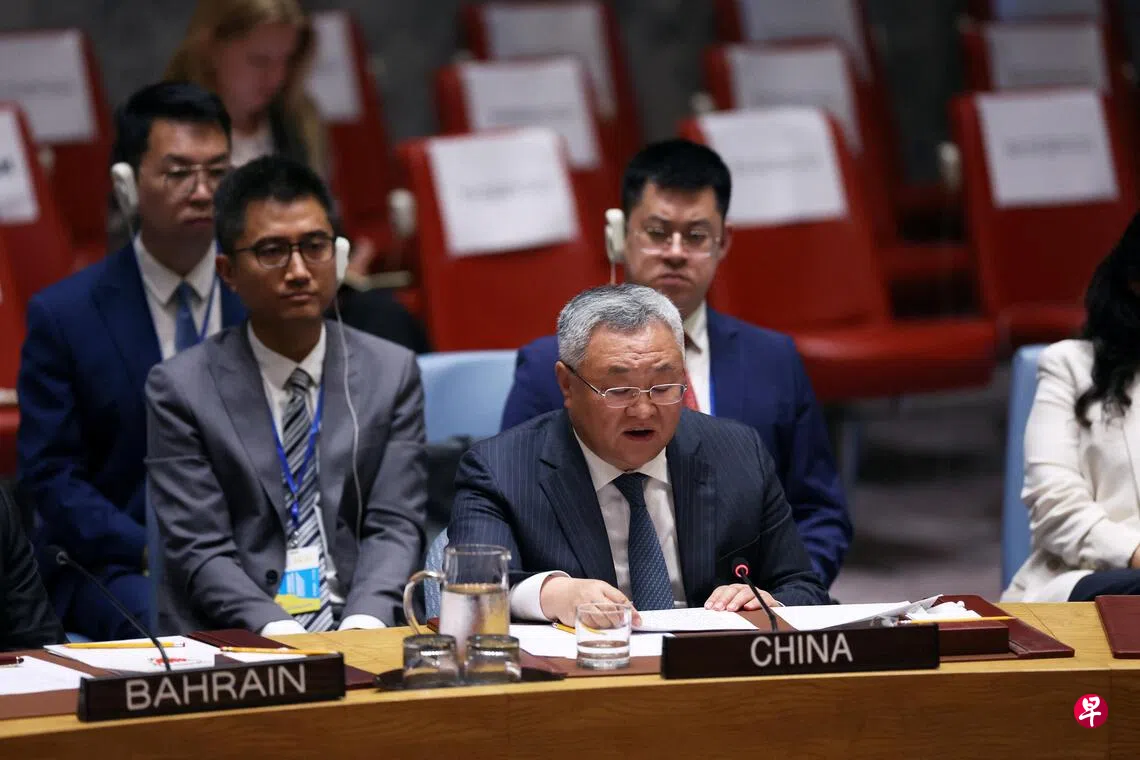
China advocates exercising navigation rights granted under international law in good faith and supports countries resolving waterway disputes through dialogue and consultation on an equal footing, Fu Cong, China’s permanent representative to the UN, said on Friday (13 November). Speaking at a UN Security Council open meeting on the situation in the Middle East and the Gulf, he said China opposed politicising, militarising or using key waterways as tools.
According to the website of China’s permanent mission to the UN, Fu Cong said the situation in the Middle East and the Gulf was undergoing profound changes, with conflicts dragging on at multiple levels and their spillover effects continuing to undermine regional security and development. The international community should remain committed to peace, strengthen solidarity and cooperation, and jointly seek integrated, comprehensive and effective solutions, he said.
Fu said the war involving the US, Israel and Iran must not be allowed to drag on. All parties to the conflict should act responsibly towards their people and history, meet each other halfway and achieve a comprehensive ceasefire as soon as possible, rather than take up arms again. The relevant parties in Yemen should exercise restraint and avoid actions that could escalate regional tensions.
He also said China appreciated the persistent mediation efforts of Qatar, Pakistan and other countries, and encouraged the US and Iran to remain committed to peace, return to the Islamabad memorandum of understanding, resume dialogue and negotiations as soon as possible, and reach a comprehensive agreement. All parties in Yemen should resolve their differences and disputes through dialogue and consultation, and restart the political process for resolving the Yemen issue at an early date.
Fu said the Middle East and the Gulf should not become an arena for major-power rivalry and geopolitical conflict. China hoped to contribute ideas and proposals to help resolve the region’s security dilemma, he said. It supported regional countries in deepening understanding, rebuilding mutual trust, improving relations and coexisting peacefully, while working towards a new regional security architecture that serves the long-term interests of their peoples and building a shared home characterised by good-neighbourliness, development, security and cooperation.
He concluded by stressing that China remained committed to ending hostilities and promoting peace, and advocated resolving disputes through political and diplomatic means. China was willing to communicate and coordinate with all parties in the region and play a constructive role in helping it emerge from the shadow of war as soon as possible and achieve lasting peace and stability.
