

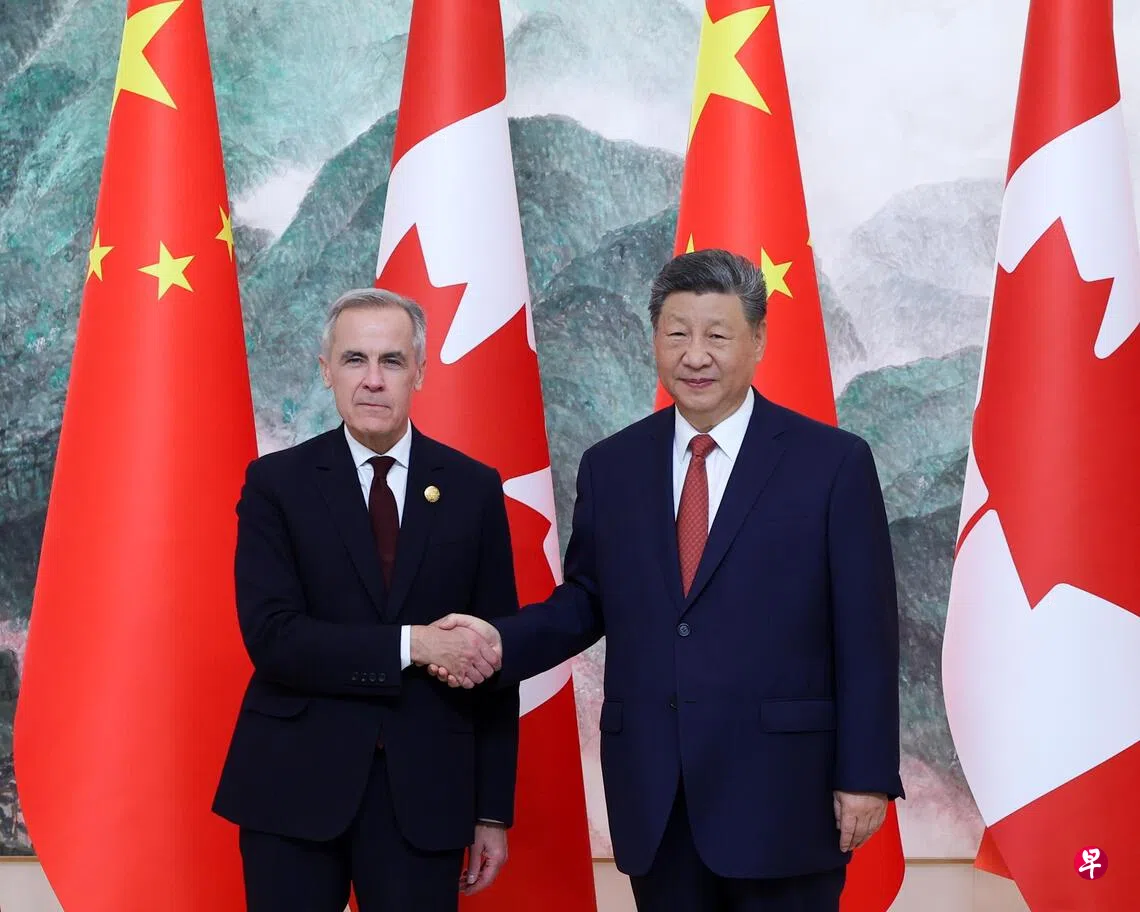
The leaders of China and Canada have agreed to expand mutual tariff relief on agricultural and steel products. Academics interviewed said Canadian Prime Minister Mark Carney was diversifying risks to build resilience as he sought to further reduce dependence on the US under pressure from the Donald J. Trump administration. China-Canada relations have consequently entered a period of steady recovery.
Chinese President Xi Jinping met Carney in Shenzhen on Tuesday (17 November) morning. The Canadian leader was in China for the Asia-Pacific Economic Cooperation (APEC) Economic Leaders’ Meeting. It was their third meeting in a year and their second in China this year.
After first meeting Xi in Gyeongju, South Korea, last October, Carney made a four-day visit to China early this year, becoming the first Canadian prime minister to visit in nearly a decade. In Beijing, he not only opened the Canadian market to Chinese electric vehicles but also agreed to pursue a “new strategic partnership” with Beijing, signalling a clear diplomatic shift.
China, in turn, agreed to remove additional tariffs on major Canadian agricultural products, including canola meal, crabs and lobsters.
Under the agreement announced on Tuesday, China will further expand tariff relief for Canadian agricultural products to cover frozen pork cuts, fish and seafood worth a total of C$400 million (S$360 million) annually. In exchange, Canada will extend tariff exemptions to some Chinese steel and aluminium products. Both sides agreed to keep these measures in place until at least the end of 2028.
Dylan Loh, an associate professor of public policy and global affairs at Singapore’s Nanyang Technological University, told Lianhe Zaobao that the agreement reflected pragmatism on both sides, “showing that both are willing to restore relations and make them more stable than before”.
Dylan Loh noted that China and Canada still had significant differences over human rights, while Canada also had national security concerns about China. Against this backdrop, reaching a further agreement was no easy task. “This requires genuine political will, particularly on Carney’s part.”
Chen Bo, a senior research fellow at the National University of Singapore’s East Asian Institute, said in an interview that Chinese aluminium and steel faced anti-dumping measures from most Western countries. “Such a move by Canada is, at the very least, a significant gesture of goodwill.” Beijing’s additional tariff relief for Canadian agricultural products was a symbolic gesture showing that “the two countries are gradually reducing bilateral trade barriers and doing more to tap the potential of their economic and trade ties”.
After Ottawa imposed steep tariffs on Chinese electric vehicles and steel in 2024, Beijing retaliated the following year with measures targeting Canadian pork and other agricultural products. Bloomberg quoted Kyle Larkin, president of the industry association Canadian Meat Council, as telling reporters in China that Tuesday’s agreement had greatly eased the difficulties facing Canadian pork producers. “There’s still some more work to do, but we’re confident with the momentum that we’ve had here,” Larkin said.
According to a statement from the Canadian Prime Minister’s Office, Ottawa has so far restored market access for more than 90% of trade previously affected by tariffs, representing nearly C$7.5 billion in Canadian exports.
At Tuesday’s meeting, Carney hailed the “greater predictability and stability” in Canada-China relations and said Canada was well ahead of schedule in its goal of boosting exports to China by 50% by the end of 2030.
Xinhua reported that Xi said at the meeting that improving and developing China-Canada relations was the right choice, and outlined four points for advancing bilateral ties. He urged both sides to build on the momentum by strengthening political trust and using constructive dialogue and communication to deepen their understanding of each other’s development paths and policy intentions; further deepening traditional cooperation in trade, energy, agriculture and finance while expanding cooperation in emerging areas such as the green economy, e-commerce and the digital economy; deepening people-to-people exchanges; and upholding the authority of the UN and the multilateral trading system.
After the meeting, the Chinese and Canadian leaders also announced other measures to improve bilateral ties, including a large Canadian business delegation’s visit to China next year and the launch of new direct flights between Vancouver and Guangzhou.
However, Tuesday’s agreement made no major changes to the automotive deal China and Canada reached in January.
Chen Bo said it would be difficult for Canada to make further major concessions to China at present, as Carney’s established foreign policy was to diversify risks, with closer ties to Europe the most important goal. With many disputes remaining in China-Europe economic and trade relations, Canada “may find it difficult, while discussing cooperation with the EU, to make too many policy concessions to China that diverge from the EU’s approach”. He added: “Especially since Canada’s policies on Chinese new-energy vehicles, steel and aluminium products have already gone further than the EU’s, it may prefer to stay in step with Europe in other areas”.
Loh said there was still room for China-Canada relations to improve further. “But given Canada’s special relationship with the US, its NATO membership and its special ties with Europe, there will always be a clear ceiling on the development of its relations with China”.
