

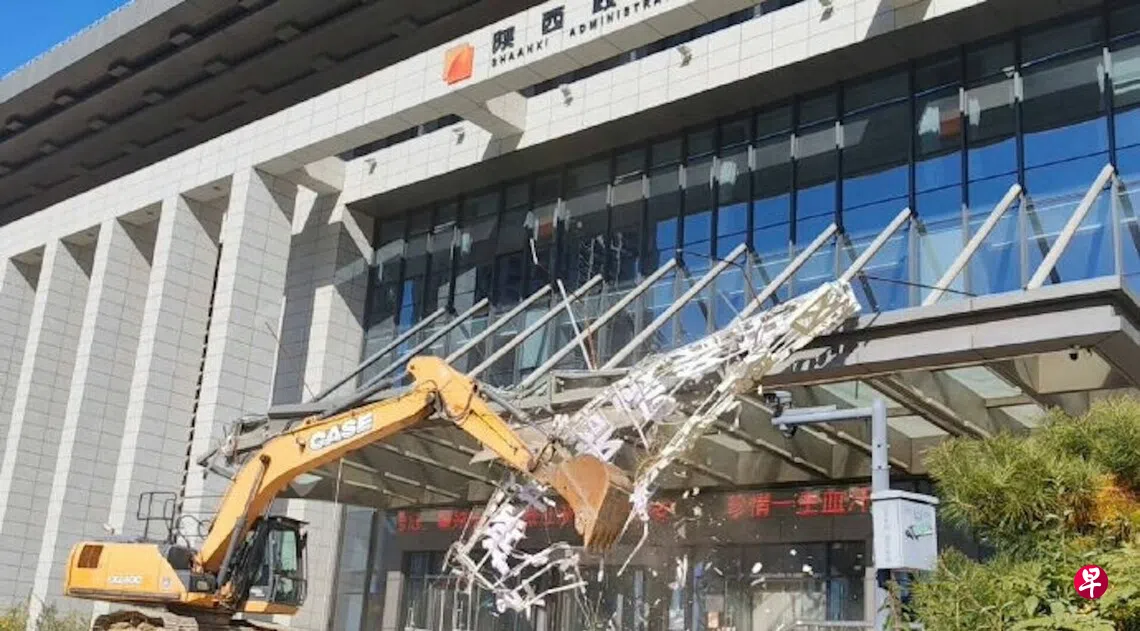
Government service centres across China are meant to be places where people get administrative matters sorted out. Yet one man drove an excavator to a centre and left its entrance sign, steps and exterior walls in ruins.
In a statement on Monday (9 November), the Xixian New Area Public Security Bureau in Xi’an said a 47-year-old man surnamed Hu had used construction machinery to damage buildings at a government service centre in the area at 11am that day.
Police responded and detained him. No one was injured. The centre resumed normal operations that afternoon, and the man has been placed under criminal compulsory measures.
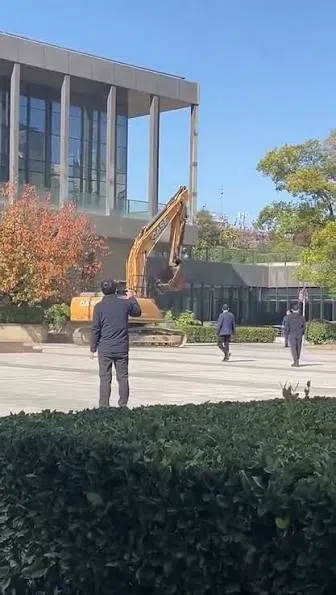
Images and videos circulating online show damaged steps and an excavator outside the centre’s main entrance. With its arm raised, the machine tore off a large section of the sign above the entrance with its bucket.
According to Jimu News, the incident took place at the Fengdong New City Government Service Centre in Xixian New Area. Steps in the square outside Building 1 were damaged, parts of the entrance sign lay on the ground, and glass doors were shattered.
Several sections of the façades or structural components at the rear of the building and on other buildings were also damaged.
The police statement did not mention the man’s motive. However, Zhijian News quoted a staff member of the Fengdong administrative committee as saying that the man responsible for the destruction was an individual dissatisfied with the compensation offered for the demolition of a livestock farm.
After the incident, some Chinese internet users initially speculated that the man might have driven the excavator there to vent his anger over unpaid government construction bills. Others pointed to demolition compensation disputes.
There is currently no evidence that the incident involved unpaid construction bills, and the details of the dispute over compensation for the farm’s demolition remain unclear.
However, such speculation does suggest that government arrears, demolition compensation disputes and difficulties seeking redress have become the first things some internet users think of when trying to understand such incidents.
Disputes with local governments over demolition compensation have in fact occurred elsewhere in China.
In June this year, a pig-farming company in Chengdu’s Tianfu New Area in Sichuan disagreed with the local government over the scope and amount of compensation for a farm facing demolition to make way for railway construction.
A ranch in Qinghai also took its local government to court over relocation compensation. Although the court ordered the government to pay compensation, payment remained outstanding.
According to an announcement issued by the ranch in January this year, the two sides eventually reached a settlement on enforcement, taking into account the local government’s financial difficulties. Cash compensation was replaced by arrangements such as the continued use of the land.
The Qinghai ranch’s experience highlights another problem: even when the government has a clear obligation to make a payment, financial difficulties may leave it unable to come up with the money for a long time.
This can happen not only in demolition compensation disputes, but also with payments owed to businesses for construction work and procurement.
Why do local governments struggle to repay their debts?
In recent years, China’s prolonged property market slump has led to falling local government revenue from land sales, putting greater strain on some local finances. Government arrears owed to businesses have also remained in the spotlight.
To address the difficulties businesses face in collecting payments, China’s central government has introduced a series of measures to clear arrears.
The Regulations on Guaranteeing Payment of Funds to Small and Medium-Sized Enterprises (SMEs), revised last year, further clarified payment deadlines.
A notice issued in September this year on strengthening efforts to address payment collection difficulties among SMEs requires government procurement projects to be paid for entirely in cash.
Centrally administered state-owned enterprises must also make all payments to SMEs in cash. Local authorities have also raised funds to settle arrears by issuing special-purpose bonds and putting assets to use, among other measures.
Despite the succession of central government policies, however, some local authorities still struggle to clear their arrears.
In a report on 31 October, the Economic Observer quoted Yuan Haixia, executive director of the research institute at China Chengxin International, as saying that efforts to clear arrears still face multiple obstacles.
These include difficulties establishing the validity of claims for some projects and unclear responsibility for payment. Some financially weaker regions have large accumulated arrears and limited fundraising channels, slowing repayment.
In some places, authorities have even run up new arrears while clearing old ones, repaid less than the amount owed or refused to comply with court rulings.
Beyond a lack of money, another question is whether local governments have an incentive to pay.
According to a Caijing report on 9 September, many government debts were incurred under previous leaders. Their successors often shirk responsibility and delay payment, saying, “I didn’t sign it” or “I’m not familiar with the situation”.
The report also quoted Bai Wenxi, vice-chairman of the China Enterprise Capital Union, as saying that slow progress in clearing arrears is often due not to a lack of options, but to a lack of incentive.
A similar reluctance to take responsibility for inherited debts has also surfaced in efforts to resolve local governments’ hidden debt.
In an earlier account of cases involving such debt, the Chinese Communist Party’s Central Commission for Discipline Inspection and China’s Ministry of Finance cited Wu Shenghua, a disgraced former member of the party’s Guizhou provincial standing committee and former party secretary of Bijie.
He had repeatedly made public remarks such as: “These debts were all incurred by my predecessors. Why should I have to repay them?”
How hard is it for businesses to recover what they are owed?
The central government has called for arrears to be cleared, yet some local authorities may continue to delay payment because they lack funds, responsibility is unclear or they have little incentive to act.
Government payments can be put off time and again, but businesses may not be able to afford the wait.
Caijing reported in September that Liu Hui, a landscaping contractor from Nantong in Jiangsu, had carried out landscaping work for a cultural centre in a city in central China six years earlier. Of the 20 million yuan (S$3.83 million) due for the project, 5 million yuan remains unpaid.
Unable to collect payment, he could not pay some of his suppliers or workers. Instead, his suppliers sued him, and he was placed on a court blacklist of defaulters. His company’s bank accounts were also frozen. Liu has since had to cut back on spending, let alone making new investments.
The government owes businesses, which in turn owe suppliers. One unpaid bill thus becomes a chain of debts, not only affecting business operations but potentially weighing on investment and consumption too.
When government bills remain unpaid for years, what can businesses do besides wait? The Economic Observer reported that a company which had long undertaken planning and architectural design projects for local governments was owed more than 10 million yuan in accumulated fees.
Its head said the company had raised its concerns through various channels, including registering them on an industry and information technology platform and seeking coordination between departments. It had even begun trying to recover the money through disciplinary inspection and judicial channels.
Yet taking a case to court and winning does not mean the money can be recovered immediately. Liao Yaozu, head of the general enforcement department at Renheren Law Firm, told Caijing: “Local protectionism is the most hidden and intractable obstacle in all enforcement cases involving the government.”
Liao said that when the debtor is a local government or one of its financing vehicles, enforcement inevitably faces constraints from various quarters because courts’ operations are closely tied to the locality. Sometimes, “passive resistance” makes it difficult to enforce a binding judgment promptly.
He also said that courts find it difficult to take compulsory measures against government officials, while freezing government fiscal accounts has wide-ranging implications and is complicated to carry out. This makes enforcement difficulties particularly acute in cases involving the government.
Hence, compensation negotiations reach an impasse, debts go unrecovered, and even a court victory fails to secure payment. All this raises a question: when businesses and members of the public have financial disputes with the government, how effective are the normal channels of negotiation, complaints and legal action?
Returning to the Xi’an incident, the act of damaging a government service centre with an excavator must, of course, be dealt with according to the law.
But the authorities should also explain exactly what disagreements existed between the two sides, and whether attempts had previously been made to resolve them through normal channels.
The damaged government service centre resumed operations that very day, and its entrance sign and steps can be repaired. But once the buildings have been restored, through what channels can disputes between the public and the government be resolved?
