


A recent debate over Uyghur identity in Xinjiang has descended into a war of words between some Chinese and Turkish users on social media platform X. Everything from the Great Wall and genetics to national flags and the lira’s exchange rate has been dragged into the fray.
The dispute began with a post on X by a Turkish user on 16 October. The author recounted meeting a Uyghur woman from Xinjiang. Thinking she did not look Chinese, he asked whether she considered herself Turkic. She replied: “No, I’m Chinese.” The author urged her to “return to her roots”.
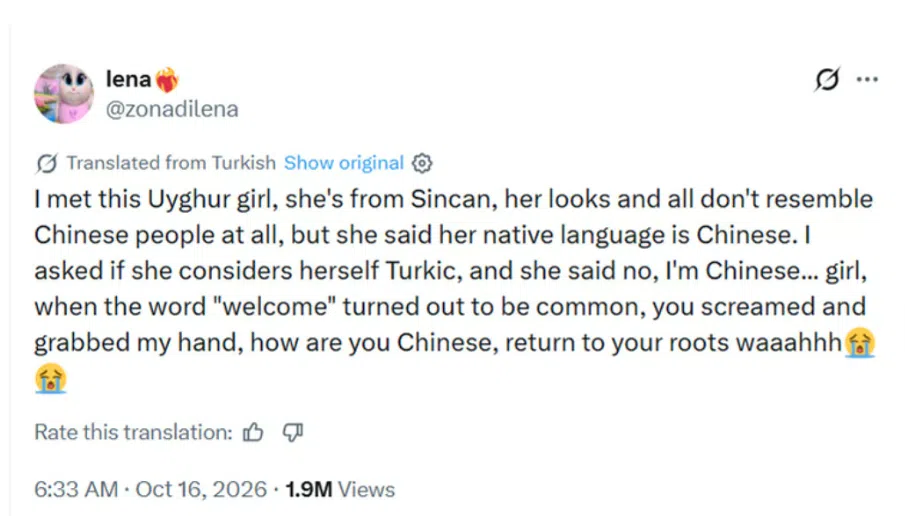
According to the South China Morning Post, the post had attracted more than two million views about a week after it was published. The account subsequently appeared to have been deleted, but the dispute did not subside. Instead, it expanded from the woman’s sense of identity to questions of history and ethnic identity.
Some Turkish users cited the history of successive Chinese dynasties building the Great Wall to fend off invasions by northern nomadic peoples, claiming that “China built the Great Wall because it feared invasion by Turkic peoples”. Chinese users countered with arguments about genetics, claiming that modern Turks were genetically closer to Greeks and Armenians and questioning their Turkic identity on that basis. Some Chinese users also mocked Türkiye’s economic situation, taking aim at inflation and the lira’s depreciation.
As the exchanges escalated, national flags also became targets of ridicule. An image that had previously circulated online went viral again: the crescent and star on Türkiye’s flag were superimposed on a scene of Patrick Star falling in the cartoon SpongeBob SquarePants, further inflaming Turkish users.
The war of words also drew in users from more countries. Users from Japan, Greece, India, Iran and several Arab countries took sides, trading profanity, memes, historical arguments, satirical jokes and artificial intelligence (AI) videos in an online free-for-all dubbed the “First X War”.
As the dispute continued to grow, Chinese and Turkish media offered different interpretations. In a commentary published on Monday (26 October), the English edition of China’s state-run Global Times said: “In recent years, certain forces have continued to deliberately fabricate disinformation about Xinjiang in an attempt to distort China's ethnic policies and the region's development achievements. Faced with such noises, the Chinese public, both in real life and cyberspace, has taken the initiative to push back against false claims and share factual information through a variety of means.”
The commentary praised Chinese internet users who spoke out rationally, stressing that online exchanges should focus on fostering understanding rather than winning arguments. It also said the debate had “enabled many overseas users who had previously held prejudices about China-related issues to see a picture of China that differs markedly from the dominant Western narrative”.
Turkish media outlet Türkiye Today, meanwhile, focused on whether Chinese accounts were using AI to generate comments in bulk. Its report quoted some X users as saying that thousands of comments from Chinese accounts might have been AI-generated as part of psychological warfare.
Why does Xinjiang resonate in Türkiye?
Some Turks regard Uyghurs as ethnic kin. This sense of shared identity and emotional connection is an important backdrop to the dispute.
Uyghur and Turkish both belong to the Turkic language family, and Uyghurs and Turks are predominantly Muslim. According to China’s 2020 National Population Census, Xinjiang has about 11.62 million Uyghurs. Türkiye is home to tens of thousands of Uyghurs, making it the largest Uyghur diaspora hub outside Central Asia. Language, religion and diaspora ties together underpin Turkish society’s interest in Xinjiang.
Ankara has also long cultivated relations with other Turkic-speaking countries, seeking to expand its influence among Turkic peoples. The predecessor to the Organization of Turkic States was established in 2009 and adopted its current name in 2021, promoting cooperation among member states through shared linguistic, historical and cultural ties. Turkish President Recep Tayyip Erdogan has proposed extending his “Turkish Century” vision to the organisation, jointly ushering in an “era of the Turks”.

Education is another channel for strengthening a shared sense of identity. When introducing a new history curriculum in 2024, Türkiye’s Ministry of Education proposed replacing the term “Central Asia” with “Turkestan”. This year, it also introduced “Turkic World” teaching materials for different educational levels, emphasising shared history, cultural heritage and links between ethnic groups.
This education policy has attracted renewed attention amid the online dispute. Chinese independent media account Xiaoyuangui published three articles in succession, criticising Türkiye for “spreading false historical claims” and alleging that the new textbooks included northwestern Chinese regions such as Xinjiang, Gansu and Qinghai within the boundaries of “Turkestan”.
One of the articles, titled “‘Turkestan’? Pure Fantasy!”, said that northwestern regions such as Xinjiang, Gansu and Qinghai had been inalienable parts of Chinese territory since ancient times, and that Xinjiang’s ethnic groups were important members of the Chinese national family. It denied that these regions had historical ties to a “fictitious Turkestan”.
The article argued that linguistic links did not equate to territorial sovereignty or historical heritage. It said “Turkestan” was merely a general term for areas inhabited by Turkic nomadic tribes and had never been a unified state or sovereign entity.
It also interpreted the textbook changes as part of Ankara’s attempt to rewrite Eurasian history and export pan-Turkism. It criticised the move as a distortion of China’s sovereignty and the history of exchanges between Eurasian civilisations, describing it as, in essence, “using education to export geopolitical ambitions and create regional divisions”.
Cooperation continues despite unresolved differences over Xinjiang
China and Türkiye’s differences over Xinjiang extend beyond historical terminology and cultural identity to the human rights situation of Uyghurs and other minority groups.
For years, the US and other Western countries have criticised China’s policies in Xinjiang. A report released in 2022 by the Office of the UN High Commissioner for Human Rights also said serious human rights violations had been committed against Uyghurs and other Muslim minorities in Xinjiang.
Türkiye, too, has publicly expressed concern on several occasions. In February 2019, Hami Aksoy, then spokesperson for Türkiye’s Ministry of Foreign Affairs, accused the Chinese government of pursuing a “policy of systematic assimilation” against Uyghurs.
In 2020, Omer Celik, then spokesperson for the ruling Justice and Development Party, said Türkiye was closely monitoring human rights and freedom of religion in Xinjiang. He said the Xinjiang Uyghur Autonomous Region’s regulations on de-extremification, introduced in 2017, contained arbitrary measures targeting Uyghurs. He also expressed hope that “Uyghur Turks” could live in peace and prosperity as equal citizens and contribute to China’s development.
The Chinese government has consistently denied allegations of genocide, forced labour, systematic sexual assault and abuse in Xinjiang, describing them as political manoeuvring by the US and some Western forces to use Xinjiang to contain China.
Responding to Aksoy’s remarks in February 2019, the Chinese embassy in Türkiye said China’s counter-terrorism and de-extremification efforts drew on international experience while taking account of its own circumstances. It called on Türkiye to “withdraw its false accusations and take measures to eliminate their harmful effects”.
These differences, however, have not halted cooperation between the two countries. In recent years, Türkiye, beset by high inflation, has continued to seek stronger trade and investment ties with China. Beijing has also repeatedly called on both sides to strengthen mutual political trust and support each other on issues concerning their core interests.
In June 2024, Turkish Foreign Minister Hakan Fidan visited China, including Urumqi and Kashgar. He advocated viewing the Uyghur issue through the lens of cultural diversity, saying it would benefit all sides to change perceptions in the international community and the Islamic world about local Uyghurs’ cultural rights and living conditions. He also reaffirmed support for the one-China policy and China’s territorial integrity and sovereignty.
Travel between the two countries is also becoming easier. Since January this year, Türkiye has granted visa-free entry to holders of ordinary Chinese passports travelling for tourism or transit, allowing stays totalling no more than 90 days within any 180-day period.
Just before the online dispute erupted, Chinese Foreign Minister Wang Yi and Fidan met on 15 October on the sidelines of the Conference on Interaction and Confidence-Building Measures in Asia summit in Azerbaijan’s capital, Baku. They discussed cooperation in investment, tourism and connectivity.
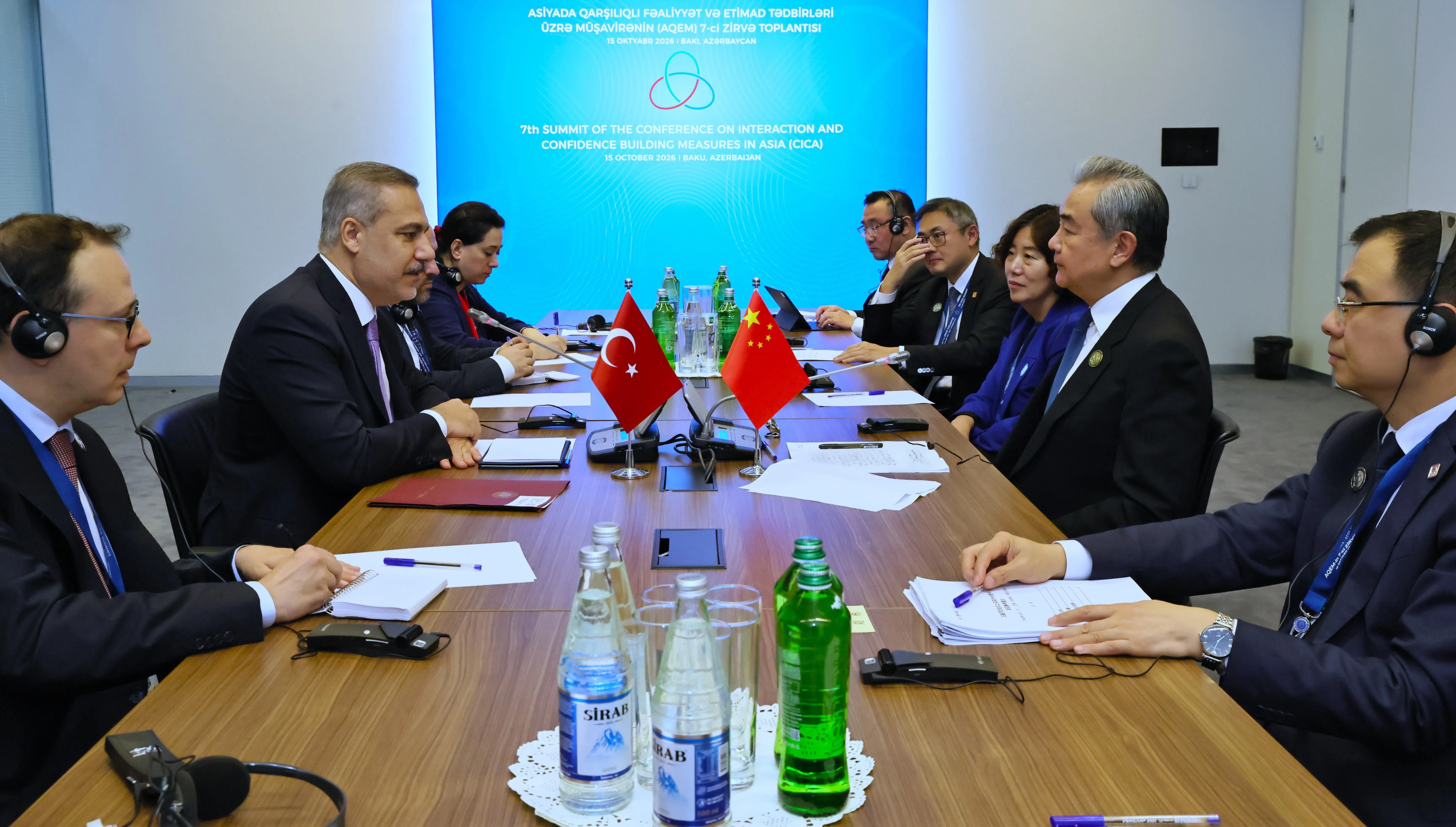
According to the Chinese readout, Fidan said Türkiye understood China’s concerns about combating extremism and terrorism, and would never allow Turkish territory to be used for activities that jeopardised China’s security. Wang welcomed Türkiye’s attention to China’s security concerns and expressed hope that it would continue to understand and support China’s position on issues concerning its core interests.
So far, neither government has publicly commented on the online war of words. Their earlier diplomatic exchanges suggest that both sides are more focused on finding common interests in counterterrorism, security and practical cooperation, while continuing to advance bilateral relations despite their differences over Xinjiang.
The online debate, meanwhile, is increasingly descending into mutual attacks on national flags, ancestry and national dignity, leaving Uyghurs’ cultural rights, everyday lives and personal identities at risk of being pushed into the background. A dispute that began with a woman’s answer to the question “Who am I?” may ultimately become a contest in which others insist on deciding who she should be.
