

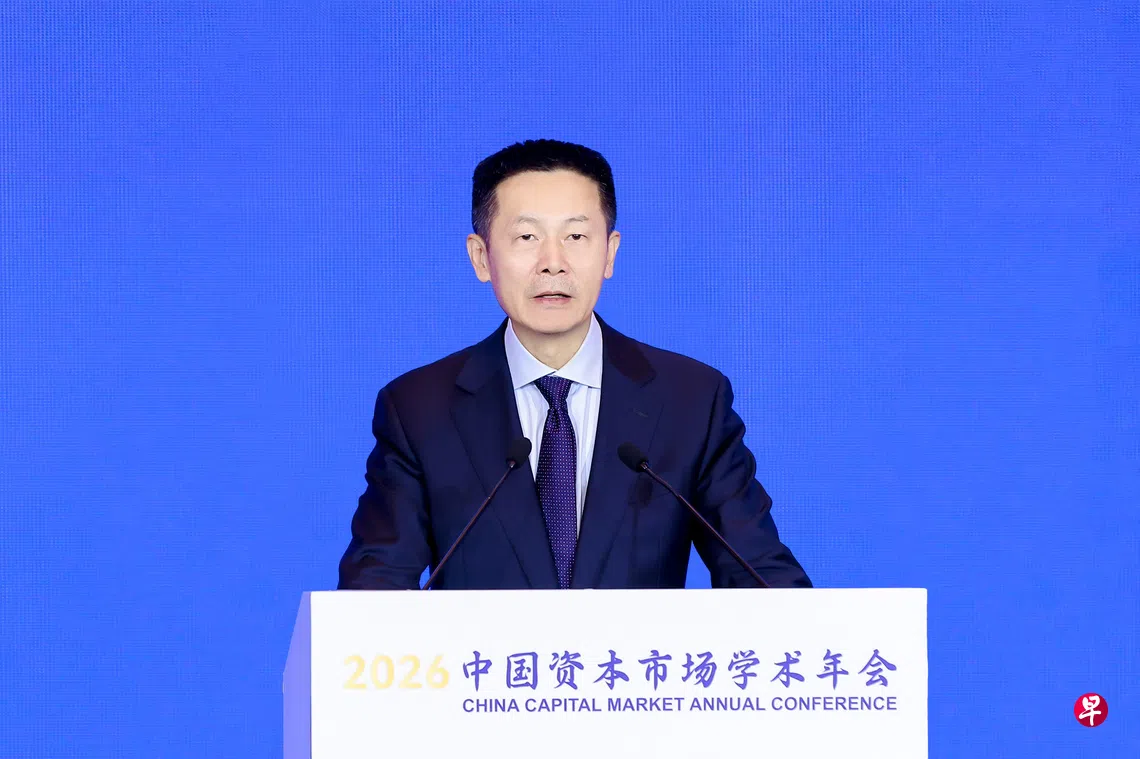
(Beijing) China Securities Regulatory Commission (CSRC) chairman Wu Qing said China’s capital markets have never been as closely interconnected with global markets as they are today. Faced with a highly uncertain external environment and risks, China will deepen research into long-term mechanisms for market stability and guarding against abnormal market fluctuations, and closely study and assess regulatory arrangements for quantitative trading and shareholding reductions.
Wu attended the inaugural China Capital Market Academic Annual Conference in Shanghai on Saturday (14 November). According to a transcript of his speech released by the CSRC, Wu said the world was beset by intertwined changes and turmoil, with growing uncertainty over the policy direction of major economies. “Global capital markets are undergoing a new round of asset repricing and rebalancing,” he said.
He said China needed to provide greater certainty through its institutional framework and continually strengthen its capital markets’ capacity and resilience to withstand major risks, including “black swan” and “grey rhino” events.
Wu said the A-share market had more than 200 million stock investors and over 800 million fund holders. “These national and market conditions are unique in the world,” he said. China therefore needed both to study and draw on the general patterns of development in mature markets and to examine in depth its own market characteristics and structural challenges.
“China’s capital markets have never been as closely interconnected with global capital markets as they are today, with movements transmitted between them and amplifying one another,” Wu said.
Faced with a highly uncertain external environment and risks originating overseas, he stressed the need to improve understanding of cyclical changes in global capital markets and strengthen research into, and responses to, risks across borders, markets and industries. He called for “systematically building mechanisms, sources of support and an ecosystem for stability to effectively guard against abnormal market fluctuations”.
Wu urged further research into market microstructure. This would include in-depth studies on improving the composition of capital supply and accelerating the growth of long-term and patient capital, as well as improving mechanisms for guiding expectations to reduce market volatility arising from “herd behaviour” and “short-term” trading. “We must also closely study and assess how to improve rules on quantitative trading and shareholding reductions, among other areas, and establish fair and reasonable regulatory arrangements to effectively protect investors’ legitimate rights and interests,” he said.
China’s central bank, the CSRC and the National Financial Regulatory Administration rolled out a series of measures in quick succession in early November to stabilise the stock market and lift subdued sentiment. But an unexpected development this week at a leading company in the US artificial intelligence industry unsettled markets: Nvidia co-founder Jensen Huang resigned as chief executive on Thursday (12 November). Chinese technology stocks were hit the following day, with A-share companies in Nvidia’s supply chain falling sharply across the board on Friday (13 November), partly erasing the previous week’s gains.
