

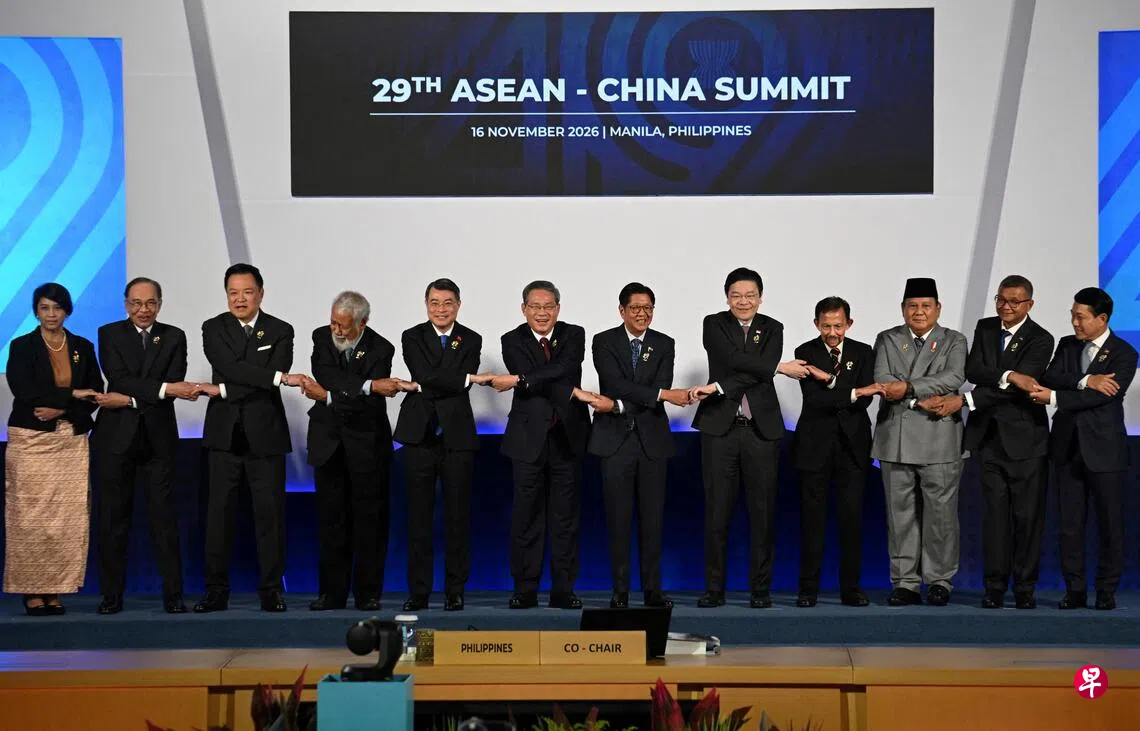
Philippine Foreign Secretary Maria Theresa Lazaro said China remains committed to concluding negotiations with ASEAN on a code of conduct for the South China Sea. Although the two sides have reached preliminary agreement on about 80% of the draft provisions, they will not meet the target of completing negotiations this year.
According to reports by the Philippine Daily Inquirer (《每日问询者报》) and The Manila Times (《马尼拉时报》), Lazaro told a press conference on Monday (16 November) that Chinese Premier Li Qiang had reaffirmed his support for an early conclusion of the South China Sea code of conduct at the ASEAN-China Summit that day, in line with Beijing's past commitments.
She noted that China and ASEAN have consistently been committed to concluding the code of conduct negotiations, and that any change in Beijing's position would cause controversy within ASEAN.
Lazaro said Manila was not disappointed that the code of conduct could not be finalised during the Philippines' ASEAN chairmanship. Following several rounds of negotiations pushed by the Philippines this year, the proportion of draft provisions on which the two sides have reached preliminary agreement has risen from about 50% to about 80%.
She said: “why would we be frustrated? We just need it more time, but we cannot, we have to stop and give it to the next chair”
Lazaro noted that despite the Philippines' push for monthly negotiations, there was still not enough time to complete the agreement. She believed that negotiations might be concluded with another five or six months, but could not give a firm timeline. She hoped Singapore could help advance the talks further next year.
ASEAN and China agreed in 2023 to accelerate negotiations, aiming to complete the South China Sea code of conduct by 2026 to establish rules for managing maritime disputes and preventing conflicts from escalating. Philippine President Ferdinand Romualdez Marcos Jr. had also made concluding the negotiations one of the main goals of his country's ASEAN chairmanship.
However, despite negotiations entering their final stage, differences remain over key issues, including whether the code of conduct should be legally binding.
China and ASEAN signed the Declaration on the Conduct of Parties in the South China Sea in 2002 and formally launched negotiations on the code of conduct in 2017. Repeated maritime stand-offs between China and the Philippines in recent years over sovereignty and maritime rights in the South China Sea have also underscored the urgency of establishing an effective crisis management mechanism.
