

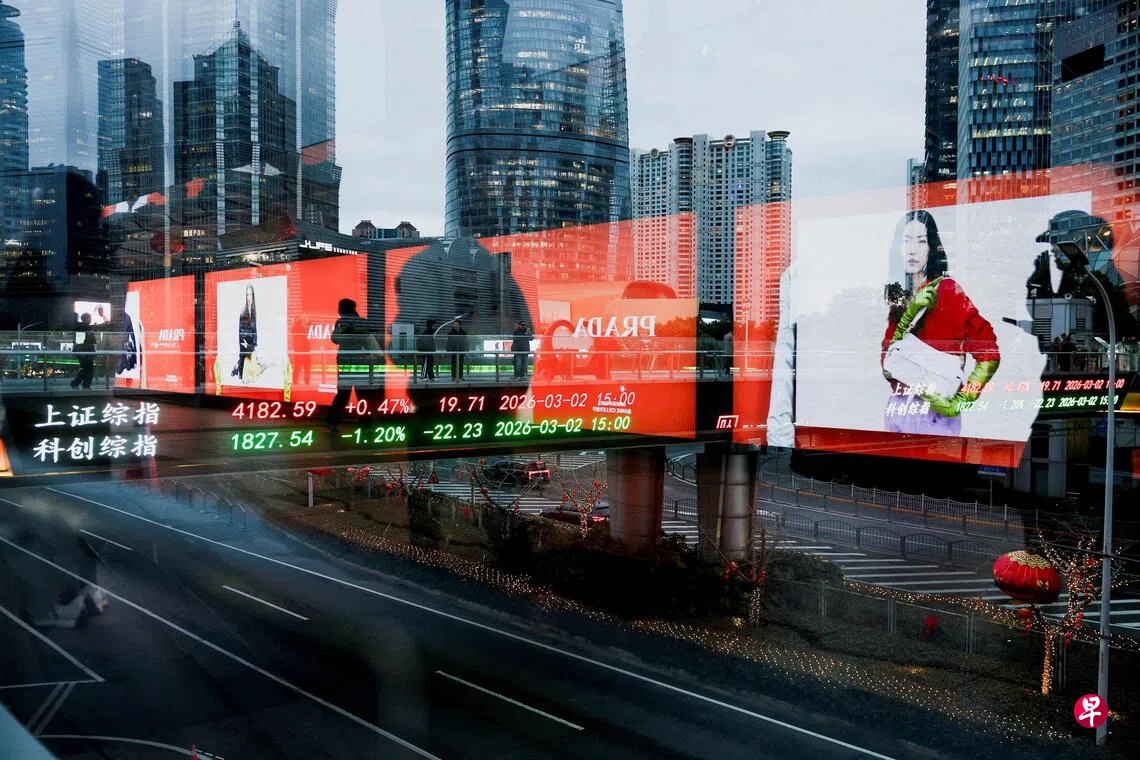
After Chinese A-shares suffered repeated heavy losses last month, the central bank announced it would conduct swap facility operations for securities firms, fund managers and insurers, and turn its relending programme for share buybacks and shareholding increases into a permanent institutional arrangement, to support the healthy and stable development of the capital market. The Shanghai Composite Index rose 1.1% on Monday (2 November), its biggest one-day gain since 27 August.
Analysts said the measures were mainly intended to boost liquidity, put a floor under the market and stabilise expectations, but were unlikely to replicate the rally that followed the first use of these policy tools in 2024.
China’s central bank, the National Financial Regulatory Administration, the China Securities Regulatory Commission (CSRC) and other agencies held a meeting on Monday to discuss how to make full and effective use of the policy tools. The central bank made the announcement after the market closed that day.
The swap facility operations will begin on Tuesday (3 November). So far, 31 securities firms and fund managers have applied for more than 100 billion yuan (about S$19.2 billion). Meanwhile, the relending programme for share buybacks and shareholding increases will become a permanent institutional arrangement rather than a temporary measure, with the relending rate cut from 1.25% to 1%.
The meeting was attended by 23 securities firms and fund managers, including China International Capital Corporation, Guotai Haitong Securities and CITIC Securities, as well as 26 banks, including Industrial and Commercial Bank of China, China Construction Bank and China CITIC Bank.
China’s financial regulatory authorities first introduced the swap facility and the relending programme for share buybacks and shareholding increases in September 2024. The former provides liquidity to securities firms, fund managers and insurers to strengthen their capacity to invest in the market. The latter uses low-cost loans to encourage listed companies to buy back shares and major shareholders to increase their stakes. Their introduction was followed by a strong stock market rebound.
A-shares have been volatile since June this year. The benchmark CSI 300 Index fell 8.5% last month, its biggest monthly decline since 2016. The Shanghai Composite Index closed at 3,599 points on the last trading day of October, falling below 3,600 for the first time in more than a year. The ChiNext Index plunged 23.02% in October, its steepest monthly fall since February 2016.
With stocks languishing and confidence shaken, the central bank rolled out the two policy tools for a third time. The CSRC said the latest measures expanded the range of institutions eligible for the swap facility and the funding available, while broadening the coverage of the special relending programme for listed-company share buybacks and shareholding increases. The commission will encourage more high-profile examples involving companies with large index weightings and leading technology stocks that have a strong influence on the market.
Buoyed by expectations of policy support, the CSI 300 Index closed 0.8% higher that day, while the STAR 50 Index gained more than 3%.
Tommy Xie, head of Asia macro research at OCBC, told Lianhe Zaobao (LHZB) that the focus this time was on lowering access barriers and costs so that existing funding quotas would actually be used. This would address shortcomings in the existing capital market support tools: “Quotas are available but underused; funds are available but are not flowing through effectively.”
He also noted that while the central bank could improve financial institutions’ ability to raise funds, it could not directly dispel their concerns about stock market declines. “Whether institutions are willing to increase their equity allocations still depends on financing costs, expected investment returns, market volatility and their own risk management requirements.”
Both Xie and Shen Meng, executive director of Chanson Capital, believe this round of policy support is unlikely to replicate the strong rally of 2024. Shen said the tools might achieve their aims of managing expectations and stabilising market sentiment, but would only be a stopgap measure for the stock market’s problems.
He explained: “If support is directed only at the capital market, without improving the fundamentals of the real economy, the market will become disconnected from those fundamentals. This will also encourage more people to engage in short-term speculation, further weakening the foundations of the entire capital market and creating a vicious circle.”
Zuo Xiaolei, former chief economist at China Galaxy Securities, also said China’s stock market was prone to being driven by irrational sentiment. Injecting funds might have a short-term effect, but longer-term capital market development was more important, including improving the quality and performance of listed companies. “Without such companies to give the market confidence, investors are more likely to trade stocks for short-term gains.”
