

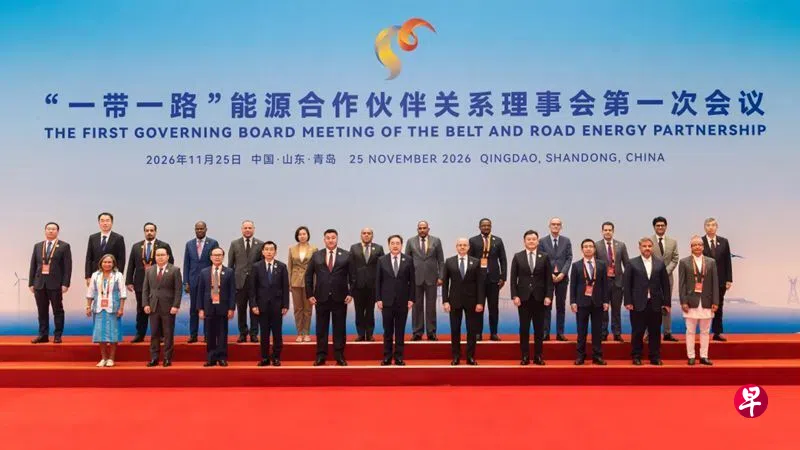
China is drawing on its lead in clean energy technology to deepen energy cooperation with countries in the Global South, pledging to help them safeguard energy security and promote economic development as they pursue a green, low-carbon transition.
According to Bloomberg and Chang’an Jie Zhishi, a WeChat account run by Beijing Daily, the fourth Belt and Road Energy Ministerial Conference was held in Qingdao, Shandong, on Thursday (26 November), with ministers and officials from dozens of countries attending.
Wang Hongzhi, head of China’s National Energy Administration, put forward six proposals at the conference: jointly strengthening energy security, upgrading power interconnections, exploring pathways for a green energy transition, fostering new drivers of energy innovation, enhancing cooperation and coordination in energy governance, and improving access to green financing.
Wang said geopolitical conflicts and competition over energy interests influence each other. Faced with a complex and changing international environment, countries need to work together to deepen cooperation more than ever, as no country can remain insulated.
Wang also stressed that China was willing to work with all parties on the basis of fairness, justice, inclusiveness and shared benefits, “respecting differences in countries’ resource endowments and stages of development, and supporting them in exploring transition pathways suited to their national circumstances”, while deepening cooperation in areas such as renewable energy development and use.
Wang said China had built the world’s largest and most comprehensive clean energy industrial chain, supplying 70% of the world’s wind power equipment and 80% of its photovoltaic modules. He added that over the next five years, China would step up new energy development while vigorously advancing oil and gas exploration and production, and consolidating and expanding its diversified sources of oil and gas imports.
On cooperation in energy technology, Wang said China was willing to support companies from various countries in conducting technological research in areas such as the integration of artificial intelligence (AI) and energy, and to jointly promote affordable, practical technological solutions suited to local conditions.
Energy has been a key area of cooperation under the Belt and Road Initiative since Chinese President Xi Jinping proposed it in 2013. The focus has gradually expanded from early infrastructure projects such as oil and gas pipelines, power stations and transmission lines to areas including solar power, wind power, batteries and power grids.
China now cooperates with more than 100 countries and regions on green energy projects, while membership of the Belt and Road Energy Partnership has grown to 35 countries. The partnership’s council was formally established on Wednesday (25 November), further institutionalising energy cooperation.
Bloomberg’s analysis noted that shortly before the conference, disagreements at the 31st UN Climate Change Conference (COP31) in Türkiye had prevented consensus on an overall agreement, highlighting the challenges facing global climate and energy cooperation. The Qingdao conference signalled greater emphasis on energy security, affordability and economic development alongside continued efforts to advance the energy transition.
Several developing countries at the conference also made clear that they sought not only China’s support in building energy infrastructure, but also technology transfers, the development of local manufacturing and the training of technical talent to drive their own industrial development.
South Africa’s Minister of Electricity and Energy Kgosientsho Ramokgopa said: “For us, the energy transition must be a tool for industrial development.”
South Sudan’s Minister of Petroleum Awow Daniel Chuang noted that only 8% of the country’s population currently had access to electricity. He publicly invited Chinese companies, including PowerChina and Huawei, to invest in South Sudan and help develop its hydropower, solar, wind and geothermal energy resources.
