

China has unveiled plans for its first crewed moon landing, confirming that it will launch two carrier rockets in succession, with two members of the crewed lunar exploration mission ultimately landing to the moon’s surface. The mission aims to put Chinese astronauts on the moon before 2030.
Experts interviewed described the plan as a pragmatic compromise, saying it was likely to heighten the urgency of the US effort to return to the moon and intensify space competition between the two countries.
Wang Xiang, deputy chief designer of China’s crewed space programme and chief designer of its lunar exploration programme, disclosed plans for the first crewed lunar exploration mission at an academic conference on Saturday (31 October).
Under the “two launches, one lunar landing” plan, two Long March 10 carrier rockets will launch separately, sending the Lanyue lunar lander and Mengzhou crewed spacecraft into Earth-moon transfer orbits in succession. They will then rendezvous and dock in the lunar orbit.
The spacecraft will carry three astronauts between Earth and the lunar orbit, where two will travel between the lunar orbit and the moon’s surface in the lander. After completing the landing mission, the two astronauts will return in the lander for a second rendezvous and docking with the spacecraft in the lunar orbit. All three will then board the spacecraft and return to Earth with samples.
Wang explained that the plan clearly separates the functions of the spacecraft and lander. The Mengzhou spacecraft will ensure the astronauts’ safety during transport, while the Lanyue lander will handle travel between lunar orbit and the surface. This approach “draws on existing capabilities to improve the reliability of the entire mission”.
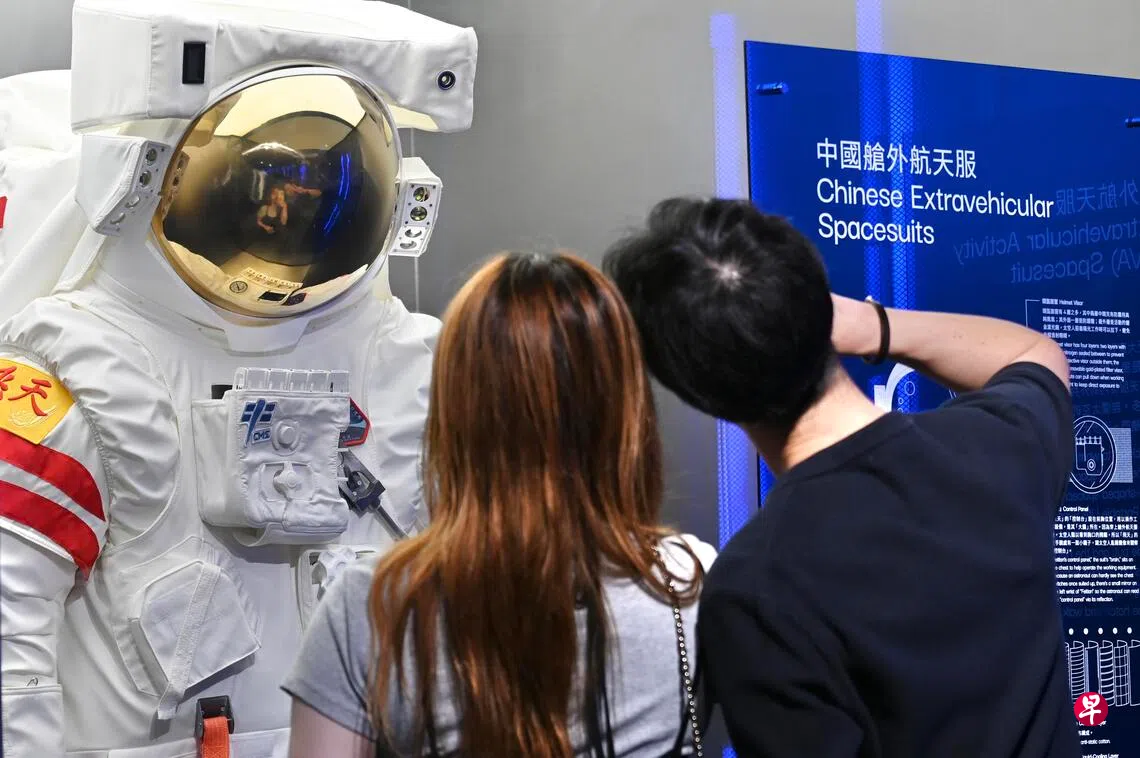
China first announced in 2023 that it planned to land astronauts on the moon before 2030. Development and testing have since begun on the Long March 10 rocket, crewed spacecraft, lander, lunar spacesuits and the Tansuo crewed lunar rover, among other equipment. The latest announcement provided further details of the mission arrangements and progress.
Several major tests have been completed so far, including a zero-altitude abort test of the Mengzhou spacecraft, an integrated landing and take-off test of the Lanyue lander, a captive firing test and low-altitude demonstration flight of the Long March rocket, and a maximum dynamic pressure abort test of the Mengzhou.
Discussion of space competition between China and the US has intensified since China announced its lunar landing plan. The US Artemis programme, which seeks to return astronauts to the moon after more than half a century, has undergone several revisions in recent years. Tests of the lunar landing system are now expected in 2027, with a landing targeted for 2028.
In February, NASA administrator Jared Isaacman said, in a reference to China without naming it: “With credible competition from our greatest geopolitical adversary increasing by the day, we need to move faster, eliminate delays, and achieve our objectives.”
Jack Congram, editor of China in Space, a daily newsletter focused on China’s space sector, told Lianhe Zaobao (LHZB), “the choice of two launches is a good compromise with the mission architecture and developing a launch vehicle that won’t be too costly.”
Available information shows that the US Apollo programme used a heavy-lift rocket for its first moon landing, capable of sending both the crewed spacecraft and lunar module towards the moon in a single launch, but at a high development cost. China’s two-launch approach spreads the payload and size requirements across two rockets. By drawing on proven technology, it also saves rocket development time and costs.
Congram added that, compared with the current US plan, China was more inclined to use proven, mature technologies. Some of its designs had been shown to be feasible in academic discussions as early as the 1960s.
Dr Zhang Jun, a Singapore-based academic who has long followed advanced technology, also said in an interview that China’s plan was “pragmatic, with a clear division of responsibilities and support from accumulated technological expertise”.
He said the main difference between the Chinese and US plans is that China’s effort is currently coordinated by the state, with the aim of establishing an independent, comprehensive capability for crewed moon landings. The US, meanwhile, hopes to draw more widely on commercial innovation and international partners, but faces the challenge of complex coordination across different systems, suppliers and mission schedules.
Both experts expected space competition between China and the US to intensify. Congram said the narrative of a race to the moon had generated enough political pressure in the US to prompt substantial changes to its plans.
Zhang said future competition between China and the US would expand from “who gets there first” to “who can travel back and forth on a sustained basis, build infrastructure such as communications and energy systems, and attract more research and industry partners”.
