

(Harbin) The Exhibition Hall of Evidence of Crime Committed by Unit 731 of the Japanese Imperial Army in Harbin, China, has unveiled three newly acquired pieces of evidence of chemical warfare brought back from Japan, revealing how the Japanese army systematically waged chemical warfare during its invasion of China under a top-down command structure.
Xinhua reported on Friday (27 November) that the three items were a refill canister for a standard-issue chemical disperser, teaching notes for chemical warfare troops and documents on cold-weather military engineering exercises.
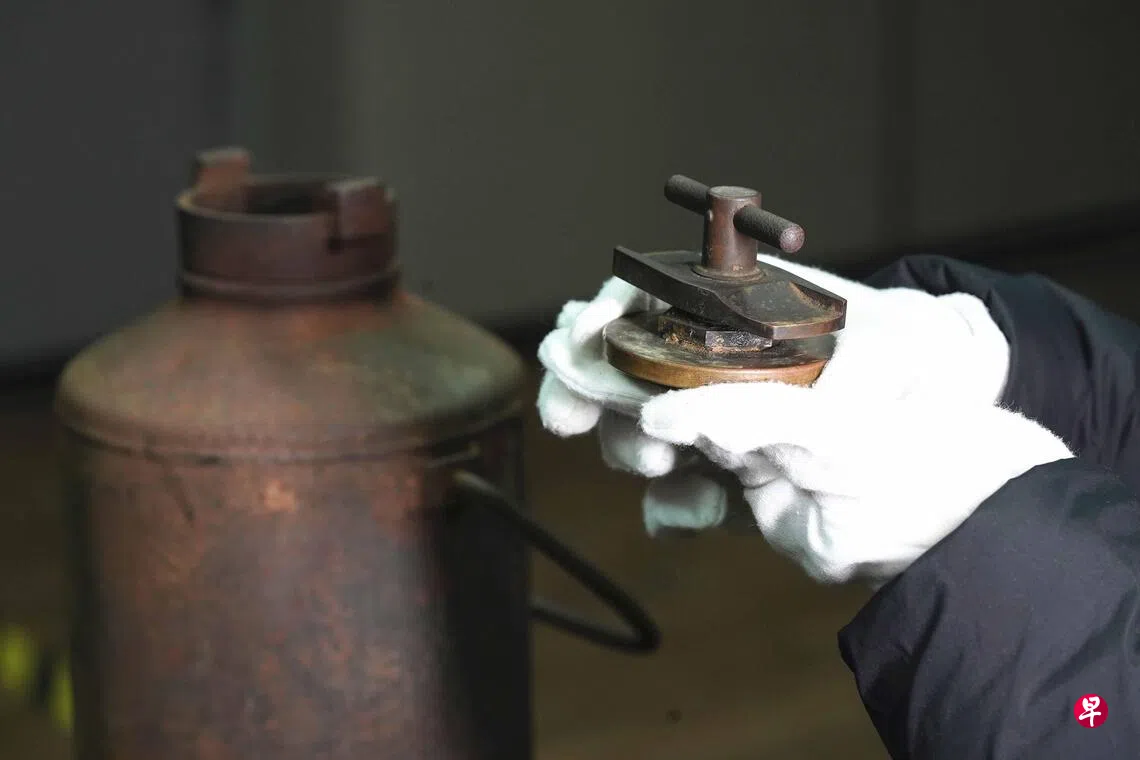
The refill canister for the Type 95 portable, manually operated chemical disperser resembles a civilian fire extinguisher. Its interior has a protective coating resistant to corrosion by blister agents, and it can hold nine kilograms of mustard gas agent when full. Researchers at the museum said the dispersers were primarily filled with blister agents such as mustard gas and were typically carried on the backs of chemical warfare troops wearing full protective equipment.
The other two items are a 39-page set of teaching notes compiled in 1942, Review and Commentary for Gas Warfare Trainees (《瓦斯修业者查阅讲评》), which contains records of poison gas experiments on animals including rabbits and dogs, as well as pathological changes in humans; and the 20-page Cold-Weather Military Engineering Operations Materials (《寒地工兵作业资料》), documenting chemical dispersal exercises conducted by the Japanese army in north-eastern China in December 1938.
The report said the mutually corroborating evidence of equipment manufacture, personnel training and field trials once again showed that the Japanese army’s chemical warfare during its invasion of China was a systematic state crime directed from the top.
