

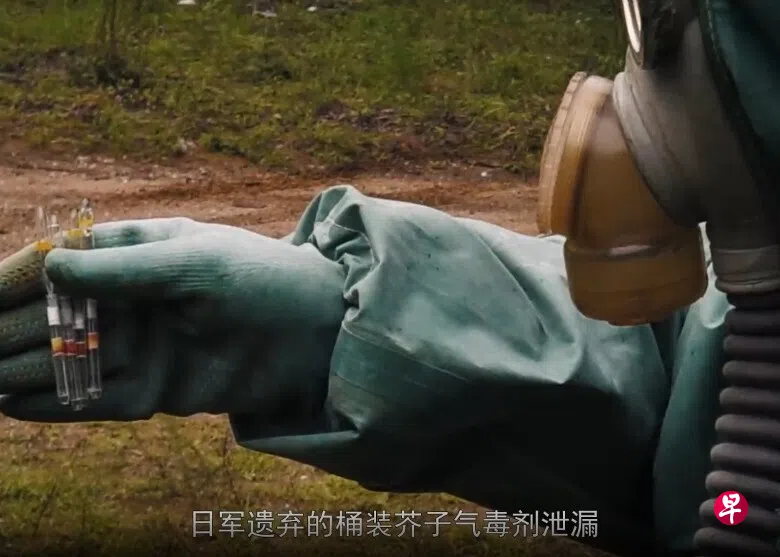
(Beijing) Amid continuing tensions between China and Japan, China’s Ministry of Defence released a documentary this week accusing the Japanese military of conducting organised, systematic chemical warfare during its invasion of China and secretly abandoning chemical weapons after the war.
The Conference of the States Parties to the Chemical Weapons Convention is being held in The Hague, the Netherlands, from 23 to 27 November. Chinese authorities have kept up pressure on Japan this month to speed up efforts to locate and destroy the chemical weapons it left in China.
On Monday (23 November) evening, China’s Ministry of Defence released the 30-minute documentary Give Us Back Our Unpolluted Land (《还我净土》). It examines the Japanese military’s use of chemical weapons during its invasion of China and its abandonment of such weapons in the country after the war, and documents China’s involvement in clearing them.
According to the documentary, Okunoshima, the Japanese military’s largest chemical weapons production base during World War II, secretly produced more than 6,000 tonnes of poison gas for chemical warfare. Chinese authorities face numerous difficulties in dealing with the chemical weapons abandoned by Japan. In August 2003, a chemical agent leak in Qiqihar, Heilongjiang province, poisoned 44 people, one of whom died.
As of August 2026, Chinese authorities had recovered more than 190,000 chemical weapons abandoned by Japan and destroyed more than 160,000. However, these represent only the tip of the iceberg, and disposal work remains seriously behind schedule.
Under the UN Chemical Weapons Convention and a memorandum on the destruction of Japanese chemical weapons abandoned in China, signed by the Chinese and Japanese governments in late July 1999, Japan bears legal responsibility for destroying all the chemical weapons it abandoned. Destruction was originally due to be completed in 2007. However, Chinese authorities say Japan’s lack of commitment to fulfilling its obligations and insufficient resources have led to repeated missed deadlines, leaving the disposal process seriously behind schedule.
The documentary says the destruction work concerns commitments Japan made to China and the international community. Tokyo has not only missed four deadlines for its destruction programme, but has also yet to provide complete information on the weapons it abandoned.
In the documentary, Chinese authorities make four demands of Japan: increase resources and accelerate disposal; provide complete information on the abandoned weapons; draw up disposal plans for large burial sites; and take responsibility for remediating contaminated soil and water.
Earlier, academic institutions, including the Institute of Japanese Studies at the Chinese Academy of Social Sciences, held a symposium in Heilongjiang from 9 to 11 November. It focused on research into the crimes committed by the Japanese military through biological and chemical warfare during its invasion of China, and presented a series of new discoveries, evidence and research findings.
Du Jidong, a researcher at the Chinese Academy of Social Sciences’ institute for Chinese modernisation studies, said the Chemical Weapons Convention explicitly stipulates that the country that abandoned the chemical weapons bears full responsibility for their destruction. Yet Japan has consistently shirked its obligations and withheld key information, with the destruction process having missed four deadlines. To date, chemical weapons abandoned by Japan have been found at more than 200 sites across 18 Chinese provinces, and large numbers of poison gas shells remain undiscovered.
At a regular press briefing on 16 November, Chinese Foreign Ministry spokesperson Mao Ning said the Japanese military had organised and carried out biological and chemical warfare during its invasion of China in World War II, inflicting suffering on the Chinese people. She said the chemical weapons it abandoned continued to threaten Chinese lives and property, as well as the ecological environment.
She urged Japan to eliminate the toxic legacy of its abandoned chemical weapons completely and as soon as possible, and “give the Chinese people back their unpolluted land”.
