

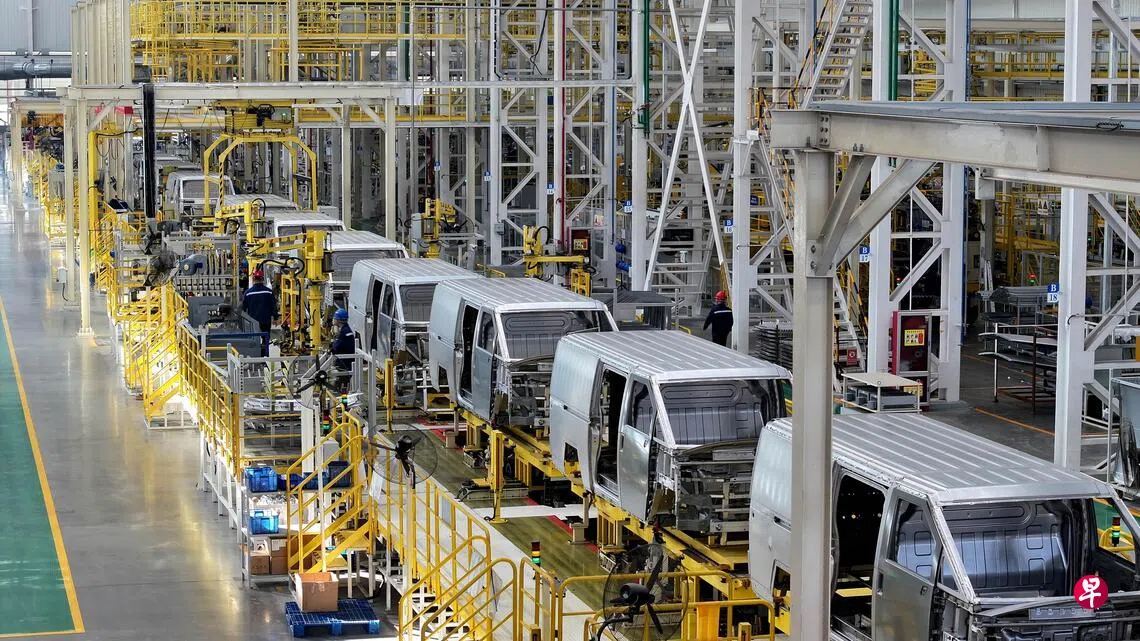
China’s economy slowed across the board in October, with industrial output, retail sales and investment all falling short of expectations, while imports and exports continued to grow strongly. Analysts said China remained on track to meet its full-year growth target despite the slowdown, leaving no need for further stimulus this year. Policy attention would instead turn to sustaining growth next year.
Data released by China’s National Bureau of Statistics on Monday (16 November) showed that industrial value-added output rose 4.8% year on year in October, below September’s 5.5% increase and the 5.3% forecast in a Reuters poll.
Retail sales of goods rose 0.4% year on year, slowing from 1.1% in September. Growth in retail sales of services for the first 10 months also eased to 4.9%, from 5% in the first three quarters.
Fixed-asset investment nationwide fell 8.1% year on year in the January–October period, deepening the 7.2% decline recorded in the first nine months. Infrastructure investment fell 5.1%, missing market expectations, while property investment dropped 21.6%, with the decline widening by one percentage point.
National Bureau of Statistics spokesperson Fu Linghui said China’s economy was broadly stable in October, with further progress in high-quality development. However, domestic supply continued to outstrip demand markedly, some businesses faced operational pressures, and the foundations for a sustained economic recovery needed to be strengthened.
Chen Bo, a senior research fellow at the National University of Singapore’s East Asian Institute, told Lianhe Zaobao that the K-shaped divergence in China’s economy had not changed and was showing signs of becoming more pronounced. October’s data showed strong growth in high-end equipment manufacturing and high-tech industries, while traditional manufacturing and property-related sectors continued to decline, he said.
Wang Qing, chief macroeconomic analyst at Golden Credit Rating International, said in an interview that the property sector was the main drag on sluggish consumption in October. It had “curbed property-related spending and continued to weigh on consumer confidence, making weak consumption difficult to reverse in the short term”.
Fuelled by the global artificial intelligence boom and strong overseas demand for cars, China’s economy grew 4.5% year on year in the third quarter. Analysts expect exports to remain strong for the rest of the year, keeping the full-year growth target of 4.5% to 5% within reach without additional stimulus.
Wang expects exports to continue growing strongly for the rest of the year, domestic policies to support growth to help improve investment, and high-tech manufacturing output to maintain relatively rapid growth. Together with one more working day in November than a year earlier, these factors should lift industrial output growth.
Chen also noted that, besides year-end effects helping to stabilise the economy, some leading indicators in services and manufacturing — including expectations indices for business activity and internet information and communications services — remained in expansionary territory. “There is no reason for urgent policy intervention,” he said.
Xu Tianchen, a senior economist at the Economist Intelligence Unit, said in an interview that he expected China’s fourth-quarter economic growth to be between 4.6% and 4.7%. The authorities were unlikely to introduce stimulus before the end of the year, he said, as policy attention had already shifted to sustaining growth next year.
Surging exports and the industrial production needed to support them have underpinned China’s economic growth this year. Wang, however, believes Chinese exports will come under pressure next year.
He said the US Philadelphia Semiconductor Index was closely correlated with China’s chip exports and typically led them by several months. Since July, year-on-year growth in the index’s monthly average has slowed markedly, with the index falling from more than 14,000 points to below 10,000 points. This suggests that growth in the value of China’s chip exports will ease from elevated levels in 2027, potentially dragging down overall export growth.
With exports under pressure, policymakers could introduce broad-based interest rate cuts and additional fiscal support to step up efforts to sustain growth, he said.
