

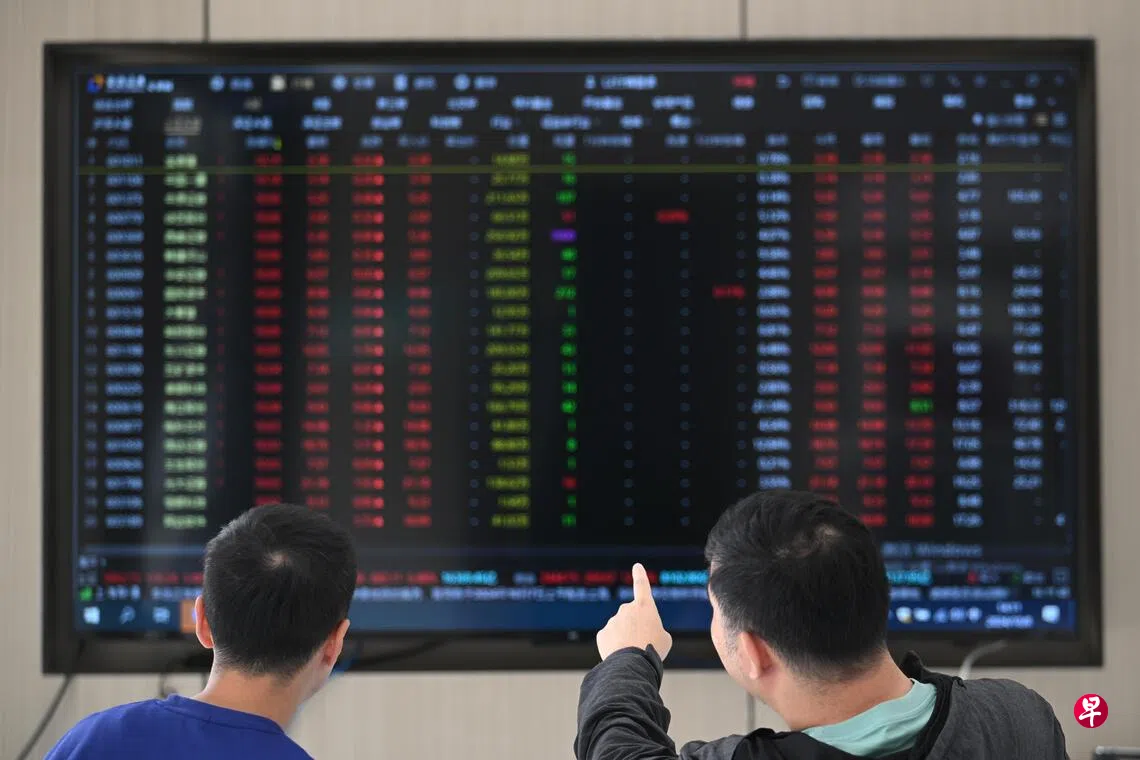
(Beijing) Chinese authorities made a rare announcement during trading hours amid a stock market slump, sending strong signals of support by saying that stabilising stocks would “stabilise expectations” and calling for a stronger market-stabilising role for the “national team”. The news boosted A-shares, with the STAR 50 Index surging more than 14% at one point and the Shanghai Composite Index returning to 3,600 points. The renminbi also strengthened.
According to Xinhua, Chinese Prime Minister Li Qiang chaired a State Council executive meeting on Friday (27 November) to discuss further comprehensive reforms to investment and financing in the capital markets, sending five key signals.
The meeting noted that capital markets “connect corporate financing and industrial upgrading on one side with household assets and consumer confidence on the other” and “have a bearing on overall economic development”. Stabilising the stock market meant “stabilising expectations, which is very important for China’s economy”.
The meeting called for continued improvements to mechanisms for stabilising capital markets, effective implementation of existing policies and plans for additional measures. It also called for a stronger market-stabilising role for the “national team”, further enhancement of Central Huijin Investment’s function as a quasi-“stabilisation fund” and efforts to “ensure ample liquidity”. Policies supporting and guiding medium- and long-term funds, including insurance funds, enterprise annuities and social security funds, into the market should also be improved to steadily expand the pool of medium- and long-term investment.
The meeting also called for “stronger efforts to prevent and respond to externally transmitted risks”.
The meeting came at a troubling time for Chinese stocks, with several A-share benchmarks already deep in bear-market territory. Cailian Press noted that this was the second time within a month that a State Council executive meeting had addressed capital market reform. Its rare call to “ensure ample liquidity” was seen as an important signal to bolster investor confidence. For the first time, the meeting’s statement also devoted as many as 285 Chinese characters to stabilising capital markets.
Buoyed by news from the State Council meeting, A-share gains widened rapidly on Friday afternoon, with technology stocks driving the broader market rebound. The STAR 50 Index rose 15.07%. At the close, the Shanghai Composite Index was up 3.73% at 3,606.49 points, its biggest one-day gain in two years. The Shenzhen Component Index rose 7.24%, the ChiNext Index gained 11.61% and the BSE 50 Index climbed 13.2%. Semiconductor, electronic chemicals, computing capacity rental and memory chip stocks all posted sharp gains, with more than 5,300 stocks advancing across the market.
The rally extended to Hong Kong, where the Hang Seng Index rose 2.1% and the Hang Seng Tech Index jumped 6.45%. The renminbi also strengthened. The offshore renminbi rose 0.1% against the US dollar, reversing earlier losses to reach its highest level in three weeks.
“The statement shows that stabilizing the capital market remains a priority at the highest levels of government, which should help ease negative sentiment,” said Fu Zhifeng, chief investment officer at Shanghai Chengzhou Investment Management, in comments to Bloomberg. “After the recent selloff, investors have shown little appetite to buy the dip, while much of the selling pressure may have already been exhausted. The announcement can therefore provide further support.”
Despite Friday’s sharp rebound, the CSI 300 Index was still down 14% for the year, putting it at risk of its worst annual performance since 2022. Chinese stocks continue to face pressures including weak corporate earnings, sluggish economic growth and concerns over excessive valuations of artificial intelligence-related stocks.
Kenny Ng, a strategist at Everbright Securities International in Hong Kong, said: "Sentiment has been downbeat for so long. There hasn't been much good news to trade on. At least now there's something to count on: the national team will come to the rescue if things really turn south."
Since October, Chinese regulators have rolled out a series of measures to boost investor confidence, while state funds have also been actively buying stocks. Previously, however, these efforts were seen more as a means of stemming the market’s decline than driving a recovery.
