

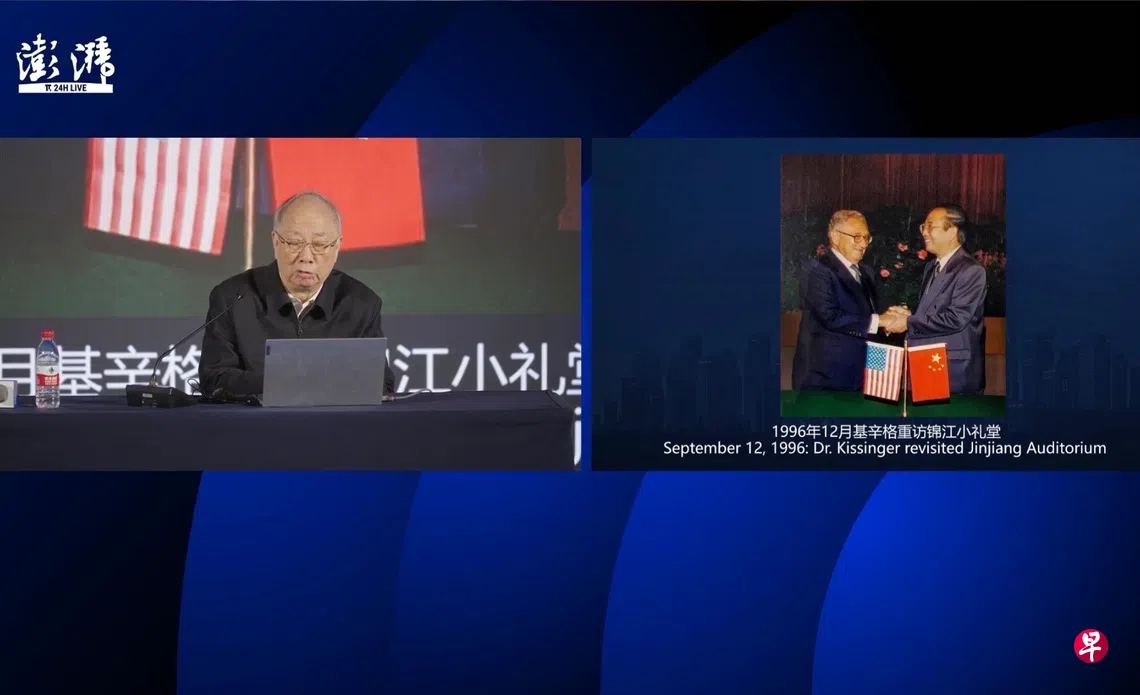
Zhao Qizheng, former director of China’s State Council Information Office, said China-US relations have been “relatively cold” since Donald J. Trump’s first term, compared with the 1980s and 1990s. Citing former US Secretary of State Henry Kissinger, he called for efforts to find a younger generation of Americans who truly understand China to “sustain warmth in China-US relations”.
Speaking on Friday (30 October) at “China-US Intergenerational Dialogue 2026 — In Search of ‘Kissinger’”, jointly organised by The Paper and the Shanghai Institutes for International Studies, Zhao shared stories of his interactions with Kissinger and reflected on changes in bilateral ties.
Zhao, 86, previously served as a member of the Communist Party of China’s Shanghai municipal standing committee, vice-mayor of Shanghai and director of the Pudong New Area Administrative Committee. He was involved in the early stages of Pudong’s development and opening-up. As director of the State Council Information Office from 1998 to 2005, he promoted reforms to the government spokesperson system, advocating the disclosure of government information and respect for the public’s right to know. He also served as a standing committee member of the Chinese People’s Political Consultative Conference National Committee and chairman of its Foreign Affairs Committee.
Zhao met Kissinger more than 10 times, and Kissinger once called him “Mr. Pudong”.
Reflecting on the evolution of China-US ties, Zhao said relations were generally improving in the 1980s and 1990s, with frequent exchanges. But ties suffered setbacks during US President Trump’s first term and subsequently under former President Joe Biden. Confrontational rhetoric became common, tariff disputes cast a shadow over relations, and exchanges declined.
In his view, China and the US should not pin their hopes on the emergence of a single Kissinger-like figure. Instead, they should seek out a group of “Kissingers” — young Americans who truly understand China — to help warm bilateral ties.
The Chinese and US presidents made historic reciprocal visits within six months this year, and the two sides agreed to build “a constructive relationship of strategic stability based on respect, fairness and reciprocity”. They are expected to meet again before the end of the year on the sidelines of the Asia-Pacific Economic Cooperation (APEC) Economic Leaders’ Meeting and the Group of 20 (G20) summit.
The intergenerational dialogue was held in the small auditorium of Shanghai’s Jin Jiang Hotel. During then US President Richard Nixon’s visit to China in 1972, the two countries issued their first joint communiqué there, the landmark Shanghai Communiqué.
According to The Paper, Zhu Feng, executive director of Nanjing University’s Collaborative Innovation Center of South China Sea Studies, said during the main dialogue session that Kissinger’s efforts to bring China and the US closer took place in a specific Cold War geopolitical context, when the two countries shared external security concerns.
But Zhu said it would be difficult today to replicate the old model of forging strategic unity around a “common enemy”. While welcoming the emergence of new “Kissingers”, it was therefore necessary to take a different approach to understanding Kissinger’s legacy.
He said that legacy rested first on valuing China’s millennia of history and civilisation, and understanding the deep civilisational foundations behind its rise; and second, on “mutual respect rooted in a shared sense of humanity”.
Rather than simply waiting for a defining figure to emerge, Zhu said, greater emphasis should be placed on pragmatism to generate fresh momentum for bilateral relations, while recognising people-to-people exchanges as a vital bridge.
He also expressed concern about the decline in young people studying in each other’s countries. A continued weakening of mutual understanding among young people would damage the foundations of bilateral ties over the long term, he said, calling for sustained efforts by all parties to maintain and broaden channels for people-to-people exchanges.
On how the next generation of China-US “bridge-builders” could bring the two countries closer, Stanford University professor and former US Assistant Secretary of State Thomas Fingar told the same dialogue that they needed the courage to communicate candidly. The aim of communication was not to argue over who was right or wrong, but to identify obstacles and solve problems together.
He said this spirit of confronting differences and engaging in pragmatic dialogue was Kissinger’s most important lesson for those who followed him.
