

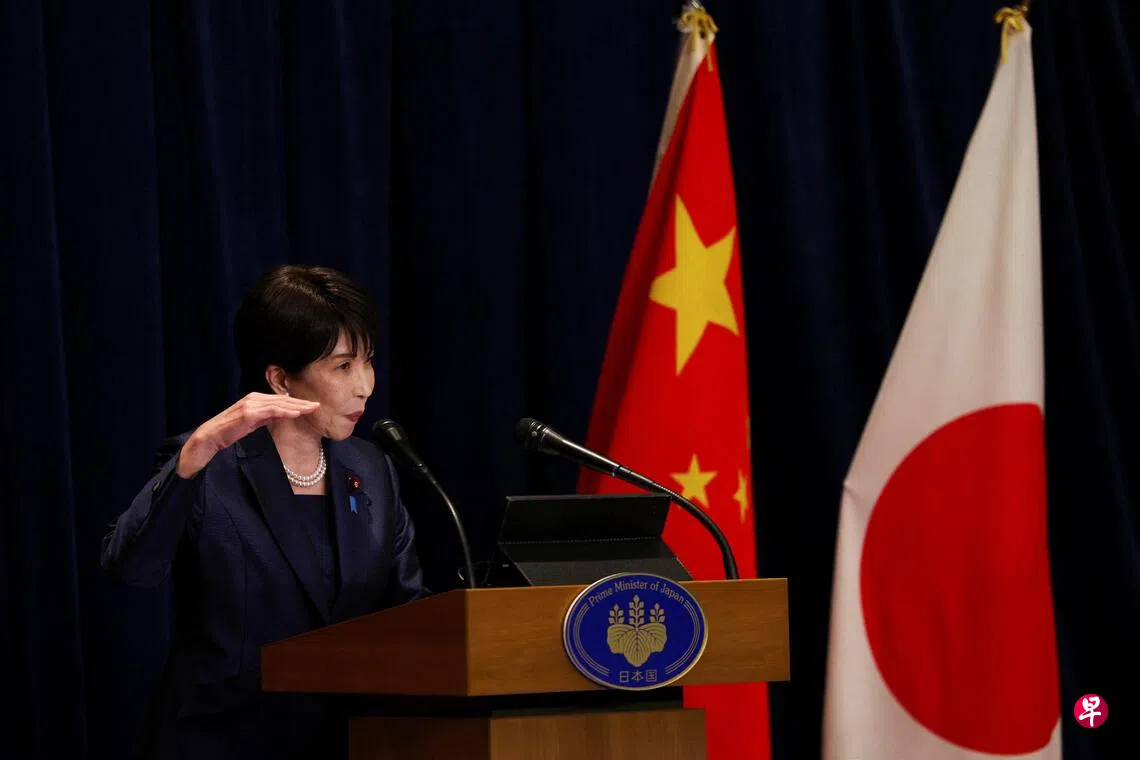
After Japanese Prime Minister Sanae Takaichi received a cool reception at the Asia-Pacific Economic Cooperation (APEC) summit in Shenzhen, Japanese non-profit organisation Genron NPO held a “Japan-China Strategic Dialogue” with Chinese academics in Shanghai. It is another non-governmental exchange mechanism launched to explore the possibility of resuming dialogue, after the organisation’s Tokyo-Beijing Forum was postponed last year for the first time.
Analysts say that with official channels closed, such non-governmental academic exchanges can provide early warnings of risks and reduce miscalculations. But they do not represent a breakthrough in ties, let alone a thaw.
Genron NPO said in a press release on its Japanese-language website on Saturday (28 November) that the two-day Japan-China Strategic Dialogue opened in Shanghai on Friday (27 November). The 10 Japanese representatives included Genron NPO founder Yasushi Kudo and former Bank of Japan deputy governor Hirohide Yamaguchi. The Chinese delegation comprised 16 scholars, including Chen Dongxiao, president of the Shanghai Institutes for International Studies.
Kudo stressed at the meeting that, at a time when relations between the Japanese and Chinese governments were in difficulty, non-governmental actors were taking the initiative to open the door to dialogue. This was also the original purpose of launching non-governmental dialogue between the two sides.
Genron NPO has organised the Tokyo-Beijing Forum annually since 2005. The non-governmental exchange mechanism, which has run for 20 years, was forced to postpone last year after Takaichi’s remarks about a “Taiwan contingency” triggered tensions between China and Japan. It has yet to reconvene.
According to the Japanese press release, the dialogue covers four themes, including the importance of Japan-China strategic dialogue, economic security and expectations for an international order led by major powers.
Chen Dongxiao said at the meeting that preparations had encountered many difficulties, but both sides had ultimately overcome the obstacles, reflecting a shared willingness to address the current problems in China-Japan relations seriously. Chinese scholars at the meeting also voiced strong criticism of Japan’s understanding of history, the Japan-US alliance and the Taiwan issue.
As of press time, the Shanghai Institutes for International Studies had not published any information about the meeting on its website.
China-Japan relations hit a low after Takaichi’s remarks about a “Taiwan contingency” last November. Japan had hoped to use the Shenzhen APEC summit to promote a thaw in bilateral ties. During the summit, Takaichi reiterated that the Japanese government’s basic position on Taiwan remained based on the 1972 Japan-China Joint Communique, known in China as the China-Japan Joint Statement, and had not changed in any way.
But her remarks drew no positive response from China, and Takaichi ultimately failed to secure formal talks with Chinese President Xi Jinping.
Bao Chengke, a council member of the Chinese Association for Japanese Studies, told Lianhe Zaobao that, from China’s perspective, Takaichi’s position remained “ambiguous and misses the key point, as she has consistently been unwilling to state clearly that ‘Taiwan is part of China’s territory’”. This, he said, was the crux of why China-Japan relations could not achieve a substantive breakthrough at present.
Chen Yang, head of the Japan programme at the Northeast Asia research centre of Wode Think Tank, and Ho Szu-shen, a distinguished professor in the Department of Japanese Language and Culture at Taiwan’s Fu Jen Catholic University, both noted that China-Japan relations had a long tradition of using non-governmental engagement to encourage official exchanges. When official channels are blocked, such non-governmental “Track Two” channels can maintain a minimum level of communication, but do not signal an improvement in bilateral ties.
Ho added: “When official channels are closed, academics can at least open a channel to help China and Japan avoid miscalculations when relations are poor.”
Chen Yang said Track Two exchanges could create room for communication but could not break the deadlock in official relations. “This dialogue is a valuable attempt at communication in a time of crisis, but it is not a turning point.”
Kei Koga, an associate professor of public policy and global affairs at Singapore’s Nanyang Technological University, also said in an interview that a political breakthrough between China and Japan remained difficult. However, exchanges in less politically sensitive areas such as business and academia could continue and might even expand further. Such exchanges could create opportunities for the resumption of higher-level political dialogue in future.
