

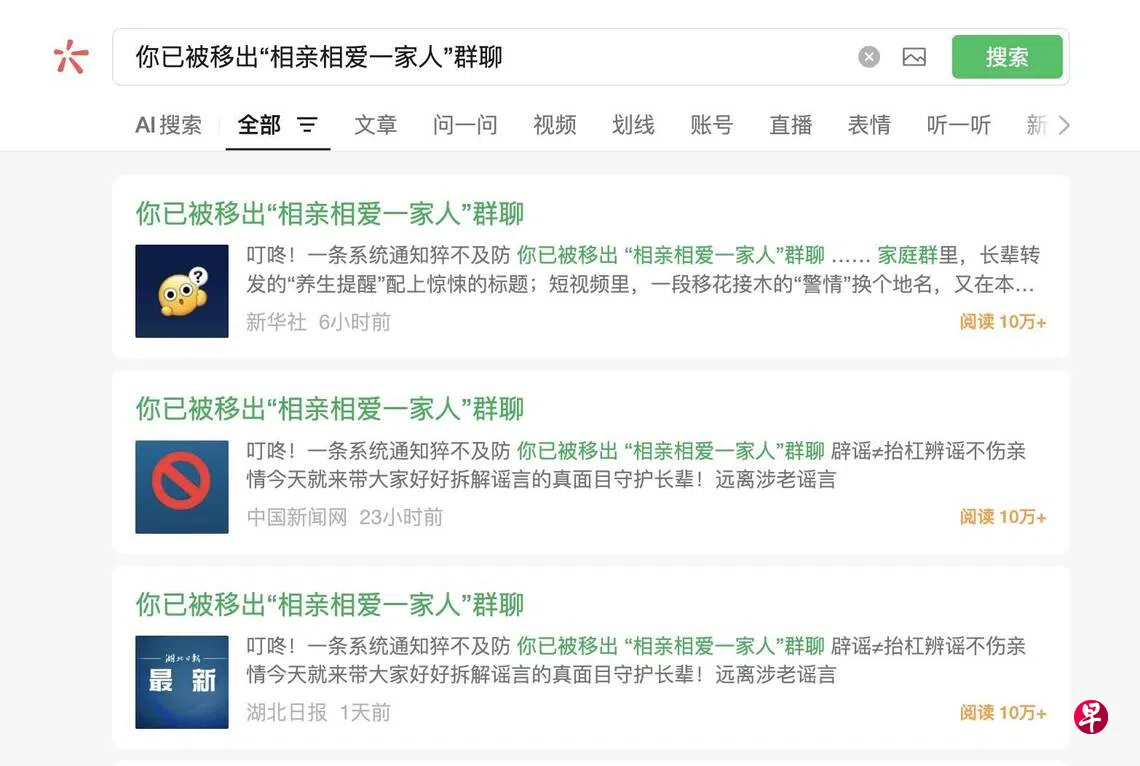
Government and state media social media accounts across China have drawn complaints from internet users after repeatedly posting clickbait articles headlined “You have been removed from the ‘Loving Family’ group chat” (《你已被移出“相亲相爱一家人”群聊》) in recent days to attract traffic. A Chinese academic criticised the swarm of clickbait posts as “spreading rumours in the guise of debunking them”, causing alarm and distress among older people.
An article titled “You have been removed from the ‘Loving Family’ group chat” has appeared on the WeChat public accounts of government bodies and state media across China this week. Many versions have become viral hits, earning WeChat’s “100,000+” label for posts with more than 100,000 views. “Loving Family” is a common name for family WeChat groups in China.
An article in the “Anhui Commentary” (《安徽时评》) column of Anhui Daily (《安徽日报》) on Saturday (28 November) said many readers had tapped on the post in alarm, only to discover that their parents had not actually removed them from the chat: it was an explainer about debunking rumours. After the false alarm, the comments section filled with self-deprecating remarks: “I thought my mum had really kicked me out.”
The article said: “A poster meant to debunk rumours first makes tens of millions of people victims of a rumour, then turns around and tells them: look, this is how rumours work. When you manufacture panic to teach people how to see through panic, the debunking itself has already gone astray. Must efforts to counter rumours really be packaged as rumours?”
Meanwhile, a popular social media post shared by several prominent Weibo commentators said an internet user had challenged Hubei Daily (《湖北日报》), the official newspaper of the Chinese Communist Party’s Hubei provincial committee, on Friday (27 November): “One WeChat public account article nearly killed my mother... Is this what you wanted to see?”
The post read: “The user said their terminally ill mother saw Hubei Daily’s post, ‘You have been removed from the Loving Family group chat’, and mistakenly believed her family had kicked her out of the group. As the father did not understand the internet either, he could only say he did not know. The mother therefore thought her family had given up on her and began making arrangements for her death that evening.”
On Saturday evening, Cao Lin, a professor at Huazhong University of Science and Technology’s School of Journalism and Information Communication, wrote on his personal WeChat public account, “Tucao Qingnian Boshi”: “Having ‘You’ve been removed from the family chat’ all over the screen is really tacky.”
The article said that in recent days, “You have been removed from the ‘Loving Family’ group chat” had been circulated as though it were a standard press release, flooding feeds to such an extent that users might suspect their phones had been infected with malware. “The uniform reposting of identical content exposes the media’s laziness and self-indulgence.”
It argued that this swarm of clickbait posts, “spreading rumours in the guise of debunking them”, not only failed to inform readers and dispel rumours but instead alarmed the public and distressed particular groups. “Older people will simply be frightened by headlines like these. For those who lack media literacy and the ability to assess headlines, this kind of suspenseful, alarmist headline causes anxiety and distress. They open their phones, see a message like this pop up and genuinely believe they have been removed from the Loving Family group chat.”
The article added: “This sort of clickbait, trying to be clever, is merely self-indulgent entertainment, a bit of fun. It turns public education into a joke, uses removal from a group chat as a gimmick and exploits headlines to generate traffic. Indiscriminate dissemination without a clearly defined audience is ineffective. It can even backfire, spreading rumours in the name of debunking them.”
By Saturday evening, China’s state news agency Xinhua had deleted its earlier article, “You have been removed from the ‘Loving Family’ group chat”. But state media and government accounts in various parts of the country were still posting related content.
