

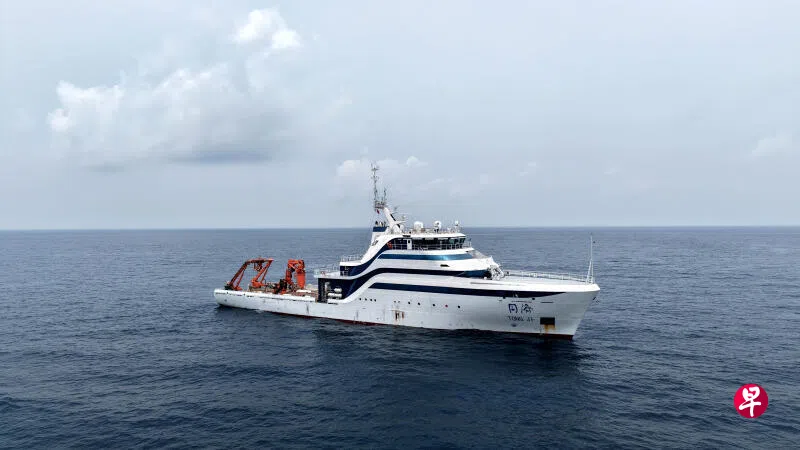
Research vessels from mainland China have been operating unusually in waters near Taiwan for months, with their routes overlapping undersea cables, Japanese media reported. The activity may be preparation for possible contingencies amid tensions in the Taiwan Strait.
The Yomiuri Shimbun on Sunday (1 November) cited geospatial intelligence analysis company ingeniSPACE as saying that four mainland research vessels had repeatedly engaged in unusual activity in specific waters near Taiwan since May. They include the Xiangyanghong 22, which belongs to the mainland’s Ministry of Natural Resources; the Tongji and Tan Kah Kee, operated by universities in Shanghai and Fujian; and a vessel identified as “MUSHANZI” on the Automatic Identification System (AIS).
The data showed that the Xiangyanghong 22 repeatedly sailed in specific waters north of Taiwan, slowing down, stopping and changing course irregularly. Similar behaviour was observed from the Tan Kah Kee in waters to the east and the MUSHANZI in the Bashi Channel to the south. The Tongji repeatedly sailed around Taiwan’s main island, stopping or slowing down at several specific locations.
Through analysis of AIS and other data, ingeniSPACE found that all the areas where the vessels slowed down or stopped overlapped with routes of undersea cables connecting Taiwan with other overseas locations. It assessed that the mainland vessels were gathering information on undersea fibre-optic cables across a wide area.
The Yomiuri Shimbun quoted a Taiwanese official as saying that ingeniSPACE’s data and analysis were consistent with the Taiwanese authorities’ understanding of the situation.
Chisako Masuo, a professor at Japan’s Kyushu University, said the mainland vessels appeared to be preparing for a possible conflict over Taiwan or a dispute between mainland China and the US. She said Beijing might, if necessary, sever undersea cables along the Pacific coast to disrupt Japanese society and hinder communications between Japan and the US.
Jason Wang, chief operating officer of ingeniSPACE, said similar operations had also been observed in waters near Japan and the Philippines, adding that China has been “deploying gray-zone tactics in a wide area along the First Island Chain in anticipation of a contingency.”
Responding to the report, former Global Times editor-in-chief Hu Xijin wrote on Weibo on Sunday that Taiwan’s waters lie at a key point in the East Asia-Pacific data corridor. He said 24 undersea cables run through the surrounding waters, including 14 international lines connecting Taiwan with countries such as Japan, the US, Singapore and the Philippines. “If all or most of these cables were cut at the same time, the impact on Taiwan would certainly be paralysing.”
Hu said mainland China should possess all the hydrographic data, seabed terrain information and other relevant information held by the US and Japan. “As for what we should use that information for, I believe its uses should be comprehensive, and that of course includes supporting our national defence.”
