

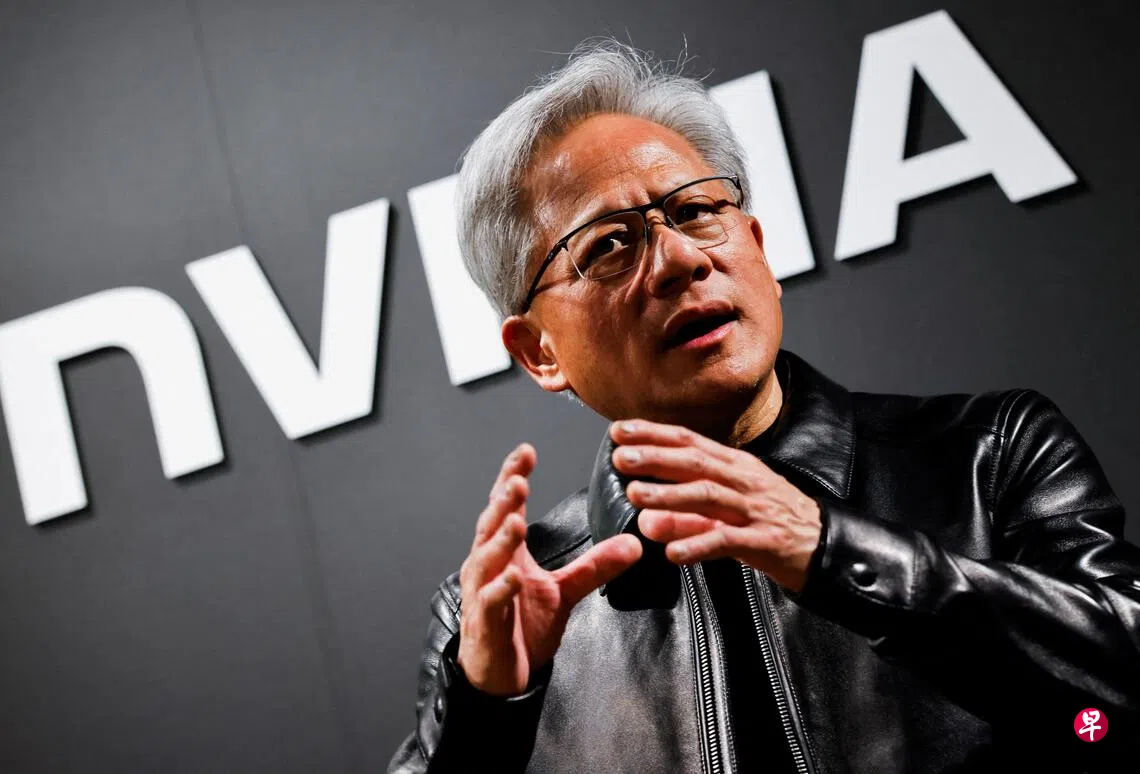
China’s state-run Global Times (《环球时报》) has published an article rebutting Bloomberg’s claim that China is the “biggest loser”, warning that US restrictions on technology will ultimately hurt the US itself.
Jensen Huang announced his resignation as chief executive of US technology giant Nvidia on Thursday (12 November), amid suspicions of espionage linked to an extramarital affair. Bloomberg published an opinion piece the same day titled “China Is the Biggest Loser From Jensen Huang’s Downfall” (《中国将是黄仁勋陨落的最大输家》).
The article opened by saying that Huang’s departure might allow Nvidia to move on from the mess he had left behind, but that the repercussions for China’s artificial intelligence (AI) industry were only beginning.
It predicted that, following its investigation into the espionage controversy surrounding Huang’s extramarital affair, the US government would further tighten export controls on advanced products destined for China. Legal channels through which Chinese companies obtain Nvidia hardware could also be affected.
The article also noted that Huang had advocated open-weight AI models and defended “distillation”. The debate over distillation has set the tone for US restrictions on Chinese large AI models, with US lawmakers and companies accusing Chinese technology firms of using the technique to steal US AI technology. Without Huang, Chinese AI companies would have one fewer supporter.
It said Huang’s legacy appeared to lie in building seemingly impossible bridges, in the hope that the AI revolution would not split the world into two camps as during the Cold War. Yet it now seemed that one person’s actions could quickly burn those bridges, potentially leaving China stranded on the other side.
On Friday (13 November), the Global Times published a commentary titled “Huang has barely resigned, and US media is already imagining that ‘China must lose’” (《黄仁勋刚辞职,美媒就臆想“中必输”》), rebutting the Bloomberg article.
The Global Times commentary said Bloomberg had rushed to declare China the “biggest loser” as soon as Huang resigned from Nvidia. It questioned whether Bloomberg had prepared the article in advance, waiting for his resignation to label China the “biggest loser”.
The commentary cited examples ranging from the US subprime mortgage crisis to US-Iran conflict and the yen’s depreciation, saying US media would seize on almost any development to claim that “China has lost again”. This had prompted Chinese internet users to dub the phenomenon “China must lose”.
The Global Times said the “China must lose” narrative had been disproved by events almost every time it surfaced. It argued that this narrative reduced complex international relations to a game of winners and losers, interpreting any event first and foremost as a setback for China in an attempt to sustain a psychological sense of “American exceptionalism” and evade the multiple crises facing the US itself. Repeatedly making erroneous predictions not only weakened the US’s own ability to understand events, but also misguided its foreign policy to some extent, leading it to pay a higher strategic price.
The commentary described Bloomberg’s “China must lose” article as a product of anxiety among some Americans, who could not face or accept the independent development of Chinese industries and instead deceived themselves by claiming imaginary victories.
It concluded that Huang had repeatedly called for open-source technology and openness because, for the technology industry, openness meant survival and isolation meant death. If US openness depended on Huang alone, and his ignominious resignation meant the US would close off channels for technological cooperation, then even greater trouble lay ahead for the US.
