

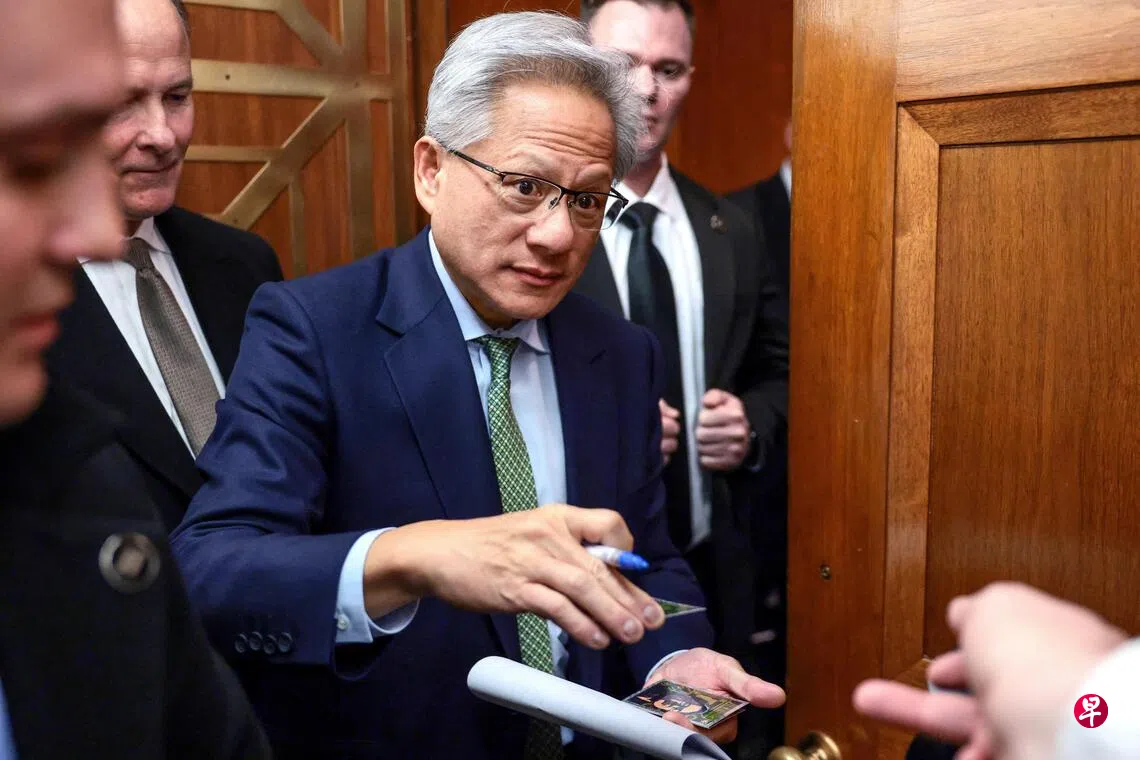
After Jensen Huang, founder of US chip giant Nvidia, was reinstated as chief executive officer (CEO), China’s state-run Global Times said in a commentary that malicious attempts to undermine China-US relations would not automatically disappear. It warned that some in American society were still profiting from anti-China narratives and called for vigilance.
In a commentary published on Tuesday (24 November), the Global Times criticised some US politicians and media outlets for using the Jensen Huang affair to stoke fears of “Chinese infiltration”. The resulting damage to American perceptions of China “will not automatically disappear simply because Huang has been reinstated”, it said.
The commentary said the next round of “witch hunts” could take the form of investigative letters, delays in export licence approvals, congressional hearings or unfounded media “exposés”. Even unproven allegations could create uncertainty at critical moments, prompting companies to censor themselves and restrict their own actions when making decisions.
It added that the dramatic reversal in Huang’s fortunes was America’s own affair, but the speed with which the episode was linked to the “China threat” was warning enough. “It reminds us that the specter of profiting from anti-China narratives still wanders through American society. We must remain vigilant.”
Bloomberg’s analysis suggested that the comments could reflect Beijing’s unease over the intense anti-China sentiment exposed by Huang’s ousting. His return has also failed to resolve Beijing’s pressing dilemma: how to respond to sweeping new US restrictions on access to Nvidia’s advanced chips, and whether to risk disrupting a trade truce due to expire on 10 January next year.
The new US rules aim to restrict Chinese companies’ use of chips through overseas data centres and their access to chips through several countries, including Singapore. Strict enforcement could cut off a major source of the computing power China needs to develop the most advanced artificial intelligence models, affecting its efforts to catch up with leading US artificial intelligence laboratories.
The report said Huang’s return had not noticeably slowed Washington’s tightening of controls. On the very day his reinstatement was announced, the US Commerce Department moved to blacklist Singapore-headquartered Megaspeed International and several affiliated entities. Megaspeed International is the company at the centre of the scandal that led to Huang’s earlier dismissal.
Beijing’s response will soon be put to the test: China’s suspension of its ban on exports of gallium, germanium and antimony to the US expires on Friday (27 November).
China imposed the ban in December 2024 after the US tightened restrictions on its semiconductor industry. Beijing suspended the ban after Chinese President Xi Jinping and US President Donald J. Trump reached a trade truce in South Korea last year. These minerals are essential raw materials for products including semiconductors and ammunition. China’s dominance in their production allows it to use supplies as leverage in negotiations with the US.
Allowing the suspension to expire would enable Beijing to retaliate without announcing new restrictions. China’s Commerce Ministry has warned that it will take countermeasures if Washington presses ahead with the controls, but has not specified what these would entail. It has also urged the Trump administration to resolve differences through dialogue.
Sun Chenghao, a scholar at Tsinghua University’s Center for International Security and Strategy, said: “Huang’s reinstatement may influence the timing and tone of Beijing’s response, but I would expect limited change in its underlying calculation. For Beijing, the decisive question is whether Washington changes the restrictions themselves.”
