

The Taipei mayoral race is heating up, with a reversal in the coattail effect within the Blue and Green camps signalling a new phase of the electoral tussle.
In the Kuomintang (KMT) camp, incumbent Mayor Chiang Wan-an initially used his strong lead to boost city council candidates. But as Democratic Progressive Party (DPP) challenger Puma Shen gains ground, councillors are now accompanying Chiang in groups to bolster his campaign. Shen, meanwhile, has gone from relying on councillors to guide him through local constituencies to drawing crowds and boosting their campaigns through his “Ocean Current” movement.
The two held their first televised debate on 31 October. A post-debate telephone poll released the following day by TVBS, one of the organisers, showed Chiang leading Shen by 46% to 42%, with the gap narrowing to four percentage points. Meanwhile, 47% of respondents thought Shen had performed better in the debate, against 40% who favoured Chiang.
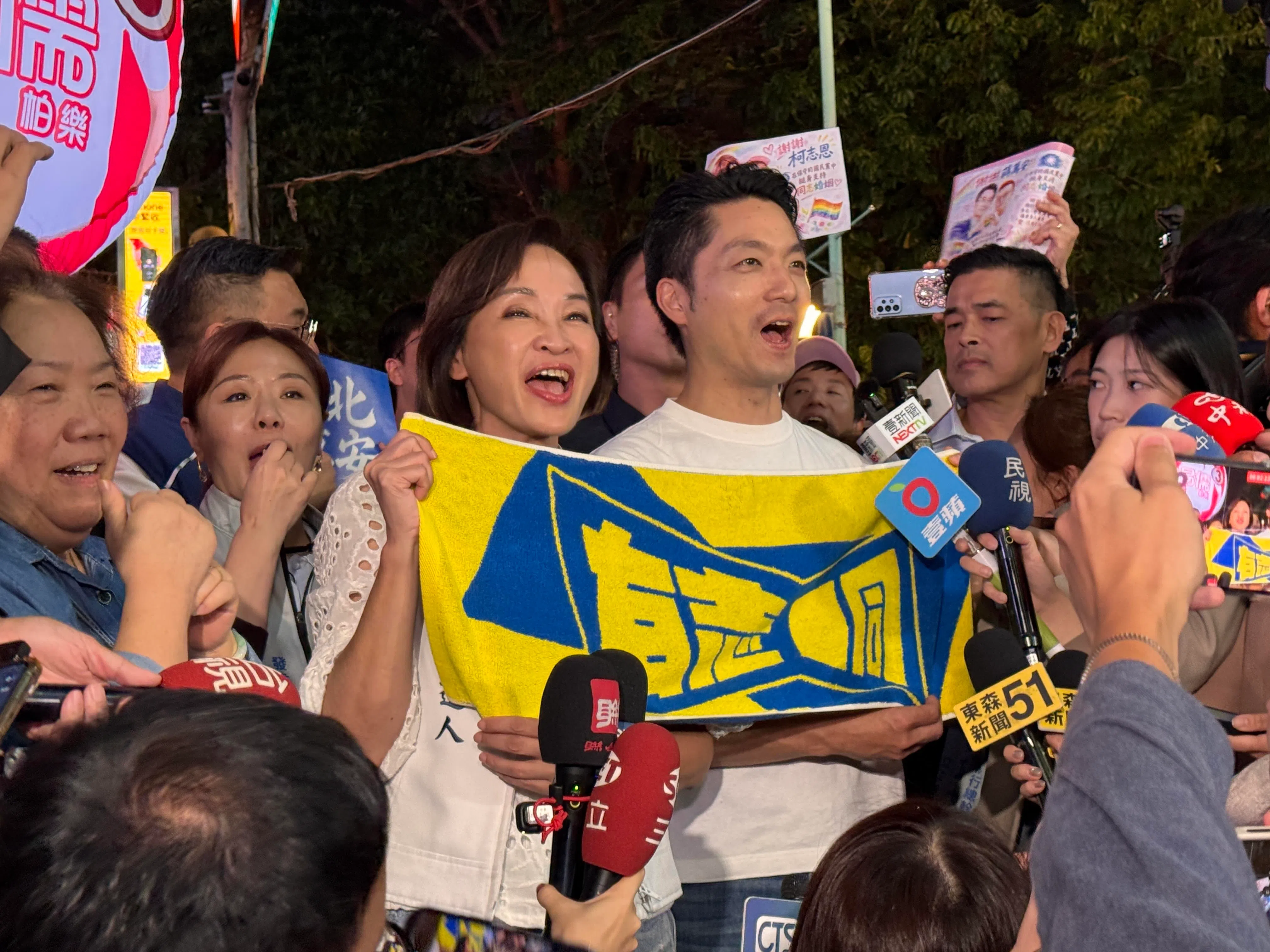
After the debate, Chiang declared that he would “sound the bugle for a counteroffensive”, and the contest promptly shifted to the streets. On 1 November, Shen held a campaign motorcade through Da’an and Wenshan districts, followed by a rally and policy speech at Da’an Forest Park, taking his campaign into a Blue-camp stronghold. Taiwanese media reported that more than 35,000 people attended.
The next day, Chiang visited the same park to canvass support among morning exercisers, saying he would visit parks across the city to seek support. On Tuesday (3 November) evening, he also joined Kaohsiung mayoral candidate Ko Chih-en for a campaign walkabout at Ningxia Night Market, where the “Ocean Current” movement began.
While Shen demonstrated the “Ocean Current” movement’s mobilisation power through a large gathering, Chiang returned to defend his ground at the same location before joining forces with Ko across constituency lines. Their contest has shifted from debate performances to street-level support and organisational mobilisation.
Chiang had enjoyed a clear lead during the nomination period. The KMT formally selected him in July to seek re-election; a TVBS poll in May showed him leading Shen by 58% to 30%.
As Shen’s profile rose and Taipei’s handling of food safety, rat infestations and child abuse came under scrutiny, a TVBS poll in early October showed Chiang’s support falling to 49% and Shen’s rising to 41%, narrowing the gap to eight percentage points.
On 19 October, Taichung Mayor Lu Shiow-yen became chair of Chiang’s campaign headquarters. Taipei’s five KMT legislators also joined his campaign team, in a rare instance of local political heavyweights and party legislators jointly campaigning for a candidate.
When the DPP nominated Shen in May, he was a legislator and academic with no experience in local elections and a lower profile than the incumbent mayor. His active involvement in last year’s mass recall campaign had also made him a prime target for the Blue camp.
In early polls, Shen trailed Chiang by nearly 30 percentage points. He subsequently raised his profile through local visits, joint appearances with councillors and street speeches. On 18 August, Shen held a walkabout at Ningxia Night Market, where supporters waited along the route and queued for autographs and photographs. The event became an early milestone in the emergence of the “Ocean Current” movement.
On 11 October, the first large-scale “Ocean Current” motorcade set off from Zhongshan and Datong districts, with more than 2,000 riders taking part. An evening speech at Dalongdong Baoan Temple drew nearly 10,000 people, with more than 60,000 livestream views. “Ocean Current fuelling stations” linked local councillors’ campaign headquarters, connecting Shen’s itinerary with their constituency organisations.

In politics, the “coattail effect” refers to a popular candidate at one level of an election pulling support for party colleagues contesting at other levels. In Taiwanese elections, this is often described as a “mother hen leading her chicks”.
In this election, the Blue camp has shifted from Chiang’s early lead lifting up council candidates to stepping up joint billboards and group appearances as Shen gains momentum – in a trend described as “chicks supporting the mother hen”. In the Green camp, councillors initially took the lesser-known Shen around their constituencies; now Shen is drawing crowds and boosting council candidates.
KMT Taipei City Councillor Chan Wei-yuan, who previously worked as a legislative aide in Chiang’s parliamentary office, told Lianhe Zaobao that a mayoral candidate with strong prospects could increase supporter enthusiasm to vote, thereby helping councillors from the same party. But swing voters who backed Chiang would not automatically vote for KMT council candidates. Swing voters “will not decide whether to extend their support to councillors based on how strong or weak the mayoral candidate’s momentum is”, he said. Councillors still had to win their support individually.
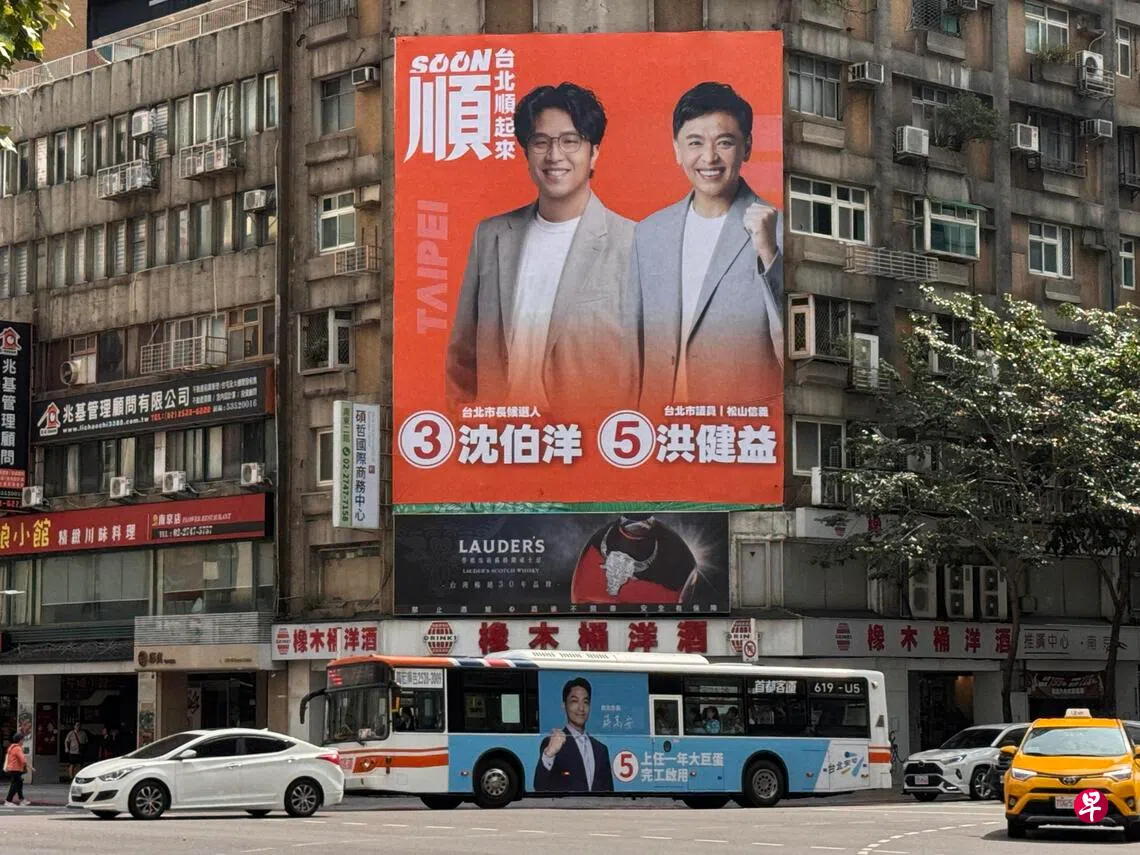
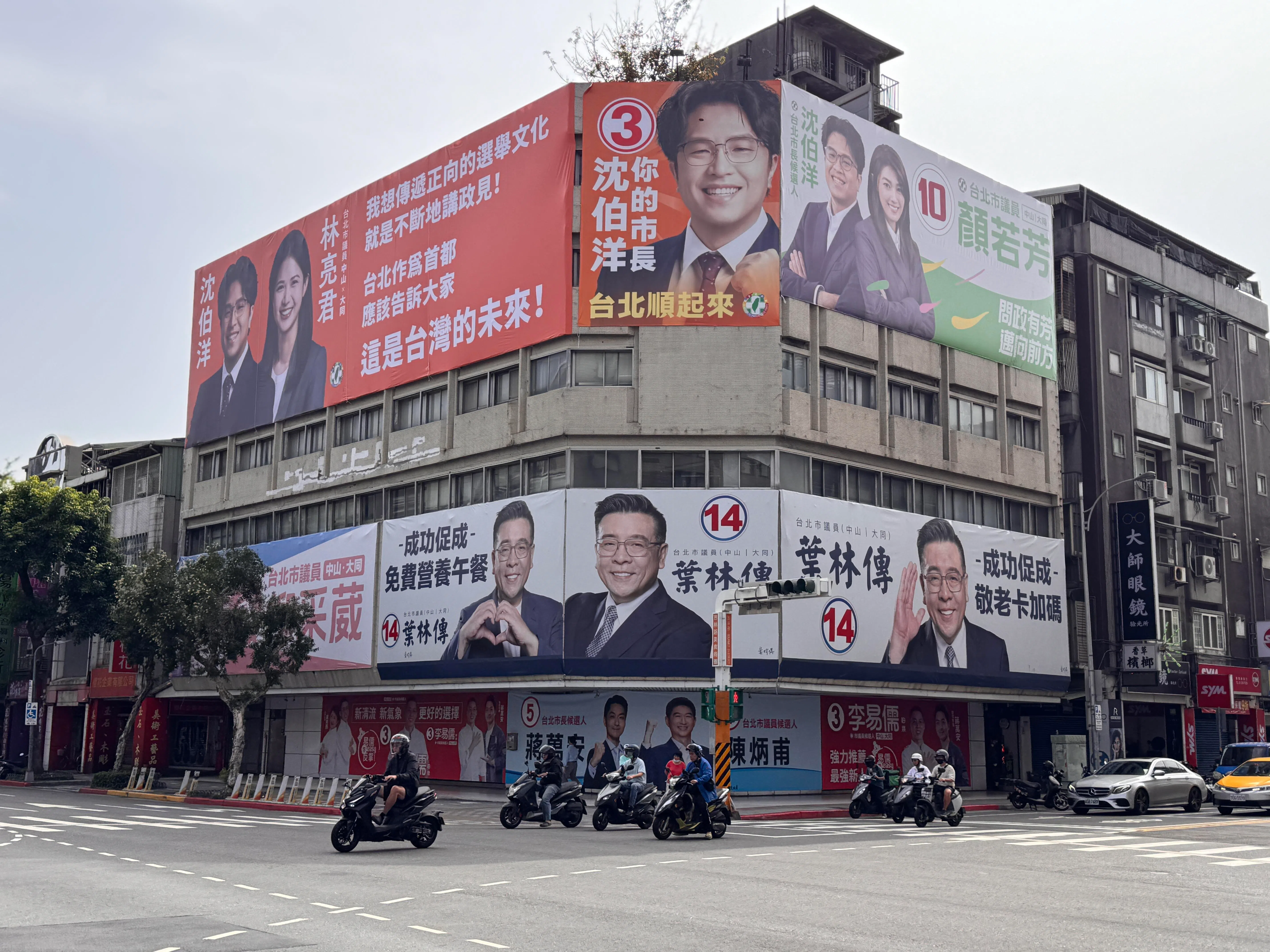
Billboards are a visible indicator of the coattail effect: While Green-camp council candidates frequently share billboards with Shen, fewer Blue-camp council candidates appear alongside Chiang than might be expected.
Chan, who has served as a campaign spokesman for Ting Shou-chung, Hau Lung-bin and Johnny Chiang, said he initially felt that joint appearances by mayoral and council candidates were “only natural”; having worked in Chiang Wan-an’s office, he did not need billboards to prove their relationship. Only after seeing more billboards featuring Green-camp candidates alongside Shen did Chan make a conscious effort to put up more photographs of himself with Chiang.
“I didn’t want the impression to be that Chiang Wan-an was nowhere to be seen,” he said. Other blue-camp councillors subsequently followed suit.
Chan also noted that after Chiang’s lead came under challenge, Blue-camp councillors began accompanying him to constituencies more frequently as a group, rather than “running away” as the polls tightened. He stressed, “Even if the chicks have to support the mother hen, that’s fine.”
DPP Taipei City Councillor Yen Juo-fang represents Zhongshan and Datong and also took part in Shen’s first large-scale “Ocean Current” motorcade. Speaking to this newspaper, she recalled that Shen had a low profile when he first entered the race, and councillors often guided him on local visits; people “knew the councillors better than they knew Puma Shen”.
Yen saw the Ningxia Night Market event and the subsequent “Ocean Current” crowds as a turning point. The campaign had shifted from “the chicks taking him [Shen] around local neighbourhoods” to “the mother hen leading all of us chicks forward”.
Polling expert Tai Li-an said at a Xinmin Association press conference on Tuesday that the DPP might deploy Shen as a “strategic weapon”, sending him on brief, dispersed campaign visits to other areas to avoid overshadowing local candidates or diminishing returns. But staying away from Taipei for too long could also prompt voters to question why he was “not in Taipei”.
Overall, the coattail effect in Taipei’s mayoral race has extended beyond joint billboard photographs to local rallies, group canvassing and campaign visits across constituency lines. The election results will test whether mayoral candidates’ popularity can translate into votes for council candidates, and whether the latter can build their own local support after benefiting from the top candidate’s appeal.
