

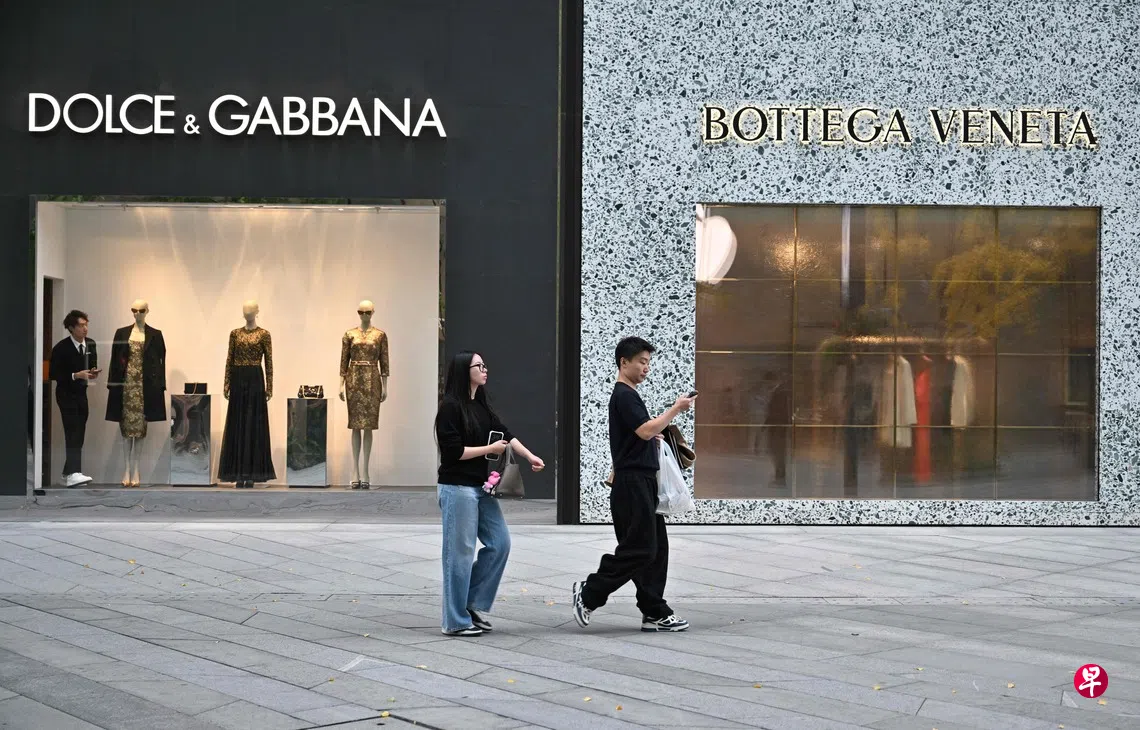
Retail spending on goods continues to shrink in Beijing and Shanghai, raising concerns about weakening consumption in China’s first-tier cities. Beijing’s retail sales of consumer goods plunged 12.1% year on year in October, while Shanghai recorded a seventh consecutive month of decline, falling 4.5%.
An academic interviewed said that, beyond falling car sales, weak consumption in the two cities was ultimately rooted in uncertainty over residents’ income and employment prospects. However, retail sales data do not fully capture growth in spending on services.
China’s National Bureau of Statistics released industrial output, retail sales and investment data on Monday (16 November). Total retail sales of consumer goods in October edged up 0.4% year on year to 4.6463 trillion yuan (S$897.28 billion).
Provinces and cities subsequently released their October consumption figures, with Beijing and Shanghai’s retail sales performing significantly worse than the national average.
Calculations based on data from the Beijing Municipal Bureau of Statistics show that the city’s total retail sales in October were about 127.1 billion yuan, down a sharp 12.1% year on year. Data from the Shanghai Municipal Statistics Bureau showed that the city’s total retail sales fell 4.5% to 147.8 billion yuan, marking a seventh straight month of decline.
By contrast, retail sales in China’s two other first-tier cities, Guangzhou and Shenzhen, were relatively resilient. In the first three quarters, their total retail sales rose 2.5% and 2.3% year on year respectively, outpacing the national increase of 1.1%.
Weak car sales were a major drag on retail sales in Beijing and Shanghai. Retail sales of cars in Beijing fell 20.7% year on year in the first 10 months, while Shanghai recorded a 21.1% decline over the same period, with the drop in October alone reaching 39.4%.
However, weakening car sales are not unique to Beijing and Shanghai. National retail sales rose 0.4% year on year in October, but grew 2.5% when cars were excluded, indicating that weak spending on cars was a significant drag on the nationwide figures.
Some observers have noted that Beijing and Shanghai, as first-tier cities with some of China’s highest household incomes, should play a greater role in expanding domestic demand. Yet their continued decline in spending on goods suggests that consumer confidence in first-tier cities remains under pressure, underscoring the challenges China faces in boosting domestic demand.
Su Jian, a professor at Peking University’s School of Economics and director of its national economy research centre, told Lianhe Zaobao that there could be three reasons why retail sales in Beijing and Shanghai were underperforming the national average.
First, retail sales data mainly reflect spending on physical goods. Residents’ spending on services in the two cities may have grown more quickly without being captured in these figures. Second, growth in per capita disposable income in both cities lagged the national average in the first three quarters of this year, which could be a fundamental factor holding back consumption. Finally, population data showing an outflow of non-local residents from both cities in recent years suggest this could also be restraining consumption growth.
Su said consumption was a function of income, and that uncertainty over residents’ income and employment prospects remained the fundamental reason for relatively weak spending in Beijing and Shanghai. “Falling property prices and uncertainty over employment and income have dealt a considerable blow to consumption among residents of first-tier cities.”
However, weak retail sales figures do not mean people are cutting back on spending across the board. Data show that spending on services in Beijing still rose 4.3% year on year in the first 10 months of this year.
Su explained that per capita consumption expenditure in Beijing and Shanghai continued to grow year on year. Given the sharp fall in spending on physical goods, this indirectly suggests that spending on services such as culture and tourism has increased.
Although sluggish consumption in Beijing and Shanghai has prompted concern among some observers over the prospects for China’s consumption recovery, an article published early this month in International Finance News, a publication under China’s state-run People’s Daily, offered a more optimistic interpretation centred on shifts in consumption patterns. The article was titled “Megacities enter a period of shifting consumption patterns” (《超大城市进入消费换挡时间》).
The article noted that the decline in total retail sales in Beijing and Shanghai could easily be interpreted as a sign of weakening consumption. However, the main drag came from cars and did not mean residents had stopped spending.
It described the changes in consumption in Beijing and Shanghai as a microcosm of the transformation in China’s domestic demand. “As room for growth in physical goods narrows and spending on services takes over to support consumption, megacities are the first to complete this round of shifts in consumption patterns.”
