

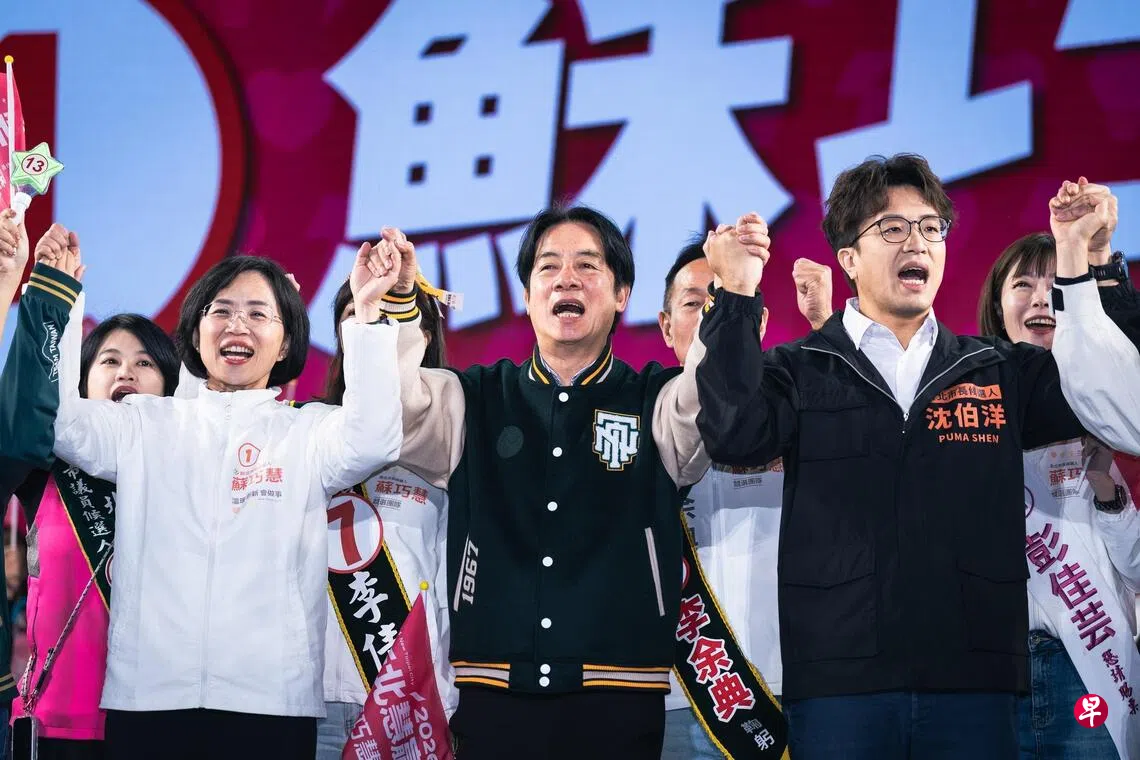
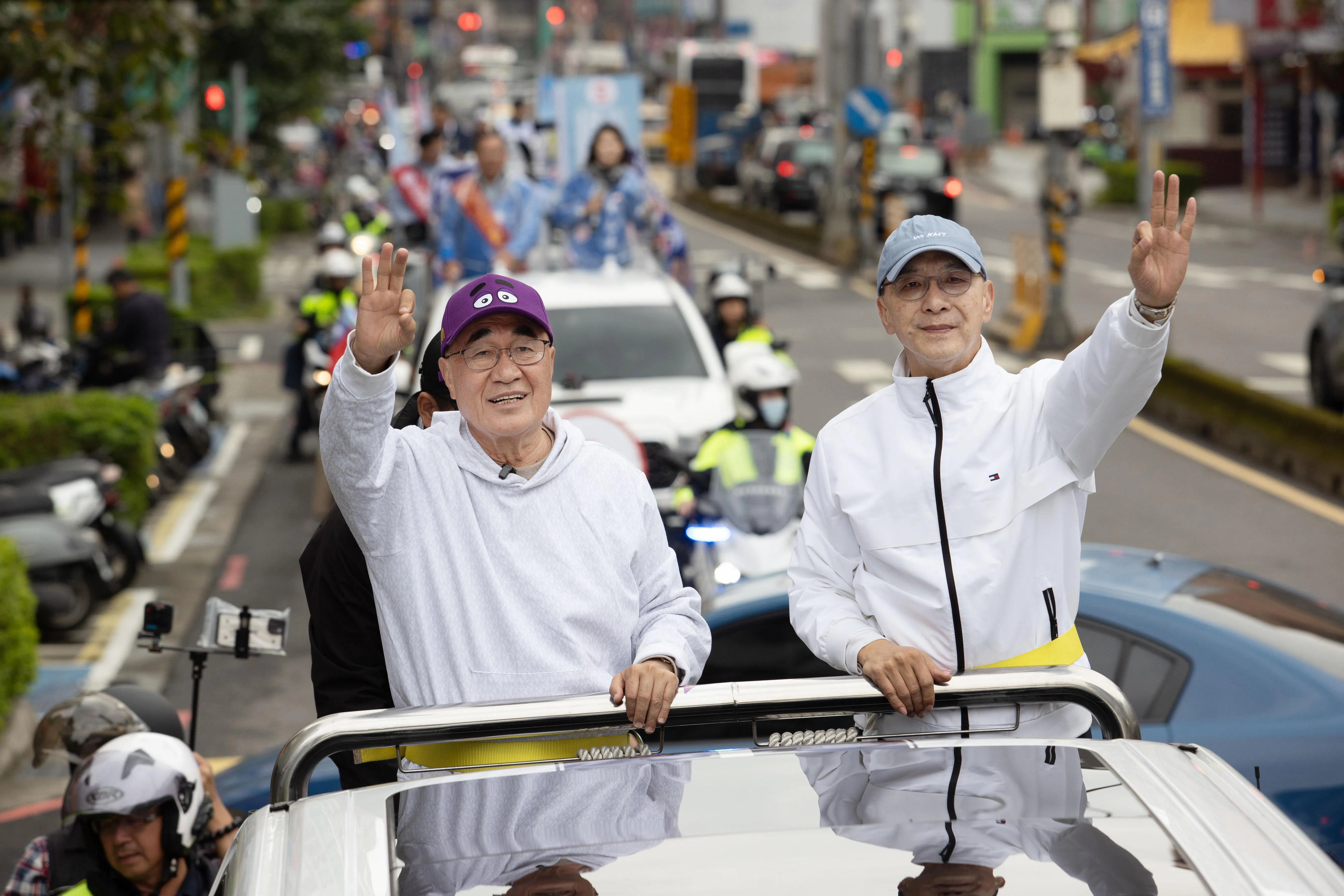
Whether New Taipei will change hands is one of the biggest questions in Taiwan’s upcoming nine-in-one local elections. With a population of four million, this electoral stronghold will have a crucial bearing on the 2028 presidential election. As the campaign enters its final stretch, the Blue and Green camps remain locked in a tug of war.
The Kuomintang’s (KMT) New Taipei mayoral candidate Lee Shu-chuan initially led in opinion polls, but his Democratic Progressive Party (DPP) rival Su Chiao-hui has recently shown signs of overtaking him.
New Taipei was formerly Taipei County before being upgraded to a special municipality in 2010. The KMT has governed the area for more than 20 years, and incumbent mayor Hou Yu-ih has an approval rating of 70%. Lee, a fellow KMT member who rose through the ranks, has an engineering background and extensive political experience, having served as deputy mayor of New Taipei, Kaohsiung and Taipei.
But the 68-year-old is contesting an election for the first time. Relying solely on his reputation for administrative competence and engineering expertise, he faces an uphill struggle against Su’s formidable challenge and mobilisation network.
Su, 50, is a three-term legislator whose father, former premier Su Tseng-chang, served two terms as Taipei County magistrate. She has substantial family resources and deep local roots, and has worked hard on the ground. She has also spent six years building a podcast around her “Mother Otter” persona, cultivating an approachable image. Academics therefore find the KMT’s portrayal of the New Taipei contest as a battle between “ordinary people and the privileged elite” unconvincing.
Su Tseng-chang’s forceful style has made him a polarising figure, and his daughter readily acknowledges that he is “both an asset and a liability”. He has rarely appeared on stage with her during this campaign. She explained that her father wanted to “leave the spotlight to the main player”. Academics, however, see his decision to manage grassroots vote mobilisation behind the scenes as a way to avoid stoking hostility in the blue camp.
In May this year, the Taiwan People’s Party (TPP) revealed that after Su Tseng-chang made sweeping changes to the chairmen and general managers of eight state-controlled banks during his premiership, Kuang-Shih Intelligent, a company whose directors included Su Chiao-hui’s younger sister Su Chiao-chun, received a combined NT$45 million (S$1.76 million) in investment from the National Development Fund and Taiwan Business Bank. The TPP said the investments had caused state-controlled banks to lose nearly NT$30 million and filed a complaint with the Taipei District Prosecutors Office. Prosecutors and investigators have yet to launch an investigation.
Responding to questions about a possible conflict of interest, Su Chiao-hui has repeatedly stressed that her sister was not responsible for the company’s investment application and had submitted the required declarations. Everything was handled in accordance with the law, she said.
In the campaign’s closing days, Lee has continued to press the issue, accusing Su of “lying ten times” and urging voters to deliver their verdict at the ballot box: “With this government fund investment, the Su family wins if it makes money, but the state loses if it does not.”
However, the case involves complex legal questions. The Ministry of Justice’s Agency Against Corruption has said that the Act on Recusal of Public Servants Due to Conflicts of Interest does not explicitly cover “investment”, and that whether it constitutes an “other transaction for consideration” remains to be clarified. The National Audit Office has written to the Ministry of Justice seeking an interpretation, while the National Development Council has said that equity investments are not subject to mandatory disclosure.
Lee, meanwhile, has faced controversy involving a relative of his own. His younger brother Lee Tzu-fu was indicted in February this year on charges including extortion, after allegedly threatening waste collection operators on Xiaoliuqiu in Pingtung and extorting NT$5.76 million in community benefit payments. He was subsequently sentenced. Lee Shu-chuan has firmly distanced himself from the case, stressing that anyone who breaks the law must be dealt with accordingly and that his brother must bear full legal responsibility for his actions.
Chu Chao-hsiang, an adjunct professor at Chinese Culture University’s Graduate Institute of National Development, told Lianhe Zaobao that Su’s strategy in the New Taipei race had been to “keep the Kuang-Shih Intelligent case vague from start to finish”. With the Ministry of Finance and other agencies backing Su Chiao-chun, and the Control Yuan taking no position, it was difficult for outsiders to establish what was wrong. The case’s impact was therefore limited, he said.
Chu said Lee’s technocratic background meant he was less adept at political sparring and publicity. Although he had recently stepped up his attacks over the Kuang-Shih Intelligent case with the TPP’s help, its complexity made it difficult to resonate with swing voters.
He said Su had spent years cultivating grassroots support and had a strong campaign organisation. She also came across as sincere, without the entitled air associated with the children of senior officials. Her father’s decision to direct operations behind the scenes had also successfully avoided fuelling hostility in the blue camp.
Wang Chih-sheng, secretary-general of the Asia-Pacific Elite Interchange Association, also noted that Su had begun laying the groundwork immediately after the last legislative election. She has projected a moderate, youthful and warm image, while linking up with the “ocean current” wave surrounding DPP Taipei mayoral candidate Puma Shen to win over voters beyond established party networks. The more forceful Su Tseng-chang, meanwhile, has stayed behind the scenes to direct organisational mobilisation.
The KMT is understood to have initially hoped to use Taipei mayoral candidate Chiang Wan-an’s popularity to boost Lee, only for Chiang to become bogged down by the “ocean current" wave, limiting his ability to help in New Taipei.
Long regarded as an unpolished speaker, Lee spoke without a script for almost the entire official policy presentation on 13 November, demonstrating his command of municipal issues. But academics said a meaningful breakthrough in his campaign would still depend on an improvement in Chiang’s electoral prospects and an all-out mobilisation by KMT heavyweights. The weather and turnout on Polling Day could also affect the outcome.
Chu said: “Young people no longer account for as large a share of Taipei’s population as they once did. Many participants in the "ocean current” wave movement are registered residents of New Taipei, so its mobilisation has a greater impact there than in Taipei.”
He said the outcome in New Taipei remained difficult to predict. “The key will be turnout. In the past, turnout in New Taipei has been around 62% to 64%. It would be more favourable for Lee only if turnout reaches or exceeds 65%.”
Wang also said that many young people joining Taipei’s “ocean current” wave came from New Taipei or Keelung. “The ‘ocean current’ wave has certainly been very successful in building momentum. But what we cannot accurately gauge now is this: even if ten people by the roadside have all turned up voluntarily, how many of them are actually Taipei residents?”
However, he noted that New Taipei faced a test of succession rather than re-election, making it difficult for Lee to inherit all of Hou’s votes. The city’s larger inflow of new residents also made its partisan loyalties more fluid. “Compared with the deadlock in Taipei, the electoral picture in New Taipei is relatively clear, with the balance favouring Su,” he said.
