

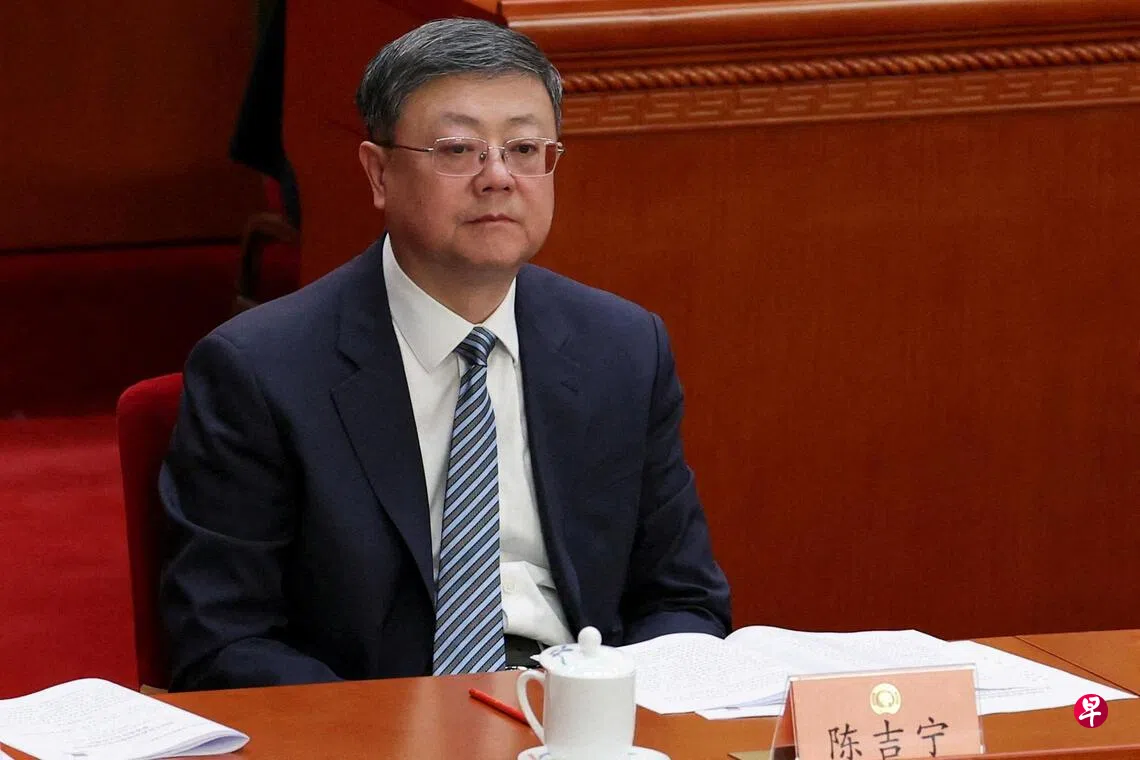
The downfall of Shanghai Communist Party secretary Chen Jining was officially announced on Tuesday (24 November), making him the fourth of the original 24 members of the 20th Chinese Communist Party (CCP) Politburo to be ousted. The first three were Central Military Commission vice-chairmen He Weidong and Zhang Youxia, and former Xinjiang Uyghur Autonomous Region party secretary Ma Xingrui.
The four — two civilian officials and two military leaders — fell in two distinct ways. The first military leader, He Weidong, “disappeared” in March 2025, more than six months before his expulsion from the party was officially announced in October that year. The first civilian official, Ma Xingrui, was transferred out of Xinjiang in July 2025, more than nine months before an investigation into him was officially announced in April 2026. The public had ample time to anticipate that both men were in trouble.
But there were no public warning signs before the subsequent downfalls of Zhang Youxia and now Chen Jining. Their abrupt removal caught observers off guard, particularly in Chen’s case. Although Zhang wielded considerable military power before his downfall, he was already 76 and in the final stretch of his career. Chen, by contrast, had been seen as having a bright future, as one of the strongest contenders for promotion to the Politburo Standing Committee at the CCP’s 21st National Congress in 2027.
Now, with just a year to go before the congress, Chen’s spectacular fall has not only sent shock waves through Shanghai’s officialdom but also has implications for personnel arrangements at the top of the central leadership.
The investigation into Chen Jining recalls the fate of another “Secretary Chen”: Chen Liangyu, the last Shanghai party chief to fall from grace. Exactly 20 years ago, in September 2006, Chen Liangyu was removed by then leaders Hu Jintao and Wen Jiabao over his involvement in the Shanghai social security fund scandal.
That, too, was a year before a party congress — the 17th, held in autumn 2007. The Chen Liangyu affair dealt a major blow to Shanghai officials’ prospects for advancement. His four predecessors as Shanghai party secretary — Jiang Zemin, Zhu Rongji, Wu Bangguo and Huang Ju — had all joined the Politburo Standing Committee, with Jiang and Zhu becoming general secretary and premier respectively. Shanghai, China’s economic centre, had also become a foremost political stronghold, with senior officials who had served there emerging as a prominent force in national politics.
At 60, Chen Liangyu was then among the Politburo’s relatively youthful core members. Only two members were younger: Liu Yunshan, then head of the CCP Central Committee’s Publicity Department, and Zhang Dejiang, then Guangdong party secretary. Chen ranked third by youth. With the added lustre of his Shanghai background, he was widely seen as having a seat on the Politburo Standing Committee all but secured. Instead, he became the first Shanghai party secretary in history to be sentenced to prison for corruption.
Since the Chen Liangyu affair, a seeming curse has hung over Chinese officialdom: on the eve of the CCP’s five-yearly leadership transitions at its national congresses, a Politburo member would fall. Examples include Chongqing party secretary Bo Xilai before the 18th Party Congress in 2012, and another Chongqing party secretary, Sun Zhengcai, before the 19th in 2017. Only the run-up to the 20th Party Congress in 2022 passed without a major downfall.
Chen Jining’s downfall has once again put Shanghai at the centre of a political storm. Excluding the current Politburo Standing Committee members, he, too, ranks third among Politburo members in terms of youth. Only Li Ganjie, head of the Central United Front Work Department, and Vice-Premier Zhang Guoqing are younger. All three were born in 1964, with Chen a few months older than the other two.
There were two main reasons why Chen Jining was considered a leading contender for the Standing Committee. The first was Shanghai’s importance as a political power base. Every Shanghai party secretary between Chen Liangyu and Chen Jining — Xi Jinping, Yu Zhengsheng
The second factor also involved another Chen. In recent years, many officials with a Tsinghua University background had been entrusted with important roles in Chinese politics. Chen Jining was among the most prominent examples.
He has spent more time studying and working abroad than any other member of the current Politburo, having lived in the UK for 10 years. After returning to China in 1998, he spent many years working at his alma mater, Tsinghua University, enjoying a smooth rise through the ranks. In 2015, he moved directly from university president to minister of environmental protection. He subsequently became Beijing mayor, followed by Politburo member and Shanghai party secretary.
Chen Xi, who served successively as Tsinghua University’s party secretary and head of the CCP Central Committee’s Organisation Department, is generally believed to have done much to advance Chen Jining’s career. His Tsinghua background was once a defining credential. But as circumstances changed, that credential gradually lost its lustre.
After Chen Liangyu’s downfall 20 years ago, then mayor Han Zheng served as Shanghai’s acting party chief for six months before Xi Jinping, then Zhejiang party secretary, was transferred to Shanghai to formally take over. This showed how cautiously the CCP leadership approached changes to Shanghai’s leadership team. But Han had spent decades working in Shanghai. The current mayor, Zhu Zhongming, formally took office only on 30 September this year, less than two months ago. It has also been only a little over two years since Zhu was transferred to Shanghai from his post as vice-minister of finance in 2024.
Past practice suggests two possible responses to upheaval in a major political stronghold. One is to send a senior central government official to take temporary charge, as happened after Bo Xilai’s removal in 2012, when then vice-premier Zhang Dejiang concurrently became Chongqing party secretary. The other is to transfer an experienced provincial party secretary into the vacancy: Zhejiang party secretary Xi Jinping filled Chen Liangyu’s vacancy in Shanghai in 2007, while Guizhou party secretary Chen Min’er filled Sun Zhengcai’s vacancy in Chongqing in 2017.
If a senior central official is indeed parachuted into Shanghai, the appointment could be seen as virtually securing a ticket to the Standing Committee next year. But the successive ousting of four Politburo members is unprecedented in more than three decades, adding uncertainty to the choice of who will be sent to contain the crisis.
