

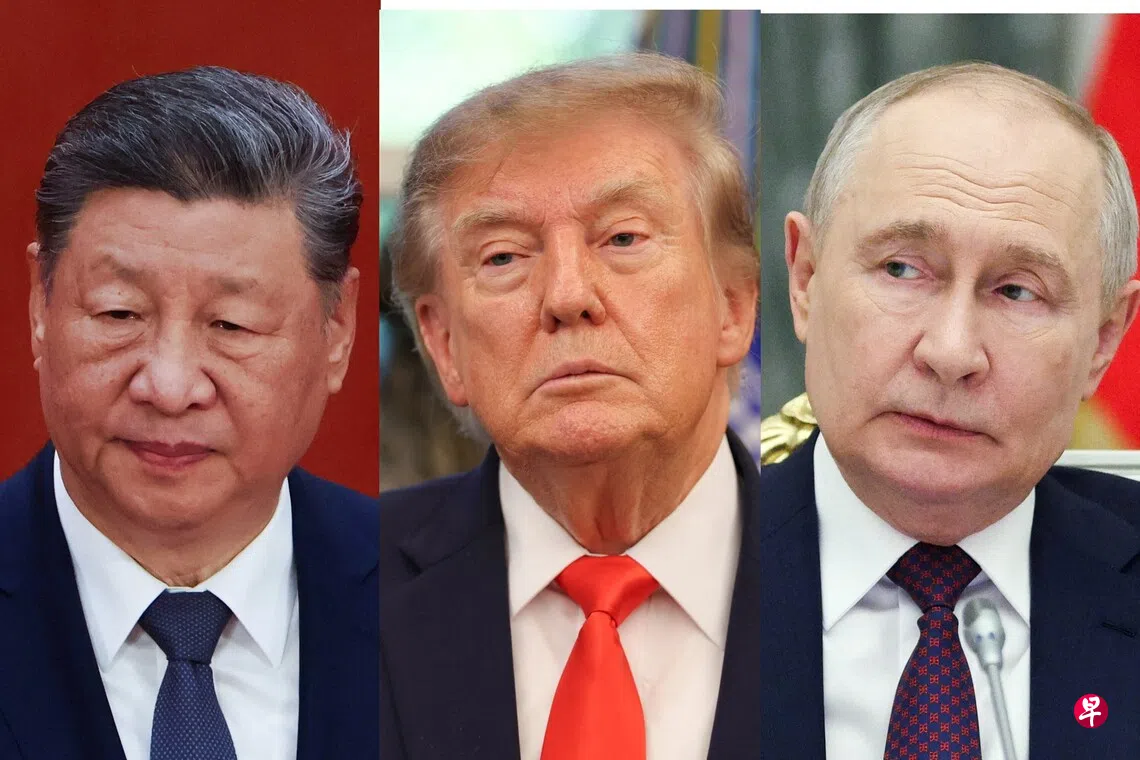
The White House and the Kremlin have separately confirmed that the leaders of China, the US and Russia will hold an unprecedented trilateral meeting in Shenzhen, China. Addressing concerns about a “Yalta 2.0”, scholars interviewed said the meeting was primarily intended to strengthen strategic communication and respond to the shift towards a multipolar world, rather than negotiate specific issues, let alone rebuild the international order or carve out spheres of influence.
Russia’s state news agency TASS on Saturday (14 November) quoted presidential spokesman Dmitry Peskov as confirming that Russian President Vladimir Putin would hold a trilateral meeting with Chinese President Xi Jinping and US President Donald J. Trump on Thursday (19 November), on the sidelines of the Asia-Pacific Economic Cooperation (APEC) Economic Leaders’ Meeting in Shenzhen.
The White House first announced the news on 13 November, with Beijing now the only party yet to confirm it. The leaders of China, the US and Russia are expected to discuss global issues including the wars in Ukraine and Iran, nuclear arms reductions and artificial intelligence.
Reuters said in an analysis that the chances of any major agreement at this rare meeting were remote, as the three sides had yet to finalise the agenda and format at the last minute, and the leaders were attending with very different objectives. Putin sees the talks as an opportunity to end the war in Ukraine on Russia’s terms. Trump, fresh from a midterm election defeat, hopes to create a historic moment while securing progress on trilateral nuclear arms control.
China currently has about 500 nuclear warheads, far fewer than the more than 5,000 each held by the US and Russia. Edgard Kagan, a former senior Biden White House official for East Asia, said China did not want to discuss arms control with the US, much less with both the US and Russia. "Because it suggests that they accept the framing that they are now a major nuclear power that should be subject to similar restrictions."
Despite growing closer since the war in Ukraine, China and Russia have taken different approaches to the trilateral meeting. Reuters quoted sources familiar with preparations for the talks and a European diplomat as saying that Moscow wanted to discuss the war in Ukraine, but Beijing had consistently opposed putting it on the agenda. A US official also said Trump was unlikely to raise the war, as the trilateral meeting was not the right forum to discuss it.
Peng Nian, director of the Hong Kong-based Research Centre for Asian Studies, told Lianhe Zaobao that, as host, China had brought the three major powers’ leaders together in Shenzhen to demonstrate its ability to coordinate diplomacy among major powers. It also aimed to get the three countries to sit down and discuss issues such as Ukraine, Iran and nuclear arms reductions, “rather than trying to resolve problems through public exchanges from afar or mutual deterrence”.
Zhu Feng, a distinguished professor at Nanjing University and former dean of its School of International Studies, said in an interview that China hoped to use the trilateral meeting to bring a swift end to the turmoil caused by several wars around the world. This had implications for global economic development, stable energy prices, future global commercial ties and even the direction of China-Europe relations. “The current economic tensions between China and Europe have also been fuelled by the Russia-Ukraine war, because many European countries believe China is Russia’s most important economic backer.”
The gathering of the Chinese, US and Russian leaders has drawn comparisons with the February 1945 meeting between the US, UK and Soviet Union in Yalta. That conference laid the foundations for the post-war world order, but also became synonymous with major powers imposing agreements on smaller countries.
Addressing fears of a “Yalta 2.0”, Wu Xinbo, dean of Fudan University’s Institute of International Studies and director of its Center for American Studies, stressed in an interview that such concerns were unfounded. “This shows that they do not understand the nature of this trilateral meeting. It is not about negotiating any specific issue, let alone carving out spheres of influence. It is more about strengthening strategic communication among the three countries and improving mutual understanding.”
Wu Xinbo said the trilateral meeting was a response to the world’s shift towards multipolarity. “It is clearly untenable for the US and its allies to dominate how the world is organised. The US must increasingly respect, and even draw on, China’s and Russia’s global weight, and strengthen communication, dialogue and coordination with these two countries.”
Shanghai-based international relations scholar Shen Dingli said in an interview that the meeting had nothing to do with the spirit of Yalta, given Trump’s considerable disregard for the international order that the US had helped establish after the Second World War. He said the three countries each had their own calculations, with “almost no point on which all three agree”. The meeting’s only purpose would be to make China’s major-power status clear to the world.
Zhu Feng also said China did not see the China-US-Russia summit as a “Yalta 2.0” and had no intention of dividing the world into blocs. “That would pose a fundamental challenge to, and run counter to, global economic openness and freedom, China’s current efforts to further advance socialist modernisation with Chinese characteristics, and Xi Jinping Thought on Diplomacy.”
The scholars interviewed all expected limited concrete results from the trilateral meeting. But Wu said: “If everyone feels that such a trilateral meeting is valuable, there could be a second and a third in future.” It could also launch an important political process of coordination among major powers. China, the US and Russia might hold regular consultations on certain important issues in future to help build consensus.
