

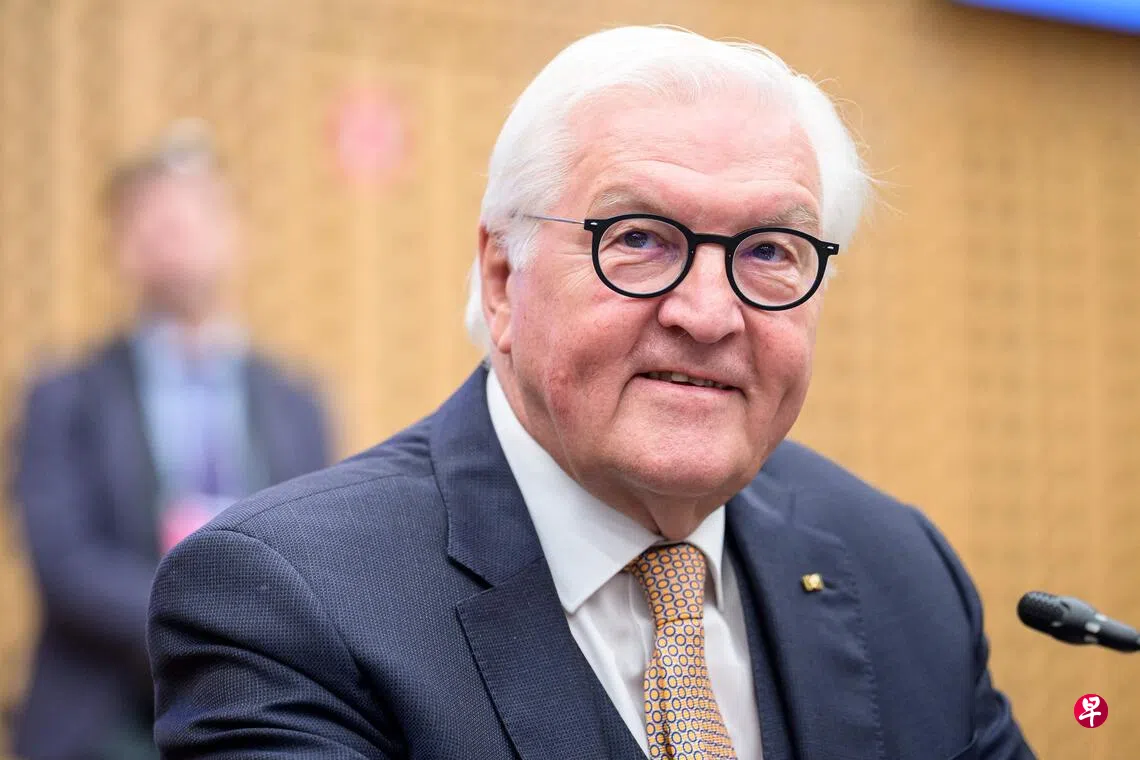
German President Frank-Walter Steinmeier arrived in Hefei, the capital of Anhui province, on Tuesday (27 October) for a five-day state visit to China amid continuing trade differences between China and the European Union (EU).
It is the first visit to China in nearly eight years by the president of Europe’s largest economy.
Academics interviewed called the visit significant for how both parties were able to maintain high-level dialogue and bilateral exchanges despite persistent trade frictions, with their shared understanding acting as a “safety valve” for the fierce industrial competition between them.
On the German president’s published itinerary are visits to the former residence of Qing Dynasty statesman Li Hongzhang and Luogang Park during his stay in Anhui, as well as German carmaker Volkswagen’s Hefei base.
He will travel to Beijing on Thursday (29 October) and deliver a speech at Peking University. On Friday (30 October), he will hold separate talks with Chinese President Xi Jinping, Premier Li Qiang, and Zhao Leji, chairman of the Standing Committee of the National People’s Congress.
Steinmeier’s office said the visit would focus on the multifaceted and complex relationship between Germany and China and the challenges facing both sides. Steinmeier will also meet China’s political leadership and representatives from business, culture, academia and civil society.
In a report issued on Tuesday, Xinhua said the healthy and stable development of the two countries' all-round strategic partnership served both sides’ interests and carried the expectations of Europe and the world.
Steinmeier’s visit comes as trade tensions between China and the EU continue to rise. Trade talks earlier this month produced an agreement to cut the number of hybrid vehicles China exports to the EU by more than half over the next four years. The EU subsequently held a meeting last week, seeking to extend restrictions beyond hybrids to sectors including chemicals, machinery and agri-food products.
Facing increasingly intense economic and trade competition from China and declining US reliability as an ally, Germany is actively expanding its strategic and trade ties with Asian partners, seeking to reduce its dependence on any single market or partner.
On the same day as Steinmeier’s visit to China, German Chancellor Friedrich Merz set off on a trip to East Asia, visiting Singapore, Japan and South Korea. This is Merz’s third trip to Asia since taking office. He visited Beijing in February this year, meeting Xi and Li.
Wang Yiwei, a professor in the Department of Diplomacy at Renmin University of China’s School of International Studies, told Lianhe Zaobao that, as president, Steinmeier had no executive authority over economic and trade policy. His visit was not about signing major deals, but about “facilitating dialogue between civilisations, providing a strategic buffer and keeping the foundations of China-Germany communication stable”.
With the EU discussing broader restrictions on Chinese goods and the German chancellor visiting East Asian allies at the same time, Wang said Steinmeier’s visit to China “provides a parallel channel for high-level communication that is not tied to short-term trade manoeuvring, preventing China-Germany and China-EU relations from being defined by trade friction alone”.
“The foundations of China-Germany relations go beyond a single deal or project,” he said. “They also rest on industrial ties and mutual learning between civilisations built up over decades. This is very likely to be the pattern for future China-EU relations: competition, friction and strategic manoeuvring will continue in economic and trade matters, but regular high-level dialogue and people-to-people, scientific and technological exchanges will also be maintained. Understanding between civilisations will provide a ‘safety valve’ for intense industrial competition.”
Lye Liang Fook, an affiliated senior fellow at Singapore’s ISEAS – Yusof Ishak Institute, said in an interview that Steinmeier’s trip, followed on from Merz’s visit to China earlier this year, was intended to underline the importance Germany continued to attach to its relations with China.
Wang said Steinmeier, a long-standing pragmatist on China and an “old friend of the Chinese people”, aimed to stabilise perceptions and counter increasingly extreme views of China. Through dialogue at the head-of-state level, he would also “clearly convey China’s red lines and concerns back home, preventing trade measures from spiralling out of control”.
On the specific issues likely to feature in the China-Germany talks, both Wang and Lye expected the focus to remain on trade, investment and related controls.
Wang added, “The Russia-Ukraine conflict remains an unavoidable topic. Long-term cooperation on the green transition, climate, science and technology, and people-to-people exchanges is also where the two sides have the most common ground and the least conflict. Global governance and multilateralism may also be discussed.”
