

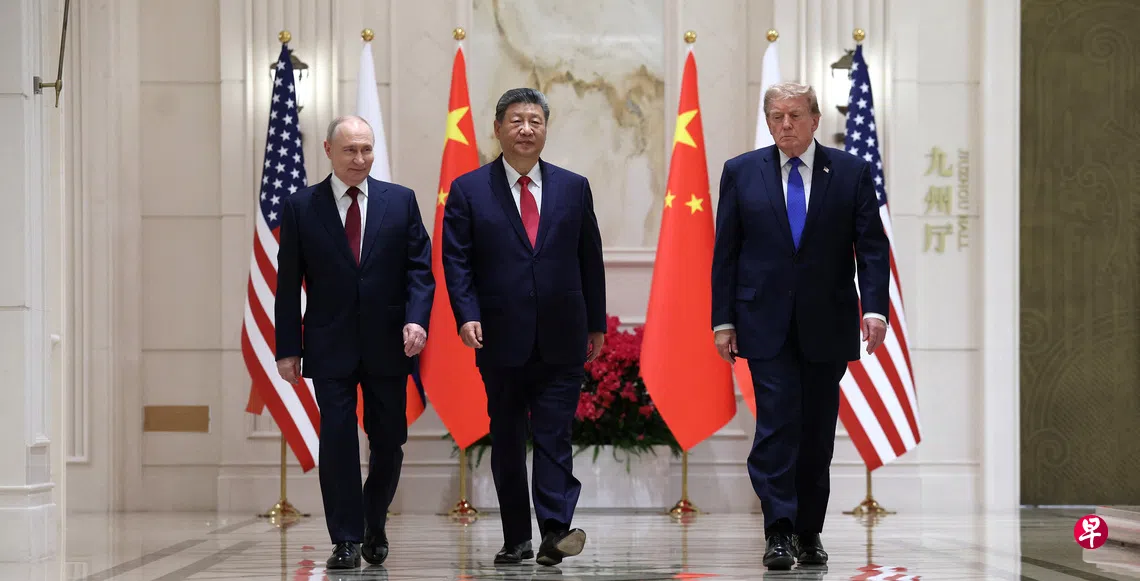
The closely watched summit between the Chinese, US and Russian leaders took place last Thursday in Shenzhen, China’s technology hub. US President Donald J. Trump said at the start of the talks that the meeting was making history. Chinese President Xi Jinping described it as groundbreaking. Vladimir Putin said the three countries had a responsibility to uphold and strengthen the international legal system.
The talks ended after an hour and a half. The three leaders issued a “peace declaration” covering UN reform, increased production and supply of refined petroleum products, the need for the International Criminal Court to refrain from abusing its jurisdiction, and dialogue to reduce nuclear proliferation.
Closed-door talks between the world’s three most powerful countries have taken place only a handful of times in the past century. There had been widespread concern that this meeting would become a Yalta 2.0, but that did not happen.
What did the trilateral talks change? Were they merely a photo opportunity to project harmony? Who gained the most? China’s international standing and image have continued to improve since Trump took office. Is China seeking to become the world’s number one power?
In this episode of Zaobao’s Global Heartbeat podcast, host Han Yong Hong and Lye Liang Fook, an affiliated senior fellow at Singapore’s ISEAS – Yusof Ishak Institute, offer an in-depth analysis.
Highlights
Host Han Yong Hong: After Trump met Xi Jinping in Busan last year, Chinese scholars I spoke to would sometimes say: “No, no, no, we don’t want a G2. We oppose hegemony.” Another point was that China did not want to be the kind of dominant power the US is, with enormous responsibilities. Do you think China has changed now? Does it feel ready to take on the responsibilities of a US-style global leader?
Lye Liang Fook, affiliated senior fellow at Singapore’s ISEAS – Yusof Ishak Institute: China has never officially stated that it wants to be number one, because it knows very well that the more prominent a country becomes, the more resistance it will face — and the greater its prominence, the stronger that resistance. But that does not mean China has no inclination to become number one. I think China is trying to find a path to becoming “number one” while avoiding the mistakes the US made. For example, China sees imperial overreach as a US mistake that has led to the current war in Iran. Whether China can successfully continue to chart this path remains to be seen.
In this episode (click the bookmarks in the player to jump to the corresponding chapters):
02:12 Has China gone from rejecting G2 to accepting it?
08:45 What did China, the US and Russia each gain from the summit?
14:24 Four points in the peace declaration, three countries with their own calculations
15:45 Is G1 China’s ultimate goal?
18:11 What does China’s rise mean for the world?
26:41 Will the US willingly accept being overtaken by China?
Taking a global view and keeping a finger on China’s pulse, the international affairs podcast Global Heartbeat explores the issues making headlines around the world and analyses global political developments. New episodes every Tuesday.
