

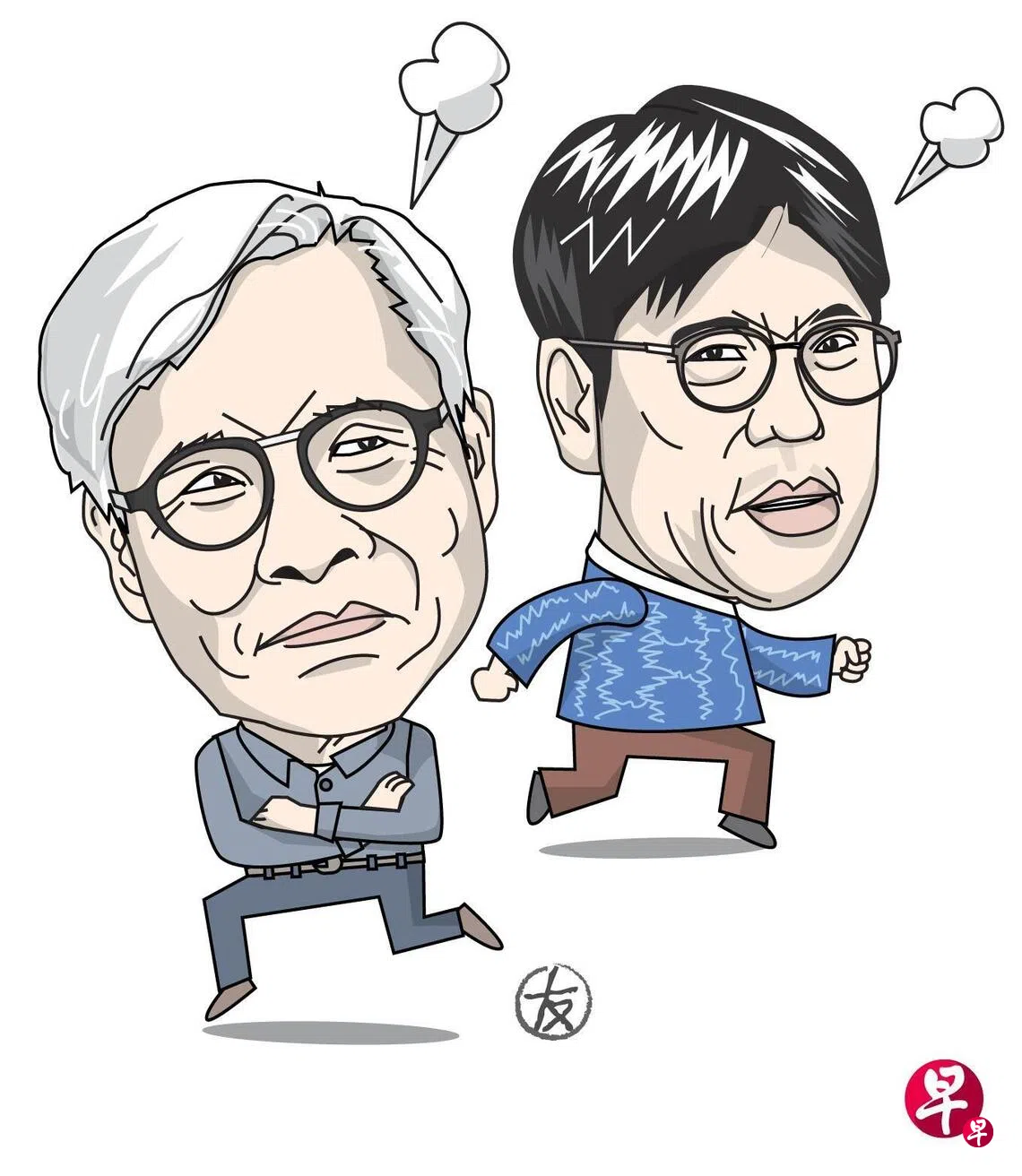
In his younger days, Taiwan’s “godfather of music” Lo Ta-yu criticised both the Chinese Communist Party and the Kuomintang (KMT). In recent years, he has repeatedly taken aim at Taiwan’s ruling Democratic Progressive Party (DPP). This week, he unleashed a barrage of criticism at pro-DPP politicians on a pro-KMT programme. He also singled out his longtime friend, music critic Ma Shih-fang, for “turning Green” — supporting the DPP — leaving Taiwan’s arts and cultural circles in shock.
The 72-year-old Lo spent more than half an hour discussing politics in a radio interview on Tuesday (10 November) with staunchly pro-KMT political commentator Tang Hsiang-lung. During the live broadcast, he first accused Taiwan President Lai Ching-te and Premier Cho Jung-tai of “shamelessly colluding in wrongdoing” and said Culture Minister Lee Yuan was “tarnishing his reputation in his later years”. He then noted that former president Tsai Ing-wen, Vice-President Hsiao Bi-khim and others have no children, arguing that they would not consider the interests of the next generation.
With Taiwan’s “nine-in-one” local elections at the end of this month entering their crucial final 18 days, Lo’s harsh remarks predictably stirred controversy and political waves. His current political stance was already well known, however. Last year, he publicly criticised the DPP-backed mass recall campaign –– which ultimately ended in a crushing defeat –– calling it a “shameless recall”.
A widely shared Facebook post reposted by several pro-DPP academics and writers said: “I don’t really care how Lo Ta-yu criticises the ruling party or Lai Ching-te... What really angers me is his utterly unwarranted attack on Ma Shih-fang.”
Lo said on the programme: “How did our good friend Ma Shih-fang become so Green? Just to make a living. Hey, ‘Ma Fang’ [his friends’ nickname for him], you’re not that kind of person. How did you end up like this?” His remarks came during a discussion of the Taiwan government’s repeatedly embattled cultural subsidy policy, which the pro-KMT camp has criticised as a way for artists and cultural figures with particular political leanings to “beg” for government money.
Ma’s political stance has, in fact, been quite clear for many years. Last year, he championed the slogan “A great success for the mass recall”, and he now supports the DPP’s Taipei mayoral candidate, Puma Shen. As early as 2019, Ma was reported as a “Taiwan independence advocate” over his public remarks and subsequently faced a wave of online abuse on mainland Chinese social media.
Ma, 55, comes from a family steeped in the arts. His father is the writer Liang Hsuan, whose real name is Ma Kuo-kuang, and his mother is veteran broadcaster Tao Hsiao-ching, known as the “mother of Taiwanese folk music”. Influenced by his family, Ma went on to become a well-known writer, broadcaster and music critic in Taiwan. He has won several Golden Bell Awards for radio, and some have dubbed him “Taiwan’s foremost arts aficionado”.
Responding to Lo’s unexpected criticism on Tuesday, Ma posted lyrics from Lo’s 1984 song “Things I Cannot Understand” on Facebook: “Wave after wave comes autumn’s vexing rain, washing away so many truths I held tight in my youth. If there are no dazzling colours, only stark black and white, should things be this way?” He also said he was “not seeking public office, not vying for power, and not relying on a political party for a living”.
The two old friends, who now appear to have publicly parted ways, once shared much brighter days.
In a 2017 article titled “Interviewing Lo Ta-yu Leaves Me Wanting More”, Ma recalled: “I first saw Lo Ta-yu perform in early 1983 and first interviewed him in 1995. Over the years since, I have interviewed him many more times: for books, albums, the formation of Superband, solo concerts, film soundtracks... We have held more than one public conversation, and I have written who knows how many tens of thousands of words about him. I suppose that makes me a ‘Lo Ta-yu specialist’.”
When Lo received the Special Contribution Award at Taiwan’s Golden Melody Awards in 2021, it was this “Lo Ta-yu specialist” who stood on stage to introduce him. Ma said of Lo then: “A singer can possess not only the soul of a poet, but also the spirit of a thinker and the temperament of a revolutionary.”
Lo began his career in the 1970s. Over the past half-century, he has produced countless songs that are still sung today, including classics such as “Song of the Dwarfs”, “Queen’s Road East” and “Orphan of Asia”, which allude to events in mainland China, Hong Kong and Taiwan.
In his introduction at the Golden Melody Awards, Ma called Lo “forever the angry young man”, saying: “Thank you. Because of your songs, we grew into more mature and courageous adults.”
The “forever angry young man” and the “courageous adult”, who once found common ground through music, are now heading in different directions in Taiwan’s politically fractured society.
