

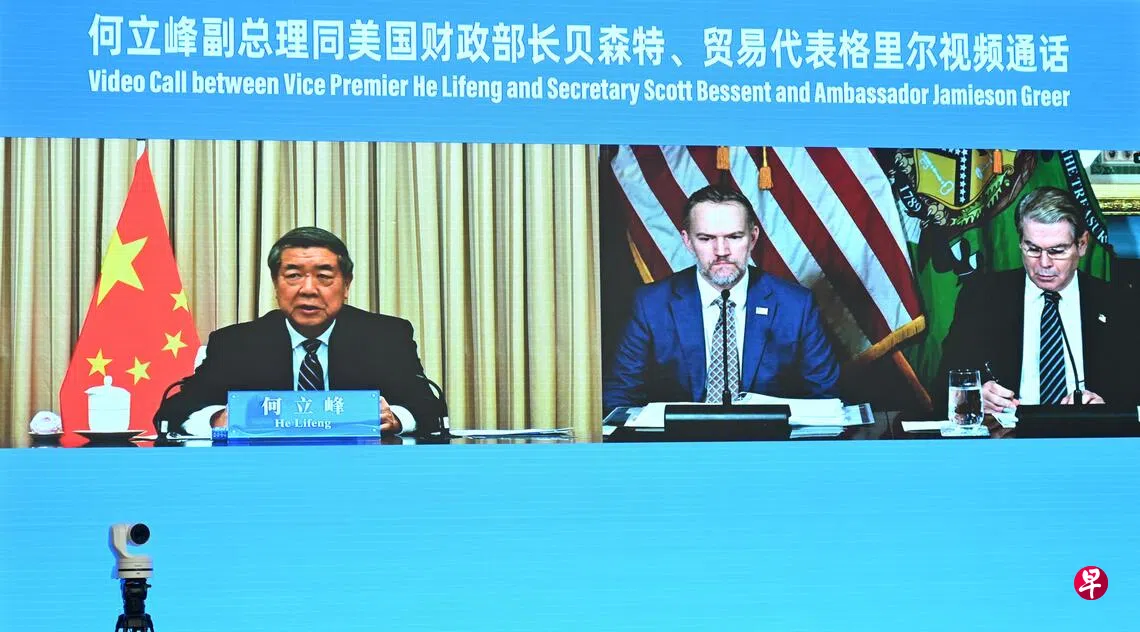
He Lifeng, China’s lead negotiator in economic and trade talks with the US, raised serious concerns over recent US trade restrictions on China in a call with US Treasury Secretary Scott Bessent and Trade Representative Jamieson Greer. Bessent and Greer stressed the critical importance of China honouring the trade agreement reached by the two countries’ leaders last October in Busan, South Korea.
According to Xinhua, Chinese Vice Premier He Lifeng, who is also China’s lead negotiator in economic and trade talks with the US, held a video call on Friday (6 November) evening with his US counterparts, Treasury Secretary Bessent and Trade Representative Greer.
The two sides held candid, in-depth and constructive exchanges on key economic and trade issues of mutual concern, focusing on implementing the important consensus reached by their leaders at meetings in Beijing and Washington, as well as the outcomes of economic and trade consultations. China expressed serious concerns over recent US economic and trade restrictions targeting China.
Both sides agreed to continue making effective use of the bilateral economic and trade consultation mechanism under the strategic guidance of their leaders, strengthen cooperation and properly manage differences. They agreed to promote the continued, stable improvement of economic and trade ties and help build “a constructive China-US relationship of strategic stability based on respect, fairness and reciprocity”.
Bessent wrote on X on Friday: “Today, Greer and I spoke with Vice Premier He Lifeng about the US-China economic relationship and implementation of the Busan arrangement. I emphasised the importance of China fully and immediately honouring its commitments, raised concerns about recent Chinese actions [economic and trade restrictions on the US] and underscored that progress depends on concrete results.”
In a statement issued by the US Treasury Department the same day, Bessent reaffirmed the Trump Administration’s dedication to pursuing trade and economic policies that benefit American workers, farmers, and businesses and strengthen US economic and national security.
In a statement issued by the Office of the United States Trade Representative on Friday, Greer said that during the call, he emphasised the critical importance of China taking concrete actions to fully implement its past commitments under the Busan arrangement, particularly as they relate to agricultural purchases from the US, rare earths, and other critical minerals.
He said: “The Trump Administration will continue to pursue balanced trade with China by monitoring compliance of past commitments while unlocking lasting benefits for American farmers, ranchers, manufacturers, and workers.”
Chinese and US officials held talks in New York and Washington in September on issues including US access to Chinese rare earths, agricultural trade and artificial intelligence (AI) technology. During Chinese President Xi Jinping’s visit to Washington in September, the two countries agreed to each lower tariffs on US$30 billion (S$38.4 billion) worth of non-sensitive goods from the other side. They also agreed to extend their trade truce, which was due to expire on 10 November, until 10 January 2027, buying time for further negotiations.
Despite the easing of bilateral tensions, Reuters reported in early October, citing people familiar with the matter, that the Trump Administration had recently slowed approvals of licences to export aircraft parts to China and restricted the volume of components supplied to Commercial Aircraft Corporation of China (COMAC). The moves sought to turn China’s reliance on American aviation suppliers into leverage in trade negotiations.
China’s Ministry of Commerce announced on Thursday (5 November) that it would continue imposing countervailing duties on imports of n-propanol (NPA) produced in the US for five years from 6 November 2026.
At a regular press briefing the same day, China’s Ministry of Commerce said it was open to expanding purchases of US agricultural products, provided that the two sides implemented their previously agreed reciprocal tariff reductions covering US$30 billion in goods each. It urged the US to work with China to lower tariffs and reduce trade barriers, creating favourable conditions for agricultural trade between the two countries.
