

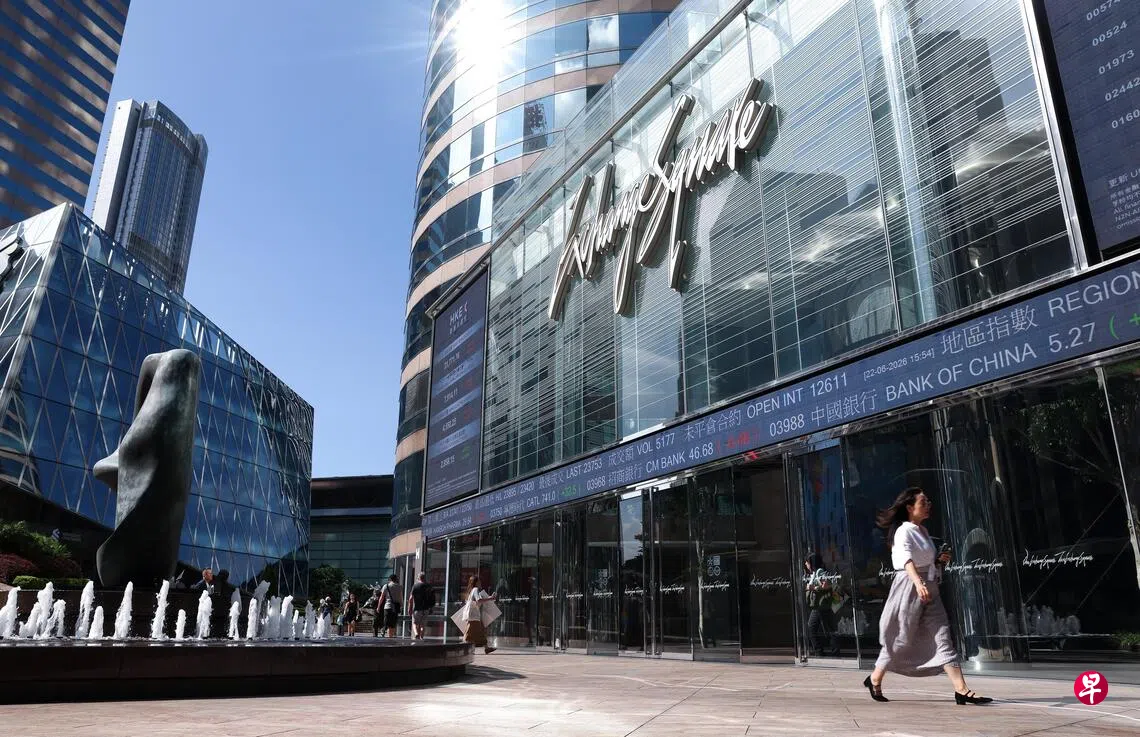
Hong Kong’s two-year listing and fundraising boom is cooling, with the proportion of listing deals left uncompleted this year rising to its highest level since the global financial crisis.
About a quarter of Hong Kong’s initial public offering (IPO) deals have not been completed so far this year, according to data compiled by Bloomberg. During the 2008 financial crisis, that proportion reached 40%.
A fundraising boom driven by companies in the artificial intelligence (AI) supply chain has pushed Hong Kong’s IPO proceeds past US$50 billion (S$63.979 billion) this year.
Over the past three months, however, listing activity has slowed as investors grow more cautious about AI investments, stock markets weaken and regulators step up efforts to crack down on suspected market-disrupting practices.
Sat Duhra, a portfolio manager at asset manager Janus Henderson Investors, said, “Hong Kong’s IPO window is not closing — smaller mainland issuers are simply discovering that a discounted H-share sale can raise too little capital to justify the dilution, fees and liquidity risk.
“Global capital crowds into larger, more liquid companies with visible earnings and a credible international story.”
Only 17 companies listed in Hong Kong between August and October this year, the data shows. That was the lowest three-month total since February to April last year.
Even companies that successfully listed saw their fundraising proceeds shrink sharply. Suzhou Dongshan Precision Manufacturing, which made its Hong Kong trading debut late last month, raised just HK$9.9 billion (S$1.61 billion), less than half its original target.
At least 78 companies have postponed or withdrawn their listing plans, or allowed their listing applications to lapse, so far this year, according to Bloomberg data. By comparison, there were only about three such cases a year over the past decade.
The International Financing Review reported last month that logistics company GLP had postponed its planned Hong Kong listing until next year.
Changzhou Weiyi Intelligent Manufacturing Technology, which had been scheduled to begin trading on 28 October and was seeking to become Hong Kong’s first listed industrial embodied intelligence company, also abruptly announced a delay after its share subscription period closed.
Besides weak market performance, new rules introduced by Hong Kong Exchanges and Clearing in August this year have given companies greater flexibility to delay listings without having to reapply. The rules extended the validity of listing applications from six months to 12 months.
Meanwhile, Hong Kong’s Securities and Futures Commission has recently stepped up scrutiny of IPOs and warned investment banks and other intermediaries against participating in arrangements that could artificially inflate IPO demand.
