

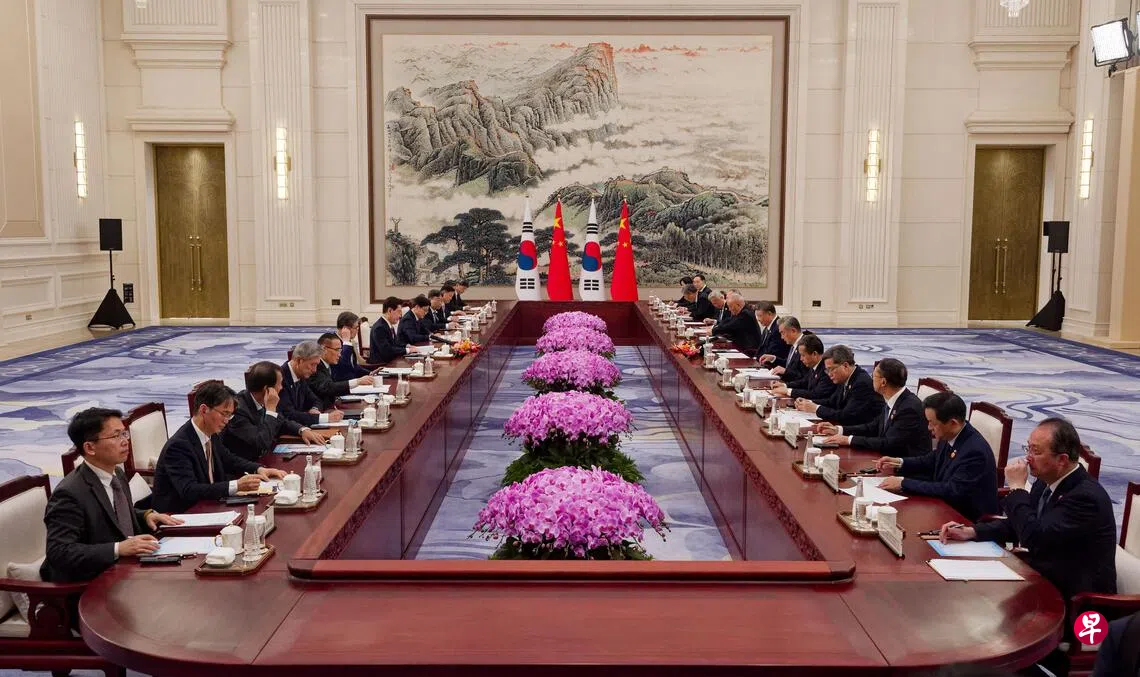
As relations between mainland China and South Korea warm, restrictions on Korean entertainment that have been in place for about a decade look set to be eased further. Hong Kong media are concerned that if South Korean artists are allowed to stage large concerts on the mainland, Hong Kong will gradually lose the advantage it has enjoyed in drawing mainland fans of Korean pop culture under its separate system, dealing a blow to the city's mega-events economy.
In an editorial on Thursday (19 November), Hong Kong's Sing Tao Daily (《星岛日报》) noted that Chinese President Xi Jinping had called for “healthy and beneficial cultural exchanges in a gradual and orderly manner” during a meeting with South Korean President Lee Jae Myung in Shenzhen the previous day. This appeared to signal a further easing of restrictions on Korean entertainment, potentially ushering in a fresh wave of cultural exchanges between China and South Korea.
The restrictions date back to 2016, when mainland China imposed informal curbs on South Korea's entertainment and cultural industries after Seoul decided to deploy the US THAAD anti-missile system. Although Beijing has never formally acknowledged the restrictions, performances by South Korean artists and the distribution of South Korean films and television programmes on the mainland have been curtailed for years.
The editorial said Hong Kong had used its advantages under “one country, two systems” to become an important gateway for Korean pop culture to the Greater China market. This drew large numbers of mainland fans to concerts in Hong Kong, boosting revenue for hotels, restaurants, retailers and cross-border transport operators.
However, if South Korean artists can stage major concert tours directly on the mainland, mainland fans will no longer need to make special trips to Hong Kong, and the city's mega-events economy “will be affected to some extent”. Cultural and entertainment facilities in the Guangdong-Hong Kong-Macao Greater Bay Area have also developed rapidly in recent years, while venue rental and operating costs remain lower than in Hong Kong. Even with Kai Tak Sports Park, Hong Kong may not have a competitive edge.
The editorial argued that Xi's use of “in a gradual and orderly manner” suggested a full opening was unlikely in the short term, giving Hong Kong time to adjust. But a shift in direction was already evident and should not be underestimated. The Hong Kong government and industry should seek to persuade South Korean superstars to make Hong Kong the first stop on their Asian tours, while working with Shenzhen to develop a Greater Bay Area circuit of major cultural events. They should also actively attract leading artists from Europe, the US, Japan and Southeast Asia to perform in Hong Kong, and support Cantopop and original local cultural works to reduce reliance on Korean pop culture.
The editorial stressed that the unique benefits Hong Kong had enjoyed from the restrictions on Korean entertainment might gradually diminish, but this did not mean its existing competitive strengths would disappear entirely. Hong Kong should draw on its system, international networks and cultural heritage to find more sustainable avenues for development.
According to reports by Yonhap News Agency and The Chosun Ilbo (《朝鲜日报》), Xi and Lee held talks in Shenzhen on Wednesday (18 November), after which the two countries announced the substantial conclusion of the second phase of negotiations on their free trade agreement (FTA). China pledged to grant South Korea most-favoured-nation treatment in sectors including film and gaming, and to further open up tourism and other service sectors.
However, officials from South Korea's presidential office said the agreement did not explicitly provide for South Korean singers to resume performances on the mainland. Performances remained a sensitive area and might not be fully opened up in the short term. Still, the two sides now had more channels to discuss the issue, creating the possibility of performances resuming in future.
