

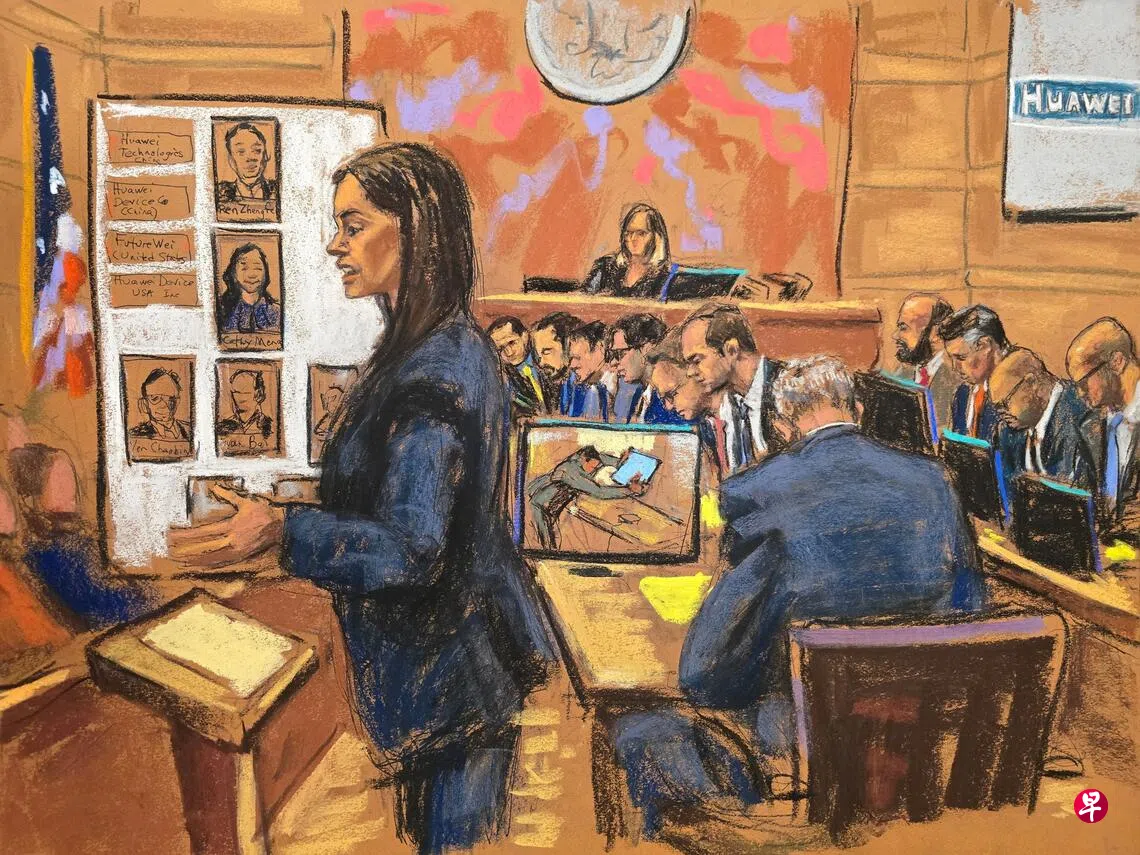
Chinese technology giant Huawei has been found guilty by a US jury on 10 counts, including bank fraud, violating US sanctions and conspiring to steal trade secrets, in a criminal case spanning nearly eight years. Huawei expressed disappointment with the verdict and said it expected to appeal.
According to Reuters and AFP, a jury at the federal court in Brooklyn, New York, on Tuesday (24 November) found Huawei guilty on 10 of the 12 criminal counts it faced. However, it acquitted the company of the more serious charge of racketeering conspiracy, as well as conspiracy to obstruct justice.
The trial lasted 11 weeks, with prosecutors calling more than 60 witnesses and the defence calling 15. US District Judge Ann Donnelly has scheduled sentencing for 14 September next year. It is not yet clear what penalties Huawei will face.
Huawei's lawyer Brian Heberlig said the company was disappointed with the guilty verdicts, but that its acquittal on the racketeering conspiracy charge affirmed its “good-faith compliance culture” and could have a significant bearing on the eventual penalties. He said Huawei expected to appeal.
Neither the White House nor the Chinese embassy in the US immediately responded to requests for comment.
The case dates back to December 2018, when Meng Wanzhou, Huawei's chief financial officer and the daughter of its founder Ren Zhengfei, was arrested in Canada at the request of the US, triggering a diplomatic crisis involving China, the US and Canada.
US prosecutors accused Meng of misleading HSBC about Huawei's business in Iran, enabling the company to conduct US dollar transactions involving Iran in violation of US sanctions. After nearly three years of extradition proceedings in Canada, Meng reached a deferred prosecution agreement with US prosecutors in 2021 and returned to China. The US subsequently dropped the charges against her.
US prosecutors charged Huawei in 2018 with misleading HSBC, Standard Chartered and BNP Paribas about its business in Iran. They added several charges in 2020, accusing Huawei of conspiring over a 20-year period to steal trade secrets from US technology companies.
During the trial, prosecutors cited several incidents of alleged technology theft, including router source code from US company Cisco Systems and antenna technology from wireless communications company Quintel.
The jury also watched a video during the trial which prosecutors said showed a Huawei employee secretly putting a component from a testing robot belonging to US telecoms operator T-Mobile into his backpack. Jurors also heard testimony about a Huawei engineer sneaking into Japanese company Fujitsu's booth at a trade show to photograph a piece of equipment.
Huawei firmly denied any wrongdoing during the trial. Heberlig accused prosecutors of having "cherry-picked" a handful of disparate incidents to support their claim of a 20-year conspiracy, and stressed that Huawei succeeded through "hard work, innovation, and investment in research and development."
The defence also argued that HSBC and other banks had long known about Huawei's business in Iran and had competed for its business.
The US government placed Huawei on a trade blacklist in 2019, citing national security risks. It restricted Huawei's access to US technology and urged other countries not to use Huawei equipment in their 5G communications networks.
However, experts said the case had not weakened Huawei's business. The company has continued to expand in recent years and has become one of the key companies in China's drive to develop its artificial intelligence (AI) industry.
