

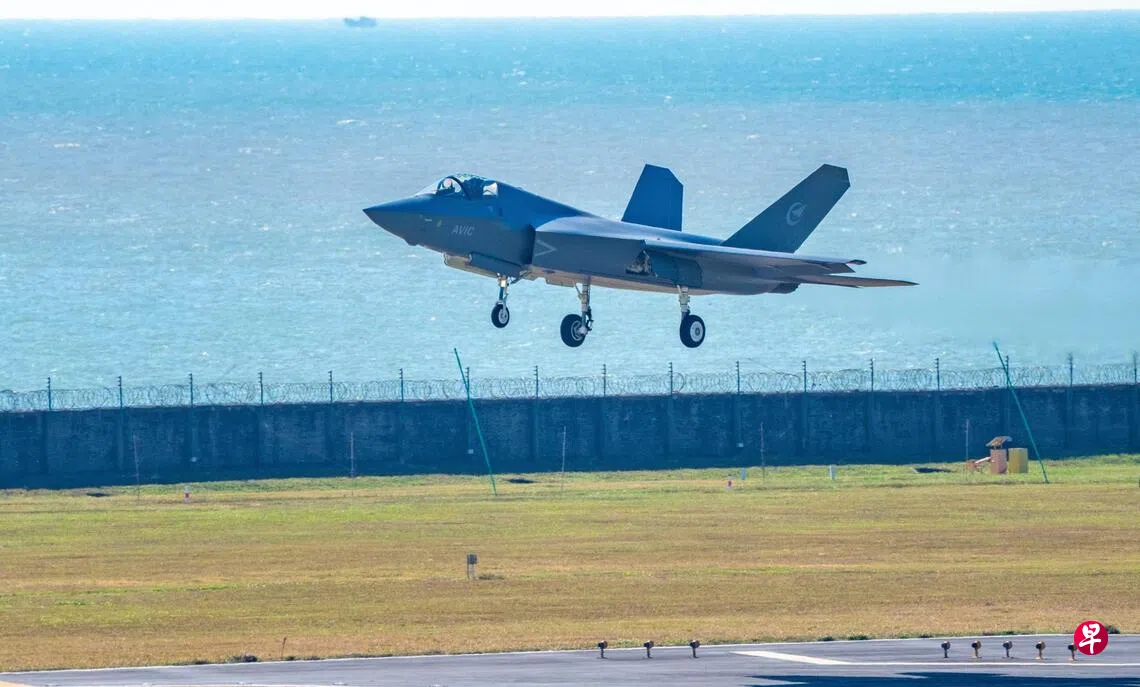
China’s J-35A fighter jet will go on static display for visitors to view at close range at the China International Aviation and Aerospace Exhibition, also known as the Zhuhai airshow, Chinese media reported.
According to China’s CCTV News, the J-35A arrived in Zhuhai on Saturday (28 November) morning. An actual aircraft will be exhibited in Hall 1 at the airshow for the first time, allowing visitors from around the world to view it up close.
The report described the J-35A as a new-generation, medium-sized stealth multirole fighter independently developed by the Aviation Industry Corporation of China. Its overall configuration integrates aerodynamic and stealth design. The single-seat, twin-engine aircraft has a blended wing-body layout, swept-back and outward-canted twin vertical stabilisers, and all-moving horizontal stabilisers. It is an important component of the stealth and counter-stealth combat system.
The report also said the aircraft was designed primarily for air superiority operations, with a secondary surface-attack role. Its main mission is to seize and maintain air superiority. It can strike enemy third- and fourth-generation fighters and land- and sea-based air defence forces, as well as intercept aerial targets such as enemy fighters, bombers and cruise missiles.
The J-35A made its public debut at the China airshow two years ago. Technology website ITHome reported that the aircraft had appeared only in flying displays at the previous two editions of the airshow, with no close-up ground viewing available.
Technology website MyDrivers said in an article that the key point of this appearance had never been its supposed “first public exhibition”, but rather the special arrangement for a “static display”.
The article noted that in previous flying displays, spectators could see the fighter streak across the sky for only a dozen or so seconds. Viewing angles and distances were dictated entirely by predetermined flight paths, leaving observers with very limited useful information to glean.
“A static display is the complete opposite. The fighter remains stationary on its display stand throughout. For the first time, visitors can stand just metres away and directly examine every detail: the sleek fuselage contours, the precision of the skin panel joints, the distinctive shape of the air intakes and the detailed design of the cockpit canopy,” the article said.
Such openness is quite rare for a top-tier stealth fighter, the article added. The more rapidly an aircraft’s technology evolves and the higher its security classification, the more its public appearances have tended to be restricted to flypasts — allowing people to see it in flight, but not to examine its details up close on the ground.
The article said the prevailing industry view was that allowing an actual stealth aircraft to be viewed from all angles in a static display generally happens at a mature stage, after its design has been finalised and it has entered service in numbers. “In other words, this fighter no longer needs to be deliberately ‘hidden away’ to maintain its mystique.”
