

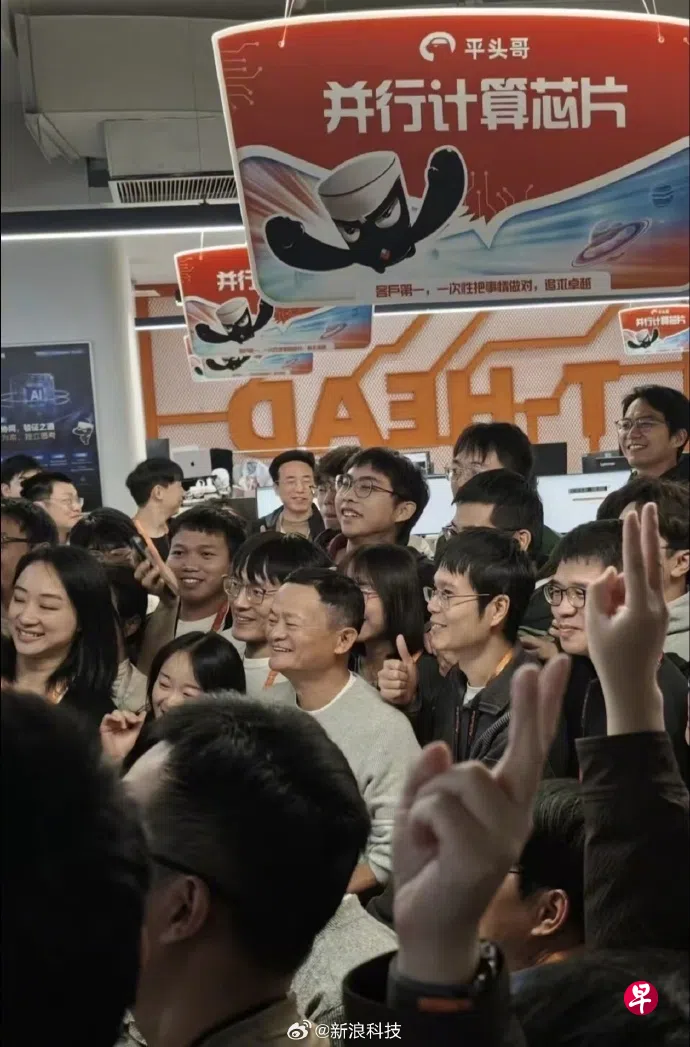
Chinese technology giant Alibaba Group has announced that its chip design unit T-Head has applied for a Hong Kong listing as part of a planned spin-off of the chip business. Alibaba founder Jack Ma visited T-Head’s offices on Thursday (26 November) afternoon and posed for photos with employees.
Sina Technology on Thursday cited social media posts saying that “Jack Ma made a rare appearance, dropping in at T-Head”. One employee said: “After seven years of working away at T-Head, I finally saw Teacher Ma in person today. I froze for three seconds, then plucked up the courage to rush over and ask for a photo. To my surprise, he nodded and agreed.”
Images taken by social media users showed Ma wearing a grey jumper, cheerfully greeting T-Head staff and warmly posing for photos with them.
Alibaba said in a filing to the Hong Kong stock exchange on 10 November that the exchange had confirmed it could proceed with its proposed spin-off and listing of T-Head. T-Head submitted a confidential listing application on 11 September and plans to issue shares through a Hong Kong public offering and an institutional placement.
The amount to be raised, the offering arrangements and Alibaba’s post-listing stake have yet to be determined. T-Head is expected to remain an Alibaba subsidiary after the listing.
T-Head officially launched its self-developed high-end artificial intelligence (AI) chip, the Zhenwu 810E, in January this year. In introducing the product on its website, the company said the Zhenwu PPU (physical processing unit) uses its own parallel computing architecture and chip-to-chip interconnect technology, together with an entirely in-house software stack, making both the hardware and software fully self-developed. It has 96G of HBM2e memory and chip-to-chip interconnect bandwidth of 700GB per second, and can be used for AI training, AI inference and autonomous driving.
Industry insiders said that, based on key specifications, the Zhenwu PPU’s overall performance surpasses that of US chip giant Nvidia’s A800 and mainstream Chinese GPUs (graphics processing units), and is comparable to Nvidia’s H20 chip.
