

Japanese Prime Minister Sanae Takaichi reaffirmed at a press conference after attending the Asia-Pacific Economic Cooperation (APEC) leaders’ informal meeting in Shenzhen that her government’s basic position on Taiwan remained based on the 1972 Japan-China Joint Communique (known in China as the China-Japan Joint Communique) and had not changed.
She also stressed her desire to build “constructive and stable” Japan-China relations and said she was not concerned that a meeting between the leaders of the US, China and Russia would harm Japan’s interests.
This was Takaichi’s first visit to China since becoming prime minister. Her remarks last November that “a Taiwan contingency is a Japan contingency” sent China-Japan relations into a downward spiral. For her visit to Shenzhen to attend the APEC meeting, China arranged for Zhang Qiyue, its retired former ambassador to Greece, to greet her at the airport, a reception at a markedly lower level than those accorded to other national leaders.
Takaichi held a press conference in Shenzhen on Thursday (19 November) after the APEC meeting concluded. Referring to her remarks during parliamentary questioning last November that a Taiwan contingency could have a major impact on Japan’s security, Lianhe Zaobao (LHZB) asked under what circumstances Japan might consider military intervention and whether her position on the issue had changed.
Takaichi replied that the Japanese government’s basic position on Taiwan continued to follow the 1972 Japan-China Joint Communique, saying, “There has been no change whatsoever in this position.” Under the communique, the Chinese government reaffirmed that Taiwan was an inalienable part of the territory of the People’s Republic of China, while the Japanese government stated that it “fully understands and respects” this position.
Asked by Japanese media how Japan would advance relations with China, Takaichi said the status of the four political documents between the two countries as the foundation of bilateral relations “has not changed in any way”. Despite their differences, she said, the two sides had all the more reason to build on the foundations of their longstanding relationship, strengthen communication and dialogue, comprehensively advance a mutually beneficial relationship based on common strategic interests, and build constructive and stable Japan-China relations. The four political documents are the 1972 China-Japan Joint Communique, the 1978 Treaty of Peace and Friendship between China and Japan, the 1998 China-Japan Joint Declaration and the 2008 China-Japan Joint Statement. The latter two reaffirmed Japan’s existing position on Taiwan.
LHZB also asked how Japan, as it continued to strengthen its defence capabilities, would convince countries in the region that its military build-up was intended to bolster deterrence rather than adopt a more aggressive military posture or even trigger an arms race. Takaichi replied that Japan had contributed to peace and prosperity in the international community as a peace-loving nation since the end of the war. “This policy will not change in any way,” she said.
She said Japan had reaffirmed this path at both the general debate of the UN General Assembly in September this year and the earlier ASEAN summit in Manila, and had “deeply felt the unwavering trust that ASEAN countries place in this”. She said Japan would continue to clearly explain the specific considerations behind its security policies to the international community, strengthen its defence capabilities while ensuring transparency, and work with regional partners to build a peaceful and prosperous future.
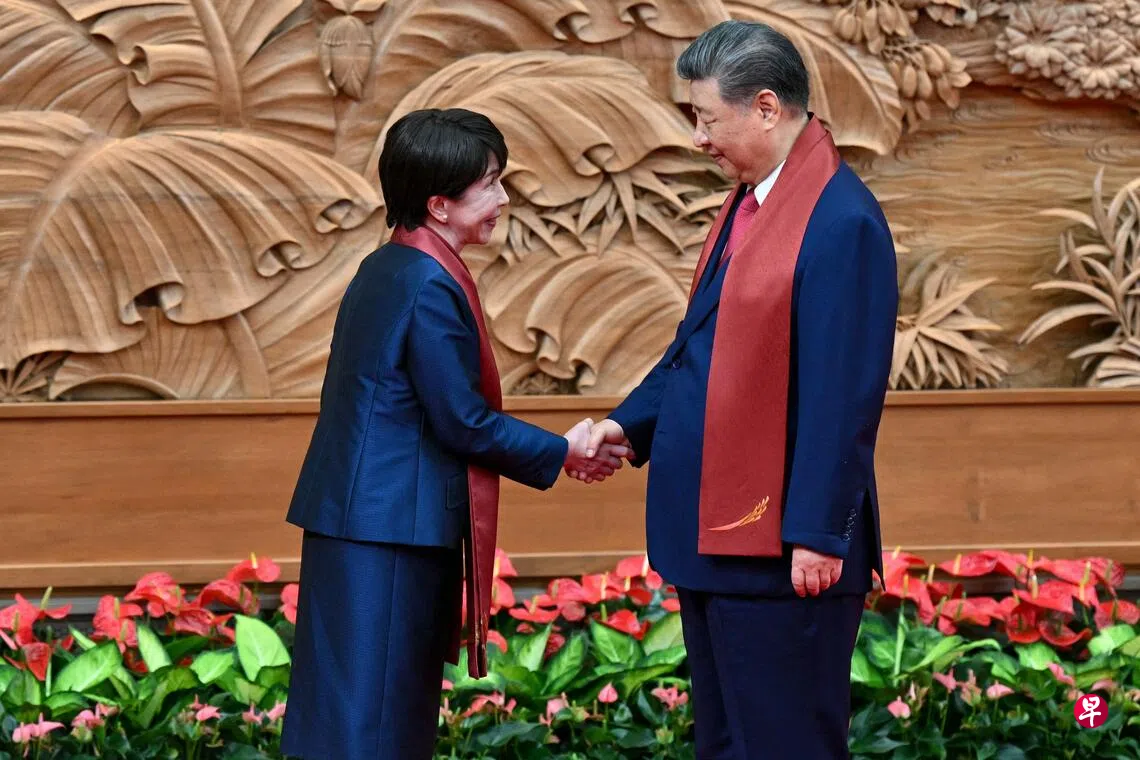
During the summit, Takaichi shook hands twice with Chinese President Xi Jinping: first before the summit’s welcome dinner on Wednesday, and again before the group photograph ahead of the leaders’ informal meeting on Thursday. The interactions lasted about 15 seconds and 10 seconds respectively. Takaichi initiated pleasantries on both occasions, but footage showed Xi did not respond verbally. Answering a question from Japanese media at the press conference, Takaichi said that during the two interactions she had expressed thanks and congratulations for China’s invitation and hospitality, its hosting of the meeting and its organisational work.
Asked by foreign media whether Japan was concerned that a meeting between the leaders of the US, China and Russia would harm its interests, Takaichi said “there is no such concern”. She added that Japan would closely monitor developments while “maintaining close communication and responding appropriately” with allies such as the US and like-minded countries.
